THE CLASSIC COLLECTION✦An outlaw’s diary: the CommuneCLASSIC FREE BOOKS
An outlaw’s diary: the Commune
Cécile Tormay
THE CLASSIC COLLECTION · 1919
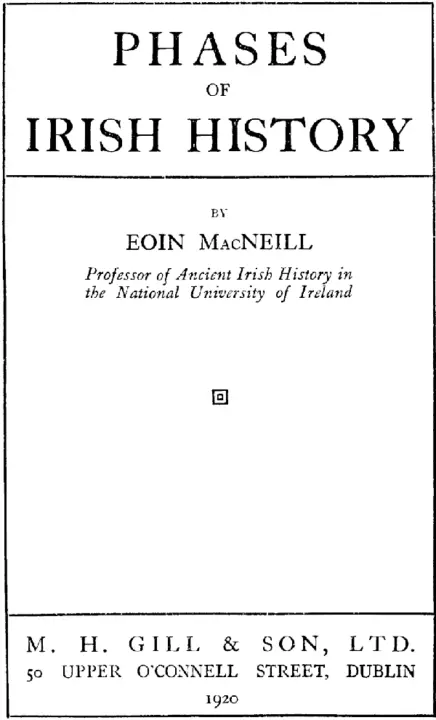
"Phases of Irish History" by Eoin MacNeill is a historical account written in the early 20th century. The work delves into the complex historical narrative of Ireland, particularly focusing on the discussion of Celtic identity and the historical understanding of the Irish people and their language. MacNeill's approach is analytical, using various historical texts and archaeological evidence to trace the lineage and cultural evolution of the Irish. The opening of the text introduces the author's perspective on the ancient Irish as part of the Celtic people, addressing common misconceptions regarding their racial identity. He emphasizes that Celtic identity is primarily linguistic rather than racial, highlighting that the ancient Irish and British lacked awareness of their Celtic kinship. MacNeill critiques traditional genealogical accounts and argues for a recognition of Celtic consciousness, setting the stage for a broader exploration of Ireland's history and its connections to pre-Christian and contemporary cultures. This opening serves as a prologue to the subsequent chapters, which promise to explore various epochs of Irish history in greater detail.
Introduction adapted from the source catalogue; source summaries may be automatically generated.
Free to read · English · 95,296 words · No account needed
MAKE TIME FOR A GOOD BOOK
On by default. Untick to stop anonymous reading totals. Each page counts after 10 seconds in view. How this works.
Anonymous counting is on unless you have switched it off.
We now come to the question of the Belgic invasion of Britain and its probable date. In Rhys's theory, which is still accepted in England, the Belgic invaders were the first to establish the Iron Age in Britain. I claim to have shown good grounds for believing that there was no Celtic occupation of Britain before the Iron Age. I have already suggested that, if this Celto-Germanic movement was brought to a standstill on the banks of the Marne, it was not likely to have succeeded in over-running all England at the commencement of the Iron Age in England. It will be seen that the Celto-Germanic migrations extended not merely to Britain but also to Ireland, and I suggest that if these Celto-German Belgae had been the first people to come over armed with iron, they would have made an easy conquest of Ireland as well as of England.
Let us look at the actual evidence of the Belgic conquest of England. The sole historical witness on the point is Julius Cæsar, and this is his testimony:
"The interior of Britain is inhabited by those who say that, according to tradition they are natives of the island; the maritime part by those who had crossed over from Belgium [meaning Belgic Gaul] for the sake of plunder, nearly all of whom are called by the same names of states as the states from which they originated and came thither, and having made war they settled permanently there and began to till the land."
From this it is clear that Cæsar was informed of two populations in Britain, one which was more ancient and claimed to be native, another which resulted from comparatively recent invasion. The older population he assigned to the interior, the more recent to the seaboard. What did Cæsar mean by the seaboard, the maritime part? Sir John Rhys has no difficulty in supposing that Cæsar did not mean the whole seaboard of Britain or if he did mean it that he was not fully informed, for according to Rhys's theory, the older population, which he supposed to be Gaelic, continued to inhabit the western seaboard of England and Wales. I also agree that, whatever Cæsar may have understood, his statement about the maritime part must be taken in a restricted sense, for no one believes that the Celtic occupation in Cæsar's time extended to the seaboard of the northern parts of the island. I agree also with the view that the traditional natives of whom Cæsar speaks probably included the earlier Celtic colonists, whose settlements dated, according to my argument, from the fourth century B.C., about three centuries before Cæsar's time. The more recent maritime settlements, in that case, would have been very recent in his time, and I think that his statement leads us to that conclusion. These later settlers on the seaboard, he tells us, are known collectively by the same names as the states on the Continent from which they originated. Now this is a statement about a fact likely to be within Cæsar's personal knowledge. He was certainly well acquainted with the names of the states of Belgic Gaul, and there is no reason why he should have said that populations retaining the same names existed in his time on the British coast if he did not know it to be a fact. His testimony on this point, touching a matter within the scope of his personal observation, is of higher evidential value than any other part of the statement quoted. Cæsar does not himself name these states, but in the two following centuries the names of the various states of Britain are given by Ptolemy and other writers, and when we compare these names with those of the states of Belgic Gaul, we find that they coincide only in three instances. These are the Parisii on the foreland north of the Humber, the Atrebatii in the district of Berkshire, and the Belgae, eastward from these to the Bristol Channel. There are some eighteen other states enumerated in Britain, so that the coincidence of names amounts to only one in seven, a proportion which by no means corresponds to Cæsar's words, fere omnes, "nearly all." Except for the Parisii, who occupied the promontory north of the Humber, the states bearing names also found in Belgic Gaul are located in southern England, south of the Thames and the Bristol Channel. One of these, and the most extensive, bears the general name Belgae, which certainly does not suggest that the remainder of the population was also Belgic. Now the fere omnes, "nearly all," in Cæsar's statement cannot refer to such a small minority of the states of Britain. Therefore, either Cæsar was grossly in error, in which case there is not much to be built on his whole statement, or, if he stated the truth, which is much more likely, then there were Belgic settlements on the British seaboard in his time which had lost their identity and passed into insignificance a century later. This I take to be true, for it will be seen that there were also Belgic settlements on the Irish coast after Cæsar's time and that as states they had disappeared a few centuries later. It is indeed quite possible that the Belgae so named, in southern England, consisted of a collection of colonies from various states of Belgic Gaul, whose names were preserved in Cæsar's time, but not one of which was sufficiently populous or otherwise considerable to be worth naming by later writers. There may have been similar Belgic colonies on other parts of the southern and eastern seaboard of Britain, none of them considerable enough to be reckoned as a state. At all events, I submit that Cæsar's statement, far from justifying the assumption of a Belgic conquest on a grand scale, comprising the greater part of Celtic Britain, is rather contrary to that assumption; also, that it cannot reasonably be taken to refer to settlements made in Britain at the close of the Bronze Age three or four centuries before Cæsar's time.
Your reading position is saved on this browser. Take it to another device with a library code. Reading pages adapt to text, rather than matching a printed edition.
BEHIND THE BOOK
This eBook is for the use of anyone anywhere in the United States and most other parts of the world at no cost and with almost no restrictions whatsoever. You may copy it, give it away or re-use it under the terms of the Project Gutenberg License included with this eBook or online at www.gutenberg.org. If you are not located in the United States, you will have to check the laws of the country where you are located before using this eBook. Read the source licence.
The original source file, including credits and licence, is retained by this library. Request an original-format copy at no charge. Please include the book title and Project Gutenberg identifier #48952.
KEEP YOUR CURIOSITY GOING
Cécile Tormay

Moritz Busch
John L. Ransom
Frances Wright
Cécile Tormay

Mabel Potter Daggett