THE CLASSIC COLLECTION✦An outlaw’s diary: the CommuneCLASSIC FREE BOOKS
An outlaw’s diary: the Commune
Cécile Tormay
THE CLASSIC COLLECTION · 1919
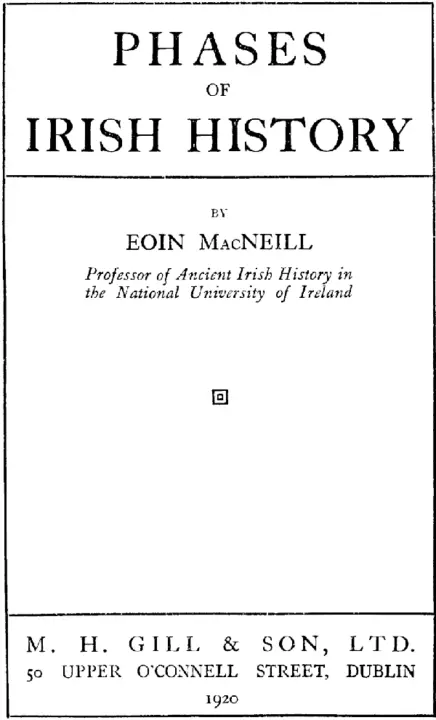
"Phases of Irish History" by Eoin MacNeill is a historical account written in the early 20th century. The work delves into the complex historical narrative of Ireland, particularly focusing on the discussion of Celtic identity and the historical understanding of the Irish people and their language. MacNeill's approach is analytical, using various historical texts and archaeological evidence to trace the lineage and cultural evolution of the Irish. The opening of the text introduces the author's perspective on the ancient Irish as part of the Celtic people, addressing common misconceptions regarding their racial identity. He emphasizes that Celtic identity is primarily linguistic rather than racial, highlighting that the ancient Irish and British lacked awareness of their Celtic kinship. MacNeill critiques traditional genealogical accounts and argues for a recognition of Celtic consciousness, setting the stage for a broader exploration of Ireland's history and its connections to pre-Christian and contemporary cultures. This opening serves as a prologue to the subsequent chapters, which promise to explore various epochs of Irish history in greater detail.
Introduction adapted from the source catalogue; source summaries may be automatically generated.
Free to read · English · 95,296 words · No account needed
MAKE TIME FOR A GOOD BOOK
On by default. Untick to stop anonymous reading totals. Each page counts after 10 seconds in view. How this works.
Anonymous counting is on unless you have switched it off.
"P-Celts" and "Q-Celts," 43, 46
Paganism, survival of, 224
Palæolithic Age not represented in Ireland, 68
Palladius, Saint, mission of, 163
Parthalón, 39, 88
Patrick, Saint, 159;
date of his death, 222;
Bury's account of, 225
Pelagius, 164
Pentarchy in Irish tradition, 100
Picts, supposed to be Iberians, 41;
Ireland and Britain named from, 59;
in Ireland and Scotland, 62-65;
legendary origin of, 64;
in Ireland, 74;
in Ulster, 120, 185;
earliest mention of, 141;
in Connacht, 180;
their kingdom in Scotland overthrown, 204;
they lose territory in Ulster, 233
Pliny on Ireland, 135
Political system in ancient Ireland, 274-278
Pomponius Mela on Ireland, 134
Poseidonios on Ireland, 133
Pre-Celtic population of Ireland, 73
Pre-Celtic metal workers, 75, 76
Pretani, significance of the name, 59, 62
Primitive races, assumptions regarding, 83
Property in land, 295-299
Ptolemy on Ireland, 136
Qreteni, an ancient name for the Picts, 59
Race, true and false notions of, 1, 2
Racial fusion in Ireland, 229
Red Earl of Ulster, 336
Revolt against Gaelic rule, 80, 119
Rígdamna (ríoġḋaṁna), precise meaning of, 231
Roman empire, collapse of, 158
Roman military system influences Ireland, 150
"Rosnaree," Ros na Ríoġ, battle of, 103
Schools, reorganisation of, 284
Scotland, Irish colonisation of, 194;
Irish settlements extend to east coast, 202;
conquest by Cinaed (Cionaoḋ), 204;
centralised polity of, 206;
extent of Irish colonisation, 207;
anglicisation, 208;
feudal institutions introduced, 209
Scotti, legendary origin of, 90;
earliest mention of, 143;
meaning of the name, 144;
St. Jerome's account of, 146
Scottish history, earliest documents of, 198
Scythians in Irish legend, 91
Segomo, a Celtic god, 127
Semaine (Seamaine), Semrige (Seimriġe), Semonrige
(Seamonraiġe), Tuath Semon (Seaman), 75, 78
Síol Aedo Sláne (Síol Aoḋa Sláine), dynasty of, 236
Sliab Badbgnai (Sliaḃ ḃáġna, "Slieve Baune"), 78
Sliab Echtgi (Sliaḃ Eaċtġa, "Slieve Aughty or
Baughty"), 78
Snakes absent from Ireland, 140
Solinus on Ireland, 140
States in ancient Ireland, classification of, 274, 275
Strabo on Ireland, 134
Sumarlidi (Soṁairliḋ), founds a kingdom in western
Scotland, 214;
spurious pedigree of, 215;
sends embassy to Derry, 284;
his descendants in Ireland, 326, 334
Tacitus on Ireland, 136
Tadhg, son of Cian, 121
Taillte ("Teltown"), assembly of, interrupted, 256;
restored, 258
"Táin Bó Cuailnge," its ancient celebrity, 100
Tanistry, origin of, 295
Tara (Teaṁair), a provincial capital, 104;
occupied by Connacht dynasty, 120;
its desertion, legendary and historical, 233-236
"Teora Connachta," 130
Tigernach (Tiġearnaċ), 86
Tillage in Ireland during Bronze Age, 72
Tin from Britain, ancient trade in, 47
Tradition, historical value of, 105;
medieval treatment of, 279
"Tribal system," theory of, 289
Tuatha Dé Danaan, 85, 95
Tuathal Teachtmhar, 118
Ui Maine kingdom, origin of, 179
Ui Néill, 130;
Northern and Southern, 184-186;
dissensions of, 233, 236
Uisneach occupied by Connacht dynasty, 118
Ulaidh, kingdom of, 185
Ulster, ancient extent of, 112, 123-125, 129;
Great Wall of, 131;
strategic aspect of frontier, 328;
O'Neill kings of, 335;
earldom, 336;
goes to English royal house, 339;
Feudal authority overthrown in, 341
Ulster kingdom, fall of, 126
Welsh settlers in Ireland, 303,
(See also under Britons)
Warfare in ancient Ireland, 227
Waterford, Norse settlement at, 262;
successfully defended, 264
World-sovereignty, Irish notions about, 269
Writing in Irish, early spread of, 176
Your reading position is saved on this browser. Take it to another device with a library code. Reading pages adapt to text, rather than matching a printed edition.
BEHIND THE BOOK
This eBook is for the use of anyone anywhere in the United States and most other parts of the world at no cost and with almost no restrictions whatsoever. You may copy it, give it away or re-use it under the terms of the Project Gutenberg License included with this eBook or online at www.gutenberg.org. If you are not located in the United States, you will have to check the laws of the country where you are located before using this eBook. Read the source licence.
The original source file, including credits and licence, is retained by this library. Request an original-format copy at no charge. Please include the book title and Project Gutenberg identifier #48952.
KEEP YOUR CURIOSITY GOING
Cécile Tormay

Moritz Busch
John L. Ransom
Frances Wright
Cécile Tormay

Mabel Potter Daggett