THE CLASSIC COLLECTION✦An outlaw’s diary: the CommuneCLASSIC FREE BOOKS
An outlaw’s diary: the Commune
Cécile Tormay
THE CLASSIC COLLECTION · 1919
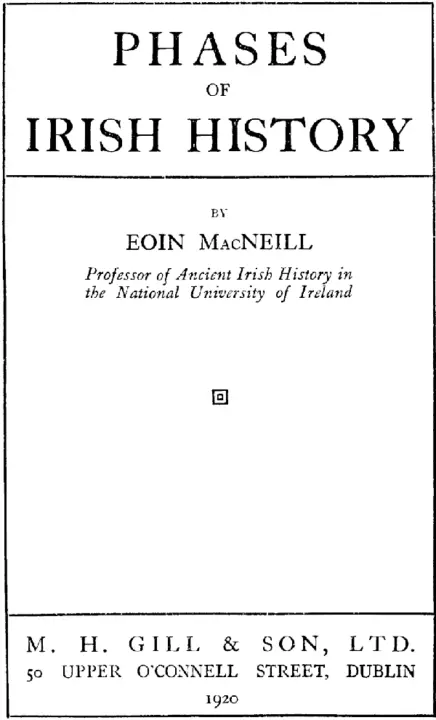
"Phases of Irish History" by Eoin MacNeill is a historical account written in the early 20th century. The work delves into the complex historical narrative of Ireland, particularly focusing on the discussion of Celtic identity and the historical understanding of the Irish people and their language. MacNeill's approach is analytical, using various historical texts and archaeological evidence to trace the lineage and cultural evolution of the Irish. The opening of the text introduces the author's perspective on the ancient Irish as part of the Celtic people, addressing common misconceptions regarding their racial identity. He emphasizes that Celtic identity is primarily linguistic rather than racial, highlighting that the ancient Irish and British lacked awareness of their Celtic kinship. MacNeill critiques traditional genealogical accounts and argues for a recognition of Celtic consciousness, setting the stage for a broader exploration of Ireland's history and its connections to pre-Christian and contemporary cultures. This opening serves as a prologue to the subsequent chapters, which promise to explore various epochs of Irish history in greater detail.
Introduction adapted from the source catalogue; source summaries may be automatically generated.
Free to read · English · 95,296 words · No account needed
MAKE TIME FOR A GOOD BOOK
On by default. Untick to stop anonymous reading totals. Each page counts after 10 seconds in view. How this works.
Anonymous counting is on unless you have switched it off.
Four centuries more established the Celtic rule in Ireland. Their rule in Ireland remained secure during four centuries of Roman domination in Gaul and Britain. During four centuries of Germanic invasion and conquest, Ireland stood intact. After four centuries of Norse supremacy over neighbouring seas and lands, Ireland emerged unconquered. Two thousand years of unbroken sway may suffice to set pride above prudence in the tradition of any class. At the end of another cycle, when the Irish nobles were scattered over Europe, the nobility of their bearing and the distinction of their manners won admiration for them in every land but one.
This intense pride is blazoned on the pages of our medieval literature, in annals, genealogies, stories, poems. The poets lived by ministering to it. In this respect, too, we can see the analogy with a good deal of modern journalism.
Too much pride blinded the native rulers of Ireland to the insecurity of their state, and made them careless of their safety, and neglectful of the measures it required. Glorying in the long vista of their past, they did not look before them. They were conservative, inadaptable, unproviding. Herein lay the fatal weakness of medieval Ireland.
We are now nearing the end of the seventh cycle. It has brought us a different experience. I must not speculate upon the outcome. If only I have succeeded in convincing you that Irish history must contain life, movement, colour, coherence, and human interest, beyond anything depicted of it in many books that have been written about it, with that and the recollection of your kind support I make a well contented conclusion.
Aed Bennán (Aoḋ Beannán), power of, 237
Agricola conquers the Britons, 36;
intends the conquest of Ireland, 136
Ailbhe, Saint, date of, 161
Ailech (Oileaċ), kingdom of, 184;
growth in power, 277
airchinnech (oirċinneaċ, "erenagh," "herenagh"), office
of, 351
airecht (oireaċt), court of assembly, 320
Airgialla (Oirġialla, "Oriel"), 126;
varying extent of, 185, 278
Aithech-thuatha, 148
Amorgen (Aṁairġean, Aiṁirgean), legend of, 97
Anglo-Norman aggression, false pretext of, 286
Anglo-Norman conquest, failure of, 323;
supposed causes of failure, 324;
extent of, 327;
rally begins against, 328;
details of rally, 335
Anglo-Norman invasion, destructive effects of, 308-311
Anglo-Normans, Irish assimilation of, 341
Annals, restricted scope of the, 178
Aristocracy, intense pride of, 354
Armagh founded, 160;
school of, a national university, 284
Assemblies, 138, 320;
of the learned, 344
Atecotti, 144, 146, 147-149
Your reading position is saved on this browser. Take it to another device with a library code. Reading pages adapt to text, rather than matching a printed edition.
BEHIND THE BOOK
This eBook is for the use of anyone anywhere in the United States and most other parts of the world at no cost and with almost no restrictions whatsoever. You may copy it, give it away or re-use it under the terms of the Project Gutenberg License included with this eBook or online at www.gutenberg.org. If you are not located in the United States, you will have to check the laws of the country where you are located before using this eBook. Read the source licence.
The original source file, including credits and licence, is retained by this library. Request an original-format copy at no charge. Please include the book title and Project Gutenberg identifier #48952.
KEEP YOUR CURIOSITY GOING
Cécile Tormay

Moritz Busch
John L. Ransom
Frances Wright
Cécile Tormay

Mabel Potter Daggett