THE CLASSIC COLLECTION✦An outlaw’s diary: the CommuneCLASSIC FREE BOOKS
An outlaw’s diary: the Commune
Cécile Tormay
THE CLASSIC COLLECTION · 1919
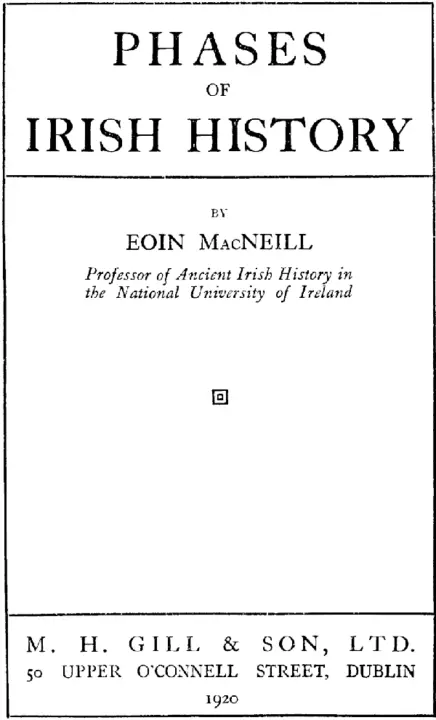
"Phases of Irish History" by Eoin MacNeill is a historical account written in the early 20th century. The work delves into the complex historical narrative of Ireland, particularly focusing on the discussion of Celtic identity and the historical understanding of the Irish people and their language. MacNeill's approach is analytical, using various historical texts and archaeological evidence to trace the lineage and cultural evolution of the Irish. The opening of the text introduces the author's perspective on the ancient Irish as part of the Celtic people, addressing common misconceptions regarding their racial identity. He emphasizes that Celtic identity is primarily linguistic rather than racial, highlighting that the ancient Irish and British lacked awareness of their Celtic kinship. MacNeill critiques traditional genealogical accounts and argues for a recognition of Celtic consciousness, setting the stage for a broader exploration of Ireland's history and its connections to pre-Christian and contemporary cultures. This opening serves as a prologue to the subsequent chapters, which promise to explore various epochs of Irish history in greater detail.
Introduction adapted from the source catalogue; source summaries may be automatically generated.
Free to read · English · 95,296 words · No account needed
MAKE TIME FOR A GOOD BOOK
On by default. Untick to stop anonymous reading totals. Each page counts after 10 seconds in view. How this works.
Anonymous counting is on unless you have switched it off.
Mr. Orpen says again and again that the Irish were turbulent. The Normans, he would have us believe, were all for law and order. It is again strange that this contrast did not occur at all to Giraldus, their comrade and kinsman and partisan. No one need wonder if a band of hardy adventurers should hold solidly together in their common interest for at least a generation. Yet the first generation of feudalism in Ireland witnessed a series of wars among the invaders themselves, quite as much warfare, in fact, as you will find on an average in an equal space of time among an equal number of chiefs of the turbulent Irish. But it was not in Ireland only that the Normans were turbulent. Henry himself spent much of his great power in quelling the rebellions of his own sons and their partisans. If Giraldus Cambrensis says nothing about the particular turbulency and anarchy of Ireland in the twelfth century, it was probably because he and his readers did not know where in western Europe to look for anything else. Let me quote here from the Anglo-Saxon Chronicle a picture of England under the Normans in the generation preceding the invasion of Ireland:
"A.D. 1137. When King Stephen came to England ... when the traitors [i.e. the nobles of England] perceived that he was a mild man, and a soft, and a good, and that he did not enforce justice, they did all wonder. They had done homage to him, and sworn oaths, but they no faith kept; all became forsworn and broke their allegiance; for every rich man built his castles and defended them against him, and they filled the land full of castles. They greatly oppressed the wretched people by making them work at these castles, and when the castles were finished they filled them with devils and evil men. Then they took those whom they suspected to have any goods, by night and by day, seizing both men and women, and they put them in prison for their gold and silver and tortured them with pains unspeakable; for never were any martyrs tortured as these were. They hung some up by their feet and smoked them with foul smoke; some by their thumbs or by the head, and they hung burning things on their feet. They put a knotted string about their heads and twisted it till it went into the brain. They put them into dungeons wherein were adders and snakes and toads, and thus wore them out. Some they put into a crucet-house, that is, into a chest that was short and narrow and not deep, and they put sharp stones in it and crushed the man therein so that they broke all his limbs. There were hateful and grim things called Sachenteges in many of the castles, which two or three men had enough to do to carry. The Sachentege was made thus: it was fastened to a beam, having a sharp iron to go around a man's throat and neck, so that he might nowise sit nor lie nor sleep but that he must bear all the iron. Many thousands they exhausted with hunger. I cannot and I may not tell of all the wounds and all the tortures that they inflicted upon the wretched men of this land. And this state of things lasted the nineteen years that Stephen was king [1135-1154] and ever grew worse and worse. They were continually levying an exaction from the towns, which they called Tenserie, and when the miserable inhabitants had no more to give, then plundered they and burnt all the towns, so that well mightest thou walk a whole day's journey, or ever shouldest thou find a man seated in a town or its lands tilled. Then was corn dear, and flesh and cheese and butter, for there was none in the land. Wretched men starved with hunger. Some lived on alms who had been erewhile rich. Some fled the country. Never was there more misery, and never acted heathen worse than these. At length they spared neither church nor churchyard, but they took all that was valuable therein and then burned the church and all together. Neither did they spare the lands of bishops, of abbots, or of priests, but they robbed the monks and the clergy; and every man plundered his neighbour as much as he could. If two or three men came riding to a town, all the township fled before them and thought that they were robbers. The bishops and clergy were ever cursing them, but this to them was nothing, for they were all accurst and forsworn and reprobate. The earth bare no corn, you might as well have tilled the sea; for the land was all ruined by such deeds, and it was said openly that Christ and his saints slept. These things, and more than we can say, did we suffer during nineteen years because of our sins."
Your reading position is saved on this browser. Take it to another device with a library code. Reading pages adapt to text, rather than matching a printed edition.
BEHIND THE BOOK
This eBook is for the use of anyone anywhere in the United States and most other parts of the world at no cost and with almost no restrictions whatsoever. You may copy it, give it away or re-use it under the terms of the Project Gutenberg License included with this eBook or online at www.gutenberg.org. If you are not located in the United States, you will have to check the laws of the country where you are located before using this eBook. Read the source licence.
The original source file, including credits and licence, is retained by this library. Request an original-format copy at no charge. Please include the book title and Project Gutenberg identifier #48952.
KEEP YOUR CURIOSITY GOING
Cécile Tormay

Moritz Busch
John L. Ransom
Frances Wright
Cécile Tormay

Mabel Potter Daggett