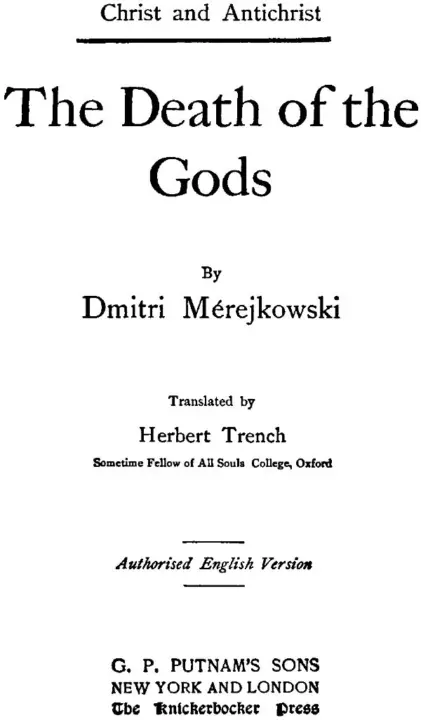
The Death of the Gods (Christ and Antichrist, 1 of 3)
Dmitry Sergeyevich Merezhkovsky
THE CLASSIC COLLECTION · 1905
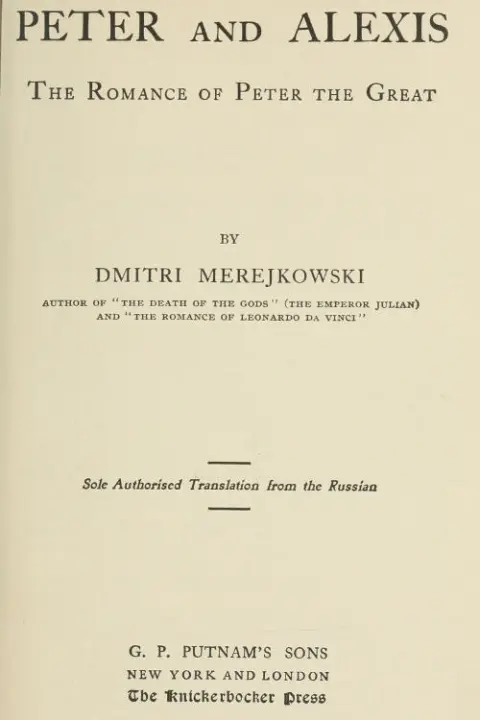
"Peter and Alexis: The Romance of Peter the Great" by Dmitry Sergeyevich Merezhkovsky is a historical novel written in the early 20th century. The narrative explores the tumultuous relationship between Tsar Peter the Great and his son, Tsarevitch Alexis, against the backdrop of early 18th century Russia, examining themes of power, rebellion, and political intrigue. The book delves into the personal struggles and societal issues of the era, focusing on Alexis's conflict with his father's sweeping reforms and the turmoil within the Romanov family. At the start of the novel, the reader is introduced to a significant encounter between Tsarevitch Alexis and a troubled old clerk, Larion Dokoukin, who speaks of the approaching Antichrist and presents seditious writings reflective of the growing unrest among the people towards Peter's westernization efforts. This opening sets the tone for Alexis's internal conflict as he grapples with the expectations of duty to his father while feeling empathy for the old man's plight, capturing his existential and moral dilemmas. The scene unfolds within the setting of early Petersburg, where Alexis's disheveled existence reveals his detachment from both his royal responsibilities and personal relationships, particularly with his pregnant wife, highlighting a deep-rooted sense of melancholy and alienation.
Introduction adapted from the source catalogue; source summaries may be automatically generated.
Free to read · English · 186,624 words · No account needed
MAKE TIME FOR A GOOD BOOK
On by default. Untick to stop anonymous reading totals. Each page counts after 10 seconds in view. How this works.
Anonymous counting is on unless you have switched it off.
Suddenly one of the audience who had remained silent all this while, a woman named Elena with a simple, kind face, started defending the Tsar. “We don’t know how to express it,” she said, in a low voice, as if to herself, “but we continually pray—O Lord, bring the Tsar back to our Christian faith!”
Her timid attempt was silenced however, by indignant voices crying:—
“He is no Tsar! only a mock-Tsar; he has squandered himself, goes about as if beside himself.”
“He has become quite a Jew, he can no longer live without a sip of blood from time to time. The day he drinks blood, that day he is content and merry, but the day he gets none he can neither eat nor drink.”
“Glutton! he will have eaten everybody soon, for himself there is no
extermination.”
“May the earth engulph him!”
“Fools! Curs!” interposed with fury the gunner Alexis Furlong, a red-haired man of huge height, with a face now suggesting a beast, now a child, “fools, for not knowing how to defend yourselves! All of you are doomed soul and body; you will be mashed up like worms in a cabbage. As for me nothing would please me better than to cut him up into little bits.”
Elena weakly sighed and made the sign of the cross; these words, she confessed afterwards, made her feel hot all over. The others looked with terror at Alexis, while he, fixing his bloodshot eyes on one spot, and clenching his fist, added slowly as if lost in thought,—and there was something yet more terrible in this measured tone than in his fury:—
“I am surprised that no one has finished him off before now. He is always about alone. There are plenty of chances to cut him up half a dozen times over.”
Elena grew pale, she wanted to say something, but her moving lips could
not articulate a sound.
“Thrice have there been attempts to kill the Tsar,” said Cornelius, “but every time has failed: evil spirits attend and protect him.”
A fair, puny soldier, with an idiotic, haggard, sickly face, quite a boy, a deserter named Petka Jisla, began to talk hurriedly, stuttering and sobbing like an infant. He told them that three ships had brought branding-irons from abroad to brand people with. Strict watch was kept over them, nobody was allowed near; sentinels being stationed by them on the Cotline island.
These were the new recruit marks introduced by Peter, about which the Tsar wrote in 1712 to the general plenipotentiary Prince James Dolgorúki:—“to mark recruits, prick a cross with the needle on the left hand and rub in powder.”
Your reading position is saved on this browser. Take it to another device with a library code. Reading pages adapt to text, rather than matching a printed edition.
Dmitry Sergeyevich Merezhkovsky
BEHIND THE BOOK
This eBook is for the use of anyone anywhere in the United States and most other parts of the world at no cost and with almost no restrictions whatsoever. You may copy it, give it away or re-use it under the terms of the Project Gutenberg License included with this eBook or online at www.gutenberg.org. If you are not located in the United States, you will have to check the laws of the country where you are located before using this eBook. Read the source licence.
The original source file, including credits and licence, is retained by this library. Request an original-format copy at no charge. Please include the book title and Project Gutenberg identifier #61235.
KEEP YOUR CURIOSITY GOING
Cécile Tormay

Moritz Busch
Coulson Kernahan
John L. Ransom

Maurice Baring
Frances Wright