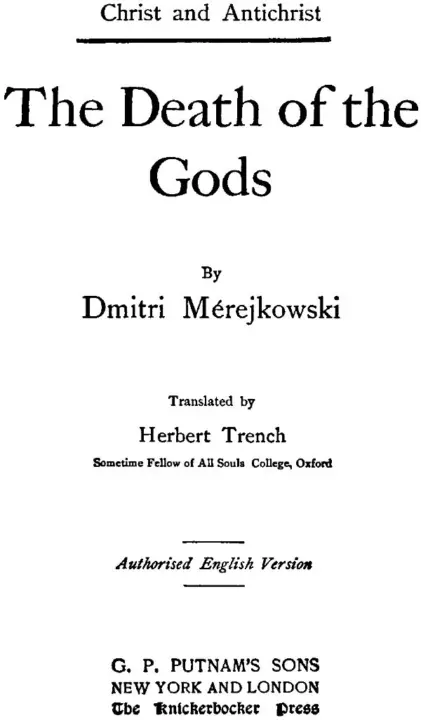
The Death of the Gods (Christ and Antichrist, 1 of 3)
Dmitry Sergeyevich Merezhkovsky
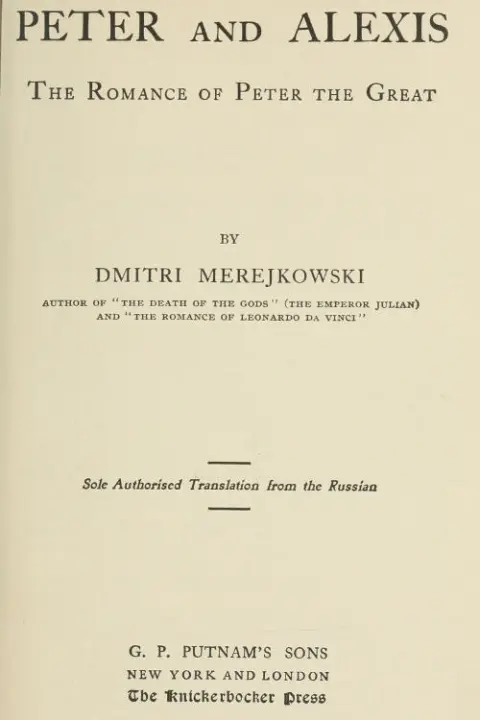
THE CLASSIC COLLECTION · 1905
"Peter and Alexis: The Romance of Peter the Great" by Dmitry Sergeyevich Merezhkovsky is a historical novel written in the early 20th century. The narrative explores the tumultuous relationship between Tsar Peter the Great and his son, Tsarevitch Alexis, against the backdrop of early 18th century Russia, examining themes of power, rebellion, and political intrigue. The book delves into the personal struggles and societal issues of the era, focusing on Alexis's conflict with his father's sweeping reforms and the turmoil within the Romanov family. At the start of the novel, the reader is introduced to a significant encounter between Tsarevitch Alexis and a troubled old clerk, Larion Dokoukin, who speaks of the approaching Antichrist and presents seditious writings reflective of the growing unrest among the people towards Peter's westernization efforts. This opening sets the tone for Alexis's internal conflict as he grapples with the expectations of duty to his father while feeling empathy for the old man's plight, capturing his existential and moral dilemmas. The scene unfolds within the setting of early Petersburg, where Alexis's disheveled existence reveals his detachment from both his royal responsibilities and personal relationships, particularly with his pregnant wife, highlighting a deep-rooted sense of melancholy and alienation.
Introduction adapted from the source catalogue; source summaries may be automatically generated.
Free to read · English · 186,624 words · No account needed
MAKE TIME FOR A GOOD BOOK
On by default. Untick to stop anonymous reading totals. Each page counts after 10 seconds in view. How this works.
Anonymous counting is on unless you have switched it off.
On the morning of Monday, February 3, 1718, two days after Peter’s first interview with Alexis, a meeting was summoned of all the ministers, generals, prelates and other civil and clerical officials in the Audience Hall of the old Kremlin Palace. The assembly was convoked to hear the manifesto, declaring the abdication of the throne by the Tsarevitch, and to take the oath of allegiance to the new heir, Peter Petrovitch.
Battalions of the Preobrazhensky Guard were stationed within the walls of the Kremlin, in all the squares, palace galleries and staircases. A rising was feared.
In the Audience Hall nothing of the old decoration had been retained save the frescoes on the ceiling, which represented the course of the stars, the twelve months of the year, and other heavenly phenomena.
All the rest were new: Dutch tapestries, crystal chandeliers, straight-backed chairs, narrow pier glasses between the windows. In the centre of the hall, under a red silk canopy, on a raised platform, reached by three steps, stood the throne, a gilt arm-chair with a golden double-headed eagle, and the keys of St. Peter embroidered on the crimson velvet.
Slanting rays of pale sunshine fell through the windows upon the white wigs of the senators and the black hoods of the prelates. The faces of all present expressed fear and that eager curiosity which is seen in a crowd at executions. The drum rolled.
A movement passed through the crowd, it separated, the Tsar entered and took his seat on the throne.
Two huge Preobrazhensky guards, with drawn swords, led in Alexis, like a
prisoner.
Without wig or sword, dressed in a plain black suit, pale, yet calm and meditative, he walked slowly, his head bent low. When near the throne and he saw his father, a gentle smile, which recalled his grandfather, the gentle Tsar Alexis, lit up his face.
Tall, narrow across the shoulders, with a thin visage surrounded by scanty tufts of straight smooth hair, suggesting now a village deacon, now the image of Saint Alexis, amid all these new Petersburg faces he seemed a being apart, a stranger as it were from another world, a phantom of ancient Muscovy. On many a face pity for this phantom mingled with curiosity and fear.
He stopped near the throne, not knowing what to do next.
“Kneel! kneel! and speak what you have prepared!” Tolstoi whispered to
him from behind.
The Tsarevitch knelt and began in a loud calm voice:—
Your reading position is saved on this browser. Take it to another device with a library code. Reading pages adapt to text, rather than matching a printed edition.
Dmitry Sergeyevich Merezhkovsky
BEHIND THE BOOK
This eBook is for the use of anyone anywhere in the United States and most other parts of the world at no cost and with almost no restrictions whatsoever. You may copy it, give it away or re-use it under the terms of the Project Gutenberg License included with this eBook or online at www.gutenberg.org. If you are not located in the United States, you will have to check the laws of the country where you are located before using this eBook. Read the source licence.
The original source file, including credits and licence, is retained by this library. Request an original-format copy at no charge. Please include the book title and Project Gutenberg identifier #61235.
KEEP YOUR CURIOSITY GOING
Cécile Tormay

Moritz Busch
Coulson Kernahan
John L. Ransom

Maurice Baring
Frances Wright