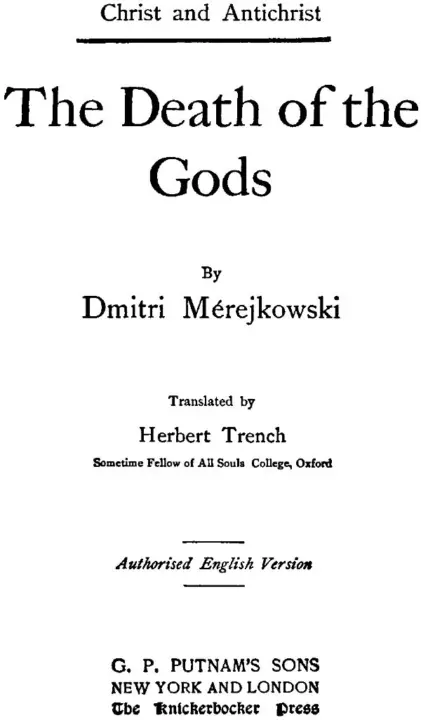
The Death of the Gods (Christ and Antichrist, 1 of 3)
Dmitry Sergeyevich Merezhkovsky
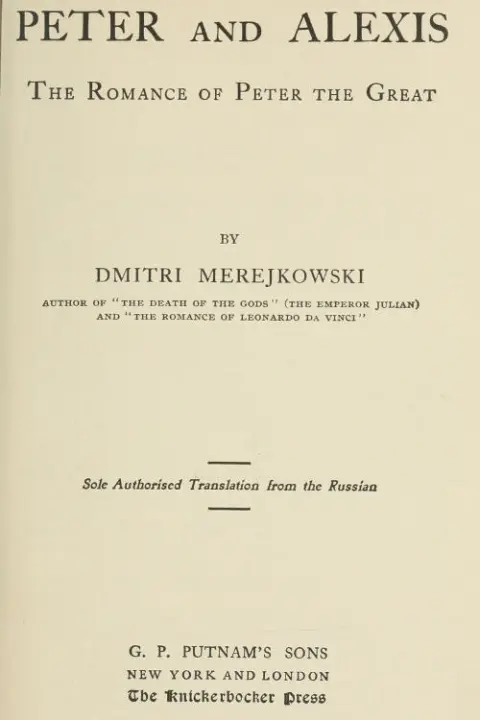
THE CLASSIC COLLECTION · 1905
"Peter and Alexis: The Romance of Peter the Great" by Dmitry Sergeyevich Merezhkovsky is a historical novel written in the early 20th century. The narrative explores the tumultuous relationship between Tsar Peter the Great and his son, Tsarevitch Alexis, against the backdrop of early 18th century Russia, examining themes of power, rebellion, and political intrigue. The book delves into the personal struggles and societal issues of the era, focusing on Alexis's conflict with his father's sweeping reforms and the turmoil within the Romanov family. At the start of the novel, the reader is introduced to a significant encounter between Tsarevitch Alexis and a troubled old clerk, Larion Dokoukin, who speaks of the approaching Antichrist and presents seditious writings reflective of the growing unrest among the people towards Peter's westernization efforts. This opening sets the tone for Alexis's internal conflict as he grapples with the expectations of duty to his father while feeling empathy for the old man's plight, capturing his existential and moral dilemmas. The scene unfolds within the setting of early Petersburg, where Alexis's disheveled existence reveals his detachment from both his royal responsibilities and personal relationships, particularly with his pregnant wife, highlighting a deep-rooted sense of melancholy and alienation.
Introduction adapted from the source catalogue; source summaries may be automatically generated.
Free to read · English · 186,624 words · No account needed
MAKE TIME FOR A GOOD BOOK
On by default. Untick to stop anonymous reading totals. Each page counts after 10 seconds in view. How this works.
Anonymous counting is on unless you have switched it off.
“Jesus Christ, Son of God, have mercy upon us sinners,” said a voice.
“Amen,” responded Tichon and Sophia.
The newcomers were pilgrims. They had lost their way in the wood, and narrowly escaped being engulfed in the bog; perceiving the light of the fire, they had after considerable difficulty found their way to it.
They sat down round the fire.
“Is it far to the monastery, friends?”
“’Tis just here at the foot of the hill,” answered Tichon, and looking steadfastly at the woman who put the question, he recognised Vitalia, the same who led the life of a migrant bird, roaming, flying everywhere, whom he had met two years ago in Petersburg on the oak-rafts of the Tsarevitch Alexis, on the night of the Venus festival. She too recognised Tichon and was delighted. With her was her inseparable companion Kilikeya the possessed; the runaway recruit Petka Gisla, whose hand, branded with the government stamp, the mark of the Beast, had withered; and the old boatman, Simple John, who, waiting for Christ’s coming, sang every night the song of the coffin-liers.
“Whence come ye, Orthodox folk?” asked Sophia.
“We are pilgrims,” answered Vitalia, “we wander everywhere, persecuted by the heretics; we have no abiding city, we are waiting for the New Jerusalem. We are now coming from Kerjensk. Cruel persecutions are going on there now. Peterin, the fierce wolf, the vampire of the church, has destroyed seventy-seven monasteries and cast out the holy monks.”
They began telling about the persecutions.
One old father had been flogged in three torture chambers, his ribs had been broken with iron tongues, he was dragged by the navel, and then (it was a very cold winter) he was stripped and ice-water was poured over him until icicles reached from his beard to the ground; at last he found death in the flames.
Others were tormented in iron collars, collars which draw head, hands and feet all together; with the result that the spine and the limbs were dislocated, and blood spurted from the mouth, nose, eyes and ears of the martyrs.
Others were forced to partake of the Lord’s supper by having a gag put into their mouths. The soldiers dragged a youth to church, laid him on the bench, the priest and deacon approached with the vessel. He was held down, his mouth was opened and the wine poured in. He spat it out. Then the deacon dealt him such a blow with his fist, that his lower jaw was broken. The lad died from this blow.
One woman to escape the persecutions made a hole in the ice, pushed her seven small children under, and then drowned herself.
Your reading position is saved on this browser. Take it to another device with a library code. Reading pages adapt to text, rather than matching a printed edition.
Dmitry Sergeyevich Merezhkovsky
BEHIND THE BOOK
This eBook is for the use of anyone anywhere in the United States and most other parts of the world at no cost and with almost no restrictions whatsoever. You may copy it, give it away or re-use it under the terms of the Project Gutenberg License included with this eBook or online at www.gutenberg.org. If you are not located in the United States, you will have to check the laws of the country where you are located before using this eBook. Read the source licence.
The original source file, including credits and licence, is retained by this library. Request an original-format copy at no charge. Please include the book title and Project Gutenberg identifier #61235.
KEEP YOUR CURIOSITY GOING
Cécile Tormay

Moritz Busch
Coulson Kernahan
John L. Ransom

Maurice Baring
Frances Wright