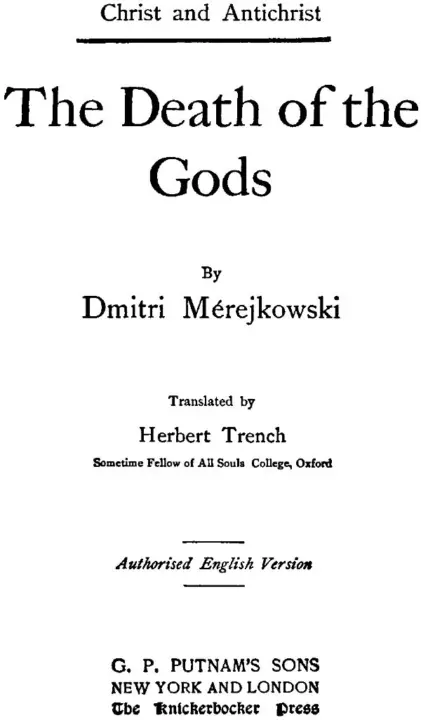
The Death of the Gods (Christ and Antichrist, 1 of 3)
Dmitry Sergeyevich Merezhkovsky
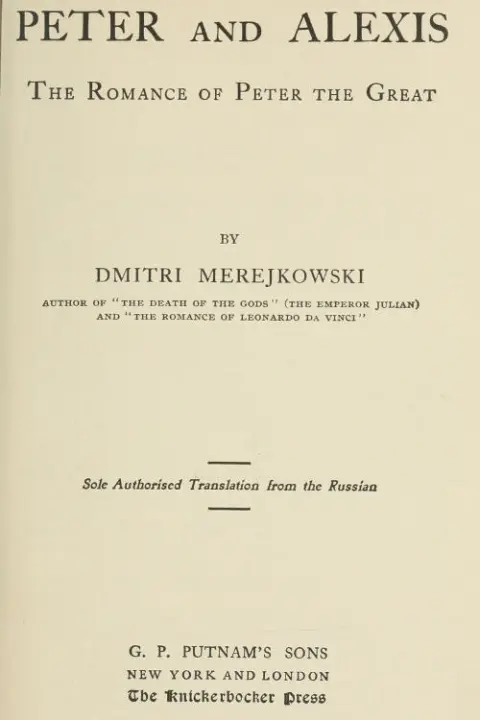
THE CLASSIC COLLECTION · 1905
"Peter and Alexis: The Romance of Peter the Great" by Dmitry Sergeyevich Merezhkovsky is a historical novel written in the early 20th century. The narrative explores the tumultuous relationship between Tsar Peter the Great and his son, Tsarevitch Alexis, against the backdrop of early 18th century Russia, examining themes of power, rebellion, and political intrigue. The book delves into the personal struggles and societal issues of the era, focusing on Alexis's conflict with his father's sweeping reforms and the turmoil within the Romanov family. At the start of the novel, the reader is introduced to a significant encounter between Tsarevitch Alexis and a troubled old clerk, Larion Dokoukin, who speaks of the approaching Antichrist and presents seditious writings reflective of the growing unrest among the people towards Peter's westernization efforts. This opening sets the tone for Alexis's internal conflict as he grapples with the expectations of duty to his father while feeling empathy for the old man's plight, capturing his existential and moral dilemmas. The scene unfolds within the setting of early Petersburg, where Alexis's disheveled existence reveals his detachment from both his royal responsibilities and personal relationships, particularly with his pregnant wife, highlighting a deep-rooted sense of melancholy and alienation.
Introduction adapted from the source catalogue; source summaries may be automatically generated.
Free to read · English · 186,624 words · No account needed
MAKE TIME FOR A GOOD BOOK
On by default. Untick to stop anonymous reading totals. Each page counts after 10 seconds in view. How this works.
Anonymous counting is on unless you have switched it off.
This was a question the Tsarevitch was anticipating with dread.
“I have sinned here,” he replied in a scarcely audible voice, “not in deed, nor in words, but in thought. I wished my father——”
And again, as before, he stopped short as if what he was going to say had frightened him. But the All-seeing Eye penetrated the very depths of his soul, and nothing could be hid from It.
With effort, trembling, pale and bathed in cold sweat, he concluded:
“When my father was ill, I longed for his death.”
He stopped and shrank together and bent his head lower still. He closed his eyes so as not to see Him who stood before him; his heart sank in an agony of dread, as though he were waiting for the last word of condemnation, or absolution, which would peal forth like thunder as on the day of Judgment, when suddenly he heard the familiar, ordinary human voice of Father James, saying: “God will forgive thee, child. We all desired it!”
The Tsarevitch lifted his head, opened his eyes, and saw the familiar, ordinary, human face, not in the least alarming, with little wrinkles round the brown eyes; kind and slightly cunning, a mole with three hairs on the round plump cheek, the reddish grizzled beard, the same he had once pulled in a scuffle, when in his cups. An ordinary priest, nothing remarkable about him; yet, if a thunderbolt had fallen, Alexis would have been less dumbfounded than by those simple words—“God will forgive thee, we all desired it.”
And meanwhile, the priest continued, as if nothing had happened:—
“Tell me, my son, hast thou abstained from blood, carrion, from the flesh of strangled animal, or those killed by the wolf, and smitten by the bird? Hast thou ever defiled thyself by eating what has been forbidden in the holy laws? Hast thou tasted in Lent, or on Wednesdays and Fridays, butter and cheese?”
“Father,” exclaimed the Tsarevitch, “great is my sin, the Lord knows how
great it is!”
“Hast thou broken the Lenten fast?” asked Father James with anxiety.
“I did not mean that, Father; I speak of my father, the Tsar. How is it possible? I am his son, flesh of his flesh. The son prayed for the death of his father! He who longs for another person’s death is a murderer. I am a parricide in thought. I am troubled, Father James, sorely troubled. Verily, Father, I confess to thee as to Christ Himself. Judge me, help me, be gracious unto me, O Lord!”
Father James looked at him, first in astonishment, then in anger.
Your reading position is saved on this browser. Take it to another device with a library code. Reading pages adapt to text, rather than matching a printed edition.
Dmitry Sergeyevich Merezhkovsky
BEHIND THE BOOK
This eBook is for the use of anyone anywhere in the United States and most other parts of the world at no cost and with almost no restrictions whatsoever. You may copy it, give it away or re-use it under the terms of the Project Gutenberg License included with this eBook or online at www.gutenberg.org. If you are not located in the United States, you will have to check the laws of the country where you are located before using this eBook. Read the source licence.
The original source file, including credits and licence, is retained by this library. Request an original-format copy at no charge. Please include the book title and Project Gutenberg identifier #61235.
KEEP YOUR CURIOSITY GOING
Cécile Tormay

Moritz Busch
Coulson Kernahan
John L. Ransom

Maurice Baring
Frances Wright