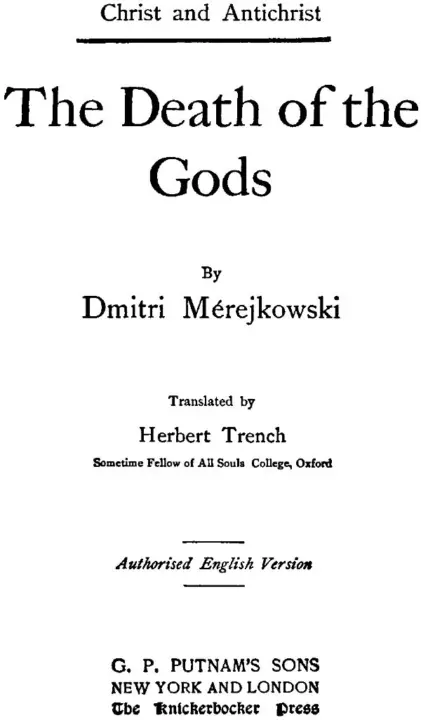
The Death of the Gods (Christ and Antichrist, 1 of 3)
Dmitry Sergeyevich Merezhkovsky
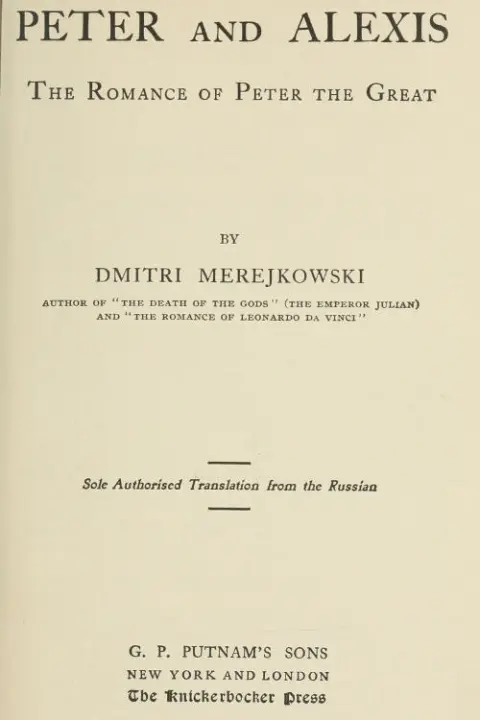
THE CLASSIC COLLECTION · 1905
"Peter and Alexis: The Romance of Peter the Great" by Dmitry Sergeyevich Merezhkovsky is a historical novel written in the early 20th century. The narrative explores the tumultuous relationship between Tsar Peter the Great and his son, Tsarevitch Alexis, against the backdrop of early 18th century Russia, examining themes of power, rebellion, and political intrigue. The book delves into the personal struggles and societal issues of the era, focusing on Alexis's conflict with his father's sweeping reforms and the turmoil within the Romanov family. At the start of the novel, the reader is introduced to a significant encounter between Tsarevitch Alexis and a troubled old clerk, Larion Dokoukin, who speaks of the approaching Antichrist and presents seditious writings reflective of the growing unrest among the people towards Peter's westernization efforts. This opening sets the tone for Alexis's internal conflict as he grapples with the expectations of duty to his father while feeling empathy for the old man's plight, capturing his existential and moral dilemmas. The scene unfolds within the setting of early Petersburg, where Alexis's disheveled existence reveals his detachment from both his royal responsibilities and personal relationships, particularly with his pregnant wife, highlighting a deep-rooted sense of melancholy and alienation.
Introduction adapted from the source catalogue; source summaries may be automatically generated.
Free to read · English · 186,624 words · No account needed
MAKE TIME FOR A GOOD BOOK
On by default. Untick to stop anonymous reading totals. Each page counts after 10 seconds in view. How this works.
Anonymous counting is on unless you have switched it off.
O beautiful city on flowing Seine
The gods have chosen thy fair domain.
The manners of boors are driven out hence
By thy most exquisite influence,
And never shall I in my soul forget
The town that I leave with such deep regret!
The old Moscow boyars, hostile to the new customs, sat a little way off, warming themselves near the stove, holding converse with one another in allusions and riddles.
“What do you think, my lord, of life in Petersburg, eh?”
“To the devil with you and your Petersburg life! These compliments and reverences and obeisances of the woman-folk, and the foreign food, make one’s head go round!”
“What’s to be done, friend, but bear it? One cannot leap into heaven, nor bury oneself in the earth. Patience, patience!”
Mons was whispering into Nastenka’s ears a newly composed ditty:
Without love and passion,
All days are dreary.
Love sighs acquaint us
With all life’s sweetness.
What, say, is life for,
If one loves not?
Suddenly, it seemed to her that the ceiling was shaking and that the naked Cupids were falling upon her head. She cried out; William Mons reassured her; it was only the wind bulging out like a sail the canvas of the picture nailed to the ceiling.
Again the shutters rattled, this time with such force that everybody
looked round in terror.
The polonaise began; the couples set out and music drowned the noise of the storm. Only the shivering old nobles, warming themselves round the stove, listened to the howling of the wind in the chimney, and whispered to one another, sighing and shaking their heads. They seemed to hear in the sounds of the storm, rendered more ill-omened still by the music, the old words: “out of the sea sorrow, out of the water, grief!”
Peter continued his conversation with Theodosius; he asked him about the heresy of the Moscow iconoclasts, Fomka the barber and Dmitri the physician. Both heretics, in propagating their teaching, had referred to the Tsar’s recent decrees: “Thanks be to God, nowadays in Muscovy everybody is free to follow what faith he chooses.”
“According to their teaching,” continued Theodosius, with a smile which made it impossible to infer whether he disagreed or sympathised with the heresy, “the true faith is founded on the Scriptures and good works, and not on miracles and traditions.
“People of any creed can be saved according to the apostle’s word: ‘In every nation he that feareth God, and worketh righteousness, is accepted with Him.”
“Very reasonable,” remarked Peter and the monk’s smile seemed to be reflected on the Tsar’s face; they understood one another without words.
Your reading position is saved on this browser. Take it to another device with a library code. Reading pages adapt to text, rather than matching a printed edition.
Dmitry Sergeyevich Merezhkovsky
BEHIND THE BOOK
This eBook is for the use of anyone anywhere in the United States and most other parts of the world at no cost and with almost no restrictions whatsoever. You may copy it, give it away or re-use it under the terms of the Project Gutenberg License included with this eBook or online at www.gutenberg.org. If you are not located in the United States, you will have to check the laws of the country where you are located before using this eBook. Read the source licence.
The original source file, including credits and licence, is retained by this library. Request an original-format copy at no charge. Please include the book title and Project Gutenberg identifier #61235.
KEEP YOUR CURIOSITY GOING
Cécile Tormay

Moritz Busch
Coulson Kernahan
John L. Ransom

Maurice Baring
Frances Wright