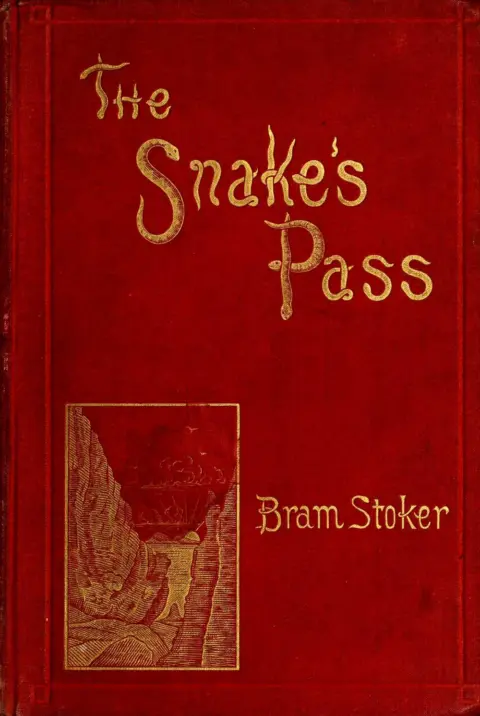
The Snake’s Pass
Bram Stoker
THE CLASSIC COLLECTION · 1906
"Personal Reminiscences of Henry Irving" by Bram Stoker is a biographical account written in the late 19th century. The text offers insights into the life and career of the renowned actor Henry Irving, detailing his journey from obscurity to acclaim and highlighting the impact he had on the theater world. Stoker, having been a close friend of Irving for nearly three decades, provides a personal perspective on Irving’s artistry, personality, and the friendships he cultivated along the way. The opening of the memoir sets the stage by recounting the author's first encounter with Henry Irving at the Theatre Royal in Dublin in 1867. Stoker vividly describes Irving's portrayal of Captain Absolute, emphasizing the remarkable quality of his acting that distinguished him from others. As the narrative progresses, it hints at the evolution of both Irving's craft and Stoker’s own critical voice, exploring the transformative power of performance and the challenges faced by artists in a shifting theatrical landscape. Through a blend of personal memory and critical reflection, the memoir unfolds the rich tapestry of Irving’s professional life and the profound influence he had on his peers and the theater industry.
Introduction adapted from the source catalogue; source summaries may be automatically generated.
Free to read · English · 183,027 words · No account needed
MAKE TIME FOR A GOOD BOOK
On by default. Untick to stop anonymous reading totals. Each page counts after 10 seconds in view. How this works.
Anonymous counting is on unless you have switched it off.
I can bear the highest testimony to the bona fides of American reporters, though they do not, either individually or collectively, require any commendation from me. I have had, in the twenty years covered by our tours in America, many hundreds of “interviews” with reporters, and I never once found one that “went back” on me. I could always speak quite openly to them individually on a subject which we wished for the present to keep dark, simply telling him or them that the matter was not for present publication. Any one who knows the inner working of a newspaper, and of the keenness which exists in the competition for the acquisition of news, will know how much was implied by the silence—the scorn and contempt that would now and then be hurled at those who “couldn’t get a story.” I have no doubt that sometimes the engagement on the paper was imperilled, or even cancelled. Of course I always tried to let them get something. It was quite impossible at times that Irving should give interviews. Such take time, and time was not always available in the midst of strenuous work; sickness and weariness are bars to intellectual undertakings; and now and again the high policy of one’s business demands silence. In Irving’s case his utterances had to be carefully considered. He was one of the very few men who was always reported verbatim. With ordinary individuals there is habitual compression and “editing” which, though it may occasionally suppress some fact or step in an argument, is protective against many errors. It is an old journalistic saying that “Parliamentary reputations are made in the Gallery!” This is almost exact; were it qualified so as to admit of exceptions it would be quite exact. In ordinary speeches, or in any form of extempore and unpremeditated utterance, there are evidences of changement during the process of thought—uncompleted sentences, confused metaphors, words ill chosen or slightly misapplied. In addition, as in almost every case Irving spoke or was interviewed on professional subjects or matters closely allied to his own work or ideas, there was always a possibility of creating a wrong impression somewhere. Also, he stood so high amongst his own craft that an omission would now and again be treated as an affront. I have known him to receive, after some speech or interview or recorded conversation where he had given a few names of actors as illustrating some part, a dozen letters asking if there was any reason why the writer’s name was omitted in that connection. Irving was always most loyal to all those of his own calling and considerate of their needs and wishes; and so in all matters where he was by common consent or by general repute vested with the responsibilities of judgment he tried to hold the scales of justice balanced. In order, therefore, to see that his real views were properly set out—and incidentally for self-protection—he always took precautions with regard to speeches and interviews. The former, he always wrote out. On occasions where he had to speak as if impromptu—such as on the stage after the performance on first or last nights; any time when mere pleasant commonplaces were insufficient—he learned the speech by heart. When he could have anything before him, such as at dinners, he would have ready his speech carefully corrected, printed in very large type on small pages printed on one side only and not fastened together—so that they could be moved easily and separately. This he would place before him on the table. He would not seem to read it, and of course he would be familiar with the general idea. But he read it all the same; with a glance he would take in a whole sentence of the big type and would use his acting power not only in its delivery but in the disguising of his effort. If there were not time to get the speech printed he would write it out himself in a big hand with thick strokes of a soft pen. With regard to interviews he always required that the proof should be submitted to him and that his changes, either by excisions or additions, should be respected. He would sign the proof if such were thought desirable. I never knew a case where the interviewer or the newspaper did not loyally hold to the undertaking. I am anxious to put this on record; for I have often heard and read diatribes by the inexperienced against not only the system of interviewing but the interviewers. Let me give an instance of the chagrin which must be felt by men, skilled in the work and with responsibilities to their newspapers, who are baffled in their undertakings by reasons which they do not understand or agree with.
Your reading position is saved on this browser. Take it to another device with a library code. Reading pages adapt to text, rather than matching a printed edition.
Bram Stoker
Bram Stoker
Bram Stoker
Bram Stoker
BEHIND THE BOOK
This eBook is for the use of anyone anywhere in the United States and most other parts of the world at no cost and with almost no restrictions whatsoever. You may copy it, give it away or re-use it under the terms of the Project Gutenberg License included with this eBook or online at www.gutenberg.org. If you are not located in the United States, you will have to check the laws of the country where you are located before using this eBook. Read the source licence.
The original source file, including credits and licence, is retained by this library. Request an original-format copy at no charge. Please include the book title and Project Gutenberg identifier #68779.
KEEP YOUR CURIOSITY GOING
John L. Ransom

Herman W. Mudgett

Harriet Monroe
Daniel Dulany Addison
Charles Lanman

Harold Rosher