
The Writing of News A Handbook with Chapters on Newspaper Correspondence and Copy Reading
Charles G. (Charles Griffith) Ross
THE CLASSIC COLLECTION · 1872
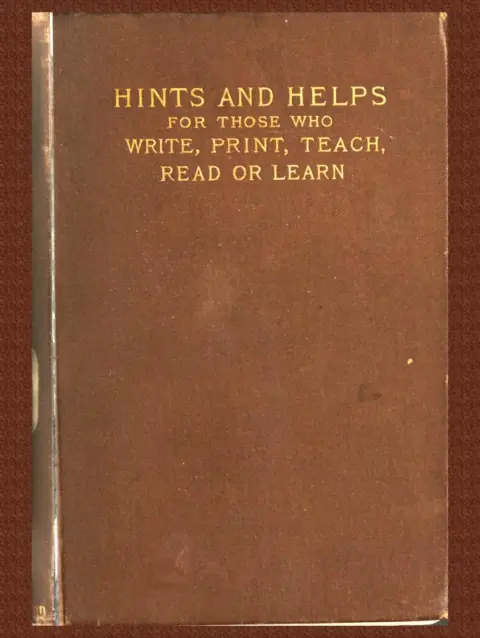
"PENS AND TYPES" by Benjamin Drew is a practical guide for aspiring authors, printers, and educators, likely written in the late 19th century. This text serves both as a manual and a reference work, aimed at offering practical advice on writing, printing, and teaching the English language. It covers various topics including proof-reading, punctuation, orthography, and capitalization, making it beneficial for anyone involved in the creation or dissemination of written content. At the start of the book, Drew emphasizes the critical role of clear and legible writing for effective communication in printing and publishing. Through examples of humorous misprints and errors caused by illegibility, he illustrates how a writer's carelessness can lead to significant misunderstandings. This opening section sets the tone for the rest of the work, establishing the importance of clarity and professionalism in written documents. Drew's insights not only cater to individuals directly involved with the press but also extend to those teaching language skills, highlighting the interconnectedness of reading and writing proficiency.
Introduction adapted from the source catalogue; source summaries may be automatically generated.
Free to read · English · 51,463 words · No account needed
MAKE TIME FOR A GOOD BOOK
On by default. Untick to stop anonymous reading totals. Each page counts after 10 seconds in view. How this works.
Anonymous counting is on unless you have switched it off.
Brackets are used to inclose words omitted by a writer or copyist; as, “Were you [on the] deck of the steamer at the [time] of the collision?” (In the Holy Scriptures, supplied words are put in italics: “Because they sought it not by faith, but, as it were, by the works of the law.”) Explanations inserted in text are usually inclosed in brackets; as in the following instance, from “The Life of Dr. Goldsmith”: “You see, my dear Dan, how long I have been talking about myself. [Some mention of private family affairs is here omitted.] My dear sir, these things give me real uneasiness,” etc.
Marks of Parenthesis are used to inclose a sentence, or part of a sentence, which is inserted in another sentence: “One Sunday morning, when her daughter (afterwards Lady Elton) went into the kitchen, she was surprised to find a new jack (recently ordered, and which was constructed on the principle of going constantly without winding up) wholly paralyzed and useless.”
The Index [☞] is used to draw attention to some particular passage. Sometimes an Asterism [⁂] is used for the same purpose. Where there are many footnotes on a page, the Index is a proper reference mark. {p121}
The Caret [‸] is used in writing, to denote the point where an interlineation is to be inserted. It is sometimes used in printing when the exact character of a manuscript is to be represented,—as in “exhibits” in law work.
The Brace [Illustration: }] is used to connect a number of words with one common term; and sometimes in poetry, to connect three lines which rhyme together:
Moore’s Works,
Saurin’s Sermons, [Illustration: }] $1.75 each.
Lewis’s Plays,
Injustice, swift, erect, and unconfined, Sweeps the wide earth, and tramples o’er mankind, [Illustration: }] While prayers, to heal her wrongs, move slow behind.
Marks of Ellipsis or Omission are the dash; as, “Col. Sm—h”: or asterisks; as, “Col. Sm**h”: or, neatest of all, points; as, “Col. Sm . . h.”
Leaders are dots which lead the eye from something on the left of the page, to some connected matter on the right:
Globe Insurance Co. . . . . . London, Eng. Mutual Life In. Co. . . . . . Hartford, Conn.
Accents are the Grave [`], the Acute [´], and the Circumflex [^]: è is read by the copy-holder grave e; é, acute e; ê, circumflex e.
Marks of Quantity are the Long, as over o in “shōw”; the Short, or Breve, as over o in “nŏt”; and the Diæresis, which denotes that the latter of {p122} two vowels is not in the same syllable as the former; as, “zoölogy,” “Antinoüs.”
Your reading position is saved on this browser. Take it to another device with a library code. Reading pages adapt to text, rather than matching a printed edition.
BEHIND THE BOOK
This eBook is for the use of anyone anywhere in the United States and most other parts of the world at no cost and with almost no restrictions whatsoever. You may copy it, give it away or re-use it under the terms of the Project Gutenberg License included with this eBook or online at www.gutenberg.org. If you are not located in the United States, you will have to check the laws of the country where you are located before using this eBook. Read the source licence.
The original source file, including credits and licence, is retained by this library. Request an original-format copy at no charge. Please include the book title and Project Gutenberg identifier #60126.
KEEP YOUR CURIOSITY GOING
Charles G. (Charles Griffith) Ross
Hannah Webster Foster

Emily Lawless
Edwin Hamlin Carr

Charles De Lano Hine
Andrew Ure