
The Writing of News A Handbook with Chapters on Newspaper Correspondence and Copy Reading
Charles G. (Charles Griffith) Ross
THE CLASSIC COLLECTION · 1872
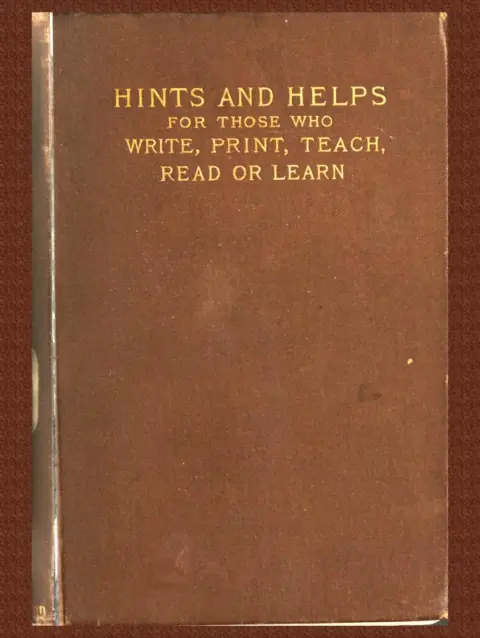
"PENS AND TYPES" by Benjamin Drew is a practical guide for aspiring authors, printers, and educators, likely written in the late 19th century. This text serves both as a manual and a reference work, aimed at offering practical advice on writing, printing, and teaching the English language. It covers various topics including proof-reading, punctuation, orthography, and capitalization, making it beneficial for anyone involved in the creation or dissemination of written content. At the start of the book, Drew emphasizes the critical role of clear and legible writing for effective communication in printing and publishing. Through examples of humorous misprints and errors caused by illegibility, he illustrates how a writer's carelessness can lead to significant misunderstandings. This opening section sets the tone for the rest of the work, establishing the importance of clarity and professionalism in written documents. Drew's insights not only cater to individuals directly involved with the press but also extend to those teaching language skills, highlighting the interconnectedness of reading and writing proficiency.
Introduction adapted from the source catalogue; source summaries may be automatically generated.
Free to read · English · 51,463 words · No account needed
MAKE TIME FOR A GOOD BOOK
On by default. Untick to stop anonymous reading totals. Each page counts after 10 seconds in view. How this works.
Anonymous counting is on unless you have switched it off.
OBS. 21. We recently met with this last sentence, pointed as follows: “My communication was offered and refused, on account of its length”; but it is not easy to see why the length of a communication should be assigned as the reason for having offered it.
“Every favor a man receives in some measure sinks him below his
dignity.”—Goldsmith.
OBS. 22. A comma should have been placed after receives.
24. No comma is put between two words or phrases in apposition, following the verbs think, name, make, consider, and others of a similar meaning.
They made him their ruler.
They called him captain.
They saluted him king.
I esteem you my friend.
Believing him an honest man, we elected him treasurer.
We constituted our Secretary a depositary of German books.
I consider him a gentleman.
OBS. 23. Of the terms in apposition, one is the subject, and the other the predicate, of to be, understood (“They made him to be their ruler”). The rule might, therefore, be worded thus: When, of two terms in apposition, one is predicated of the other, no comma is required.
25. In a compound sentence, the comma is often inserted where a verb is
omitted.
In literature, our taste will be discovered by that which we give; our judgment, by that which we withhold.
Wit consists in finding out resemblances; judgment, in discerning
differences. {p110}
In the pursuit of intellectual pleasure lies every virtue; of sensual,
every vice.
Sheridan once observed of a certain speech, that all its facts were invention, and all its wit, memory.
OBS. 24. But sometimes the comma is not inserted: especially when the style is lively; when the clauses have a common relation to something that follows; or when they are connected by a conjunction.
Could Johnson have had less prejudice, Addison more profundity, or Dryden more time, they would have been well qualified for the arduous office of a critic.
The Germans do not appear so vivacious, nor the Turks so energetic, as to afford triumphant demonstrations in behalf of the sacred weed.
The boat was tight, the day fine, the bait tempting, and the fishes
hungry.
26. A short quotation, a remarkable expression, or a short observation somewhat in manner of a quotation, is set off by the comma.
Plutarch calls lying, the vice of slaves.
It hurts a man’s pride to say, I do not know.
Cicero observed to a degenerate patrician, “I am the first of my family, but you are the last of yours.”
An upright minister asks, what recommends a man; a corrupt minister,
who.
There is an old poet who has said, “No deity is absent, if prudence is
with thee.”
Your reading position is saved on this browser. Take it to another device with a library code. Reading pages adapt to text, rather than matching a printed edition.
BEHIND THE BOOK
This eBook is for the use of anyone anywhere in the United States and most other parts of the world at no cost and with almost no restrictions whatsoever. You may copy it, give it away or re-use it under the terms of the Project Gutenberg License included with this eBook or online at www.gutenberg.org. If you are not located in the United States, you will have to check the laws of the country where you are located before using this eBook. Read the source licence.
The original source file, including credits and licence, is retained by this library. Request an original-format copy at no charge. Please include the book title and Project Gutenberg identifier #60126.
KEEP YOUR CURIOSITY GOING
Charles G. (Charles Griffith) Ross
Hannah Webster Foster

Emily Lawless
Edwin Hamlin Carr

Charles De Lano Hine
Andrew Ure