
The Writing of News A Handbook with Chapters on Newspaper Correspondence and Copy Reading
Charles G. (Charles Griffith) Ross
THE CLASSIC COLLECTION · 1872
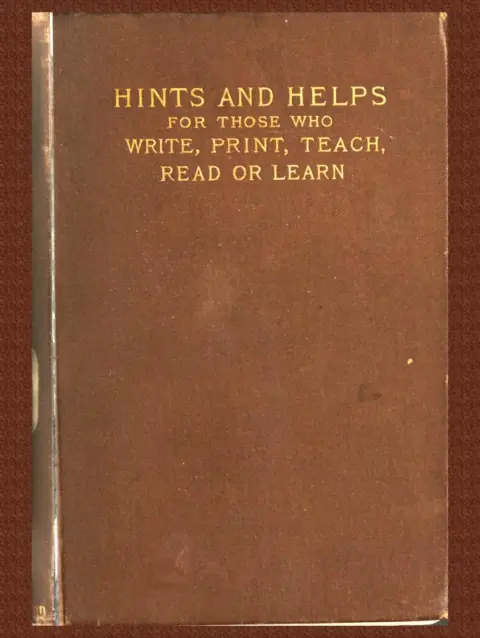
"PENS AND TYPES" by Benjamin Drew is a practical guide for aspiring authors, printers, and educators, likely written in the late 19th century. This text serves both as a manual and a reference work, aimed at offering practical advice on writing, printing, and teaching the English language. It covers various topics including proof-reading, punctuation, orthography, and capitalization, making it beneficial for anyone involved in the creation or dissemination of written content. At the start of the book, Drew emphasizes the critical role of clear and legible writing for effective communication in printing and publishing. Through examples of humorous misprints and errors caused by illegibility, he illustrates how a writer's carelessness can lead to significant misunderstandings. This opening section sets the tone for the rest of the work, establishing the importance of clarity and professionalism in written documents. Drew's insights not only cater to individuals directly involved with the press but also extend to those teaching language skills, highlighting the interconnectedness of reading and writing proficiency.
Introduction adapted from the source catalogue; source summaries may be automatically generated.
Free to read · English · 51,463 words · No account needed
MAKE TIME FOR A GOOD BOOK
On by default. Untick to stop anonymous reading totals. Each page counts after 10 seconds in view. How this works.
Anonymous counting is on unless you have switched it off.
21. A word or phrase used in apposition, to explicate or illustrate a previous word or phrase, should be set off by commas; but if the words in apposition constitute a single phrase or a proper name, they should not be separated.
a. Comma required.
Johnson, that mighty Caliban of literature, is held up to view in the
pages of Boswell.
The alligator, or cayman, is found in the Orinoco.
Paul, the apostle of the Gentiles, was eminent for his zeal and
knowledge.
If the position of the terms in apposition is reversed, commas are
required.
The apostle of the Gentiles, Paul, was eminent for his zeal and
knowledge.
That old last century poet, Crowley, sings thus.
b. Comma not required.
Johnson the lexicographer completed his dictionary in seven years.
{p107}
We the undersigned agree to pay the sums set against our names
respectively.
Jeremy the prophet commanded them that were carried away to take of the fire, as it hath been signified.
I Paul have written it with mine own hand.
The poet Chaucer lived in the reign of Richard II.
Sir John Walpole understood two grand secrets of state: the power of principal, and the weakness of principle.
22. A simple sentence usually requires no point except the period at
the end of it.
Count Bismarck has preserved a pleasant intimacy with his old
preceptor.
OBS. 17. When the subject is a clause ending with a verb, or with a noun that might be mistaken for the nominative, a comma should be inserted before the predicate.
That winter campaigns are undertaken, shows a desire to kill the
Indians.
Captain Smith’s obedience to orders, issued in his promotion.
Every year that is added to the age of the world, serves to lengthen
the thread of its history.
He that gives a portion of his time and talent to the investigation of mathematical truth, will come to all other questions with a decided advantage over his opponents.
In the following sentence, a comma after “them” might not be improper (for we once heard a reader place a pause after “attacked”),—but we shall not attack one of General Sherman’s sentences, lest we “get the worst of it.”
During this campaign hundreds if not thousands of miles of similar intrenchments were built by both armies, and as a rule whichever party attacked one of them got the worst of it.—Memoirs Gen. W. T. Sherman.
OBS. 18. Whether a comma should be inserted after the verb to be, when that verb is followed by an infinitive clause which might by transposition be made the nominative, is a question on which the best authorities differ.
Your reading position is saved on this browser. Take it to another device with a library code. Reading pages adapt to text, rather than matching a printed edition.
BEHIND THE BOOK
This eBook is for the use of anyone anywhere in the United States and most other parts of the world at no cost and with almost no restrictions whatsoever. You may copy it, give it away or re-use it under the terms of the Project Gutenberg License included with this eBook or online at www.gutenberg.org. If you are not located in the United States, you will have to check the laws of the country where you are located before using this eBook. Read the source licence.
The original source file, including credits and licence, is retained by this library. Request an original-format copy at no charge. Please include the book title and Project Gutenberg identifier #60126.
KEEP YOUR CURIOSITY GOING
Charles G. (Charles Griffith) Ross
Hannah Webster Foster

Emily Lawless
Edwin Hamlin Carr

Charles De Lano Hine
Andrew Ure