
The Writing of News A Handbook with Chapters on Newspaper Correspondence and Copy Reading
Charles G. (Charles Griffith) Ross
THE CLASSIC COLLECTION · 1872
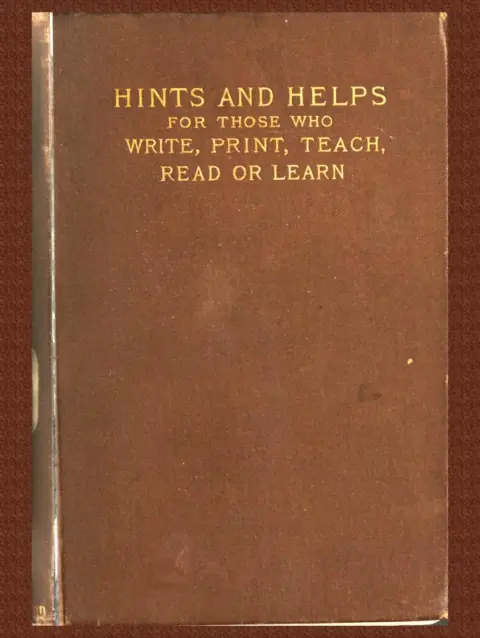
"PENS AND TYPES" by Benjamin Drew is a practical guide for aspiring authors, printers, and educators, likely written in the late 19th century. This text serves both as a manual and a reference work, aimed at offering practical advice on writing, printing, and teaching the English language. It covers various topics including proof-reading, punctuation, orthography, and capitalization, making it beneficial for anyone involved in the creation or dissemination of written content. At the start of the book, Drew emphasizes the critical role of clear and legible writing for effective communication in printing and publishing. Through examples of humorous misprints and errors caused by illegibility, he illustrates how a writer's carelessness can lead to significant misunderstandings. This opening section sets the tone for the rest of the work, establishing the importance of clarity and professionalism in written documents. Drew's insights not only cater to individuals directly involved with the press but also extend to those teaching language skills, highlighting the interconnectedness of reading and writing proficiency.
Introduction adapted from the source catalogue; source summaries may be automatically generated.
Free to read · English · 51,463 words · No account needed
MAKE TIME FOR A GOOD BOOK
On by default. Untick to stop anonymous reading totals. Each page counts after 10 seconds in view. How this works.
Anonymous counting is on unless you have switched it off.
OBS. 8. The exceptions to this rule are numerous. If the first and last words of a passage are related (for him the summer wind murmured); if the inverted phrase be brief, and can be read in close connection with what follows (in youth we have little sympathy with the misfortunes of age); or if the principal clause is itself inverted (In the center of the common rises a noble monument),—the comma is usually omitted.
OBS. 9. In long lists of proper names, as Directories, etc., it is usual to omit the comma, although the names are transposed, and to print thus:
Smith James W.
Thomson Theophilus.
16. When the principal sentence is broken to receive an incidental or parenthetic expression, a comma is placed at the break, and another at the end of the inserted clause.
Rulers and magistrates should attempt to operate on the minds of their respective subjects, if possible, by reward rather than punishment.
Some writers, in a vain attempt to be cutting and dry, give us only that which is cut and dried.
It is known to every physician, that, whatever lazy people may say to the contrary, early rising tends to longevity.
Go, then, where, wrapt in fear and gloom,
Fond hearts and true are sighing.
OBS. 10. The former comma is frequently omitted. Especially is this the case when the previous part of the sentence has required commas. Liberal pointing would omit the comma after “where,” in the above example. And in the following sentence, from General Marcy’s “Ramblings in the West,” note the omission of the comma after “and,” and from the parenthetic clause “it was believed”:
This, with the destruction of our trains, consumed the greater part of our winter supplies, and as they could not be replenished from the Missouri River before the following June, General Johnston, the commander, determined to send a detachment directly over the mountains to New Mexico, from whence it was believed supplies could be obtained earlier than from farther east. {p103}
Notice, also, the omission of the comma after “and” and “but,” in the following paragraphs:
He left college; and forsaken by his friends, he took refuge with the parliament party.—Marsh, Eccl. Hist.
The written law is sufficient to decide this case; but inasmuch as the irregularity in question is a fertile source of disputes, the case has been deemed worthy of insertion.—Cavendish.
(The most common parenthetic expressions are at least, at most, accordingly, as it were, beyond question, consequently, doubtless, furthermore, generally speaking, in the mean time, on the other hand, etc.)
Your reading position is saved on this browser. Take it to another device with a library code. Reading pages adapt to text, rather than matching a printed edition.
BEHIND THE BOOK
This eBook is for the use of anyone anywhere in the United States and most other parts of the world at no cost and with almost no restrictions whatsoever. You may copy it, give it away or re-use it under the terms of the Project Gutenberg License included with this eBook or online at www.gutenberg.org. If you are not located in the United States, you will have to check the laws of the country where you are located before using this eBook. Read the source licence.
The original source file, including credits and licence, is retained by this library. Request an original-format copy at no charge. Please include the book title and Project Gutenberg identifier #60126.
KEEP YOUR CURIOSITY GOING
Charles G. (Charles Griffith) Ross
Hannah Webster Foster

Emily Lawless
Edwin Hamlin Carr

Charles De Lano Hine
Andrew Ure