
The Writing of News A Handbook with Chapters on Newspaper Correspondence and Copy Reading
Charles G. (Charles Griffith) Ross
THE CLASSIC COLLECTION · 1872
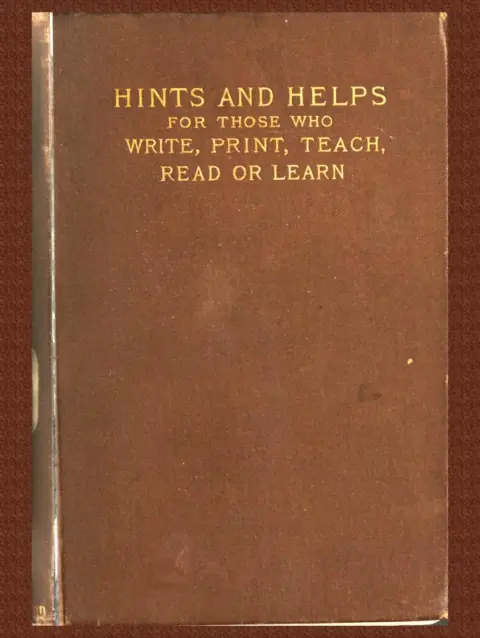
"PENS AND TYPES" by Benjamin Drew is a practical guide for aspiring authors, printers, and educators, likely written in the late 19th century. This text serves both as a manual and a reference work, aimed at offering practical advice on writing, printing, and teaching the English language. It covers various topics including proof-reading, punctuation, orthography, and capitalization, making it beneficial for anyone involved in the creation or dissemination of written content. At the start of the book, Drew emphasizes the critical role of clear and legible writing for effective communication in printing and publishing. Through examples of humorous misprints and errors caused by illegibility, he illustrates how a writer's carelessness can lead to significant misunderstandings. This opening section sets the tone for the rest of the work, establishing the importance of clarity and professionalism in written documents. Drew's insights not only cater to individuals directly involved with the press but also extend to those teaching language skills, highlighting the interconnectedness of reading and writing proficiency.
Introduction adapted from the source catalogue; source summaries may be automatically generated.
Free to read · English · 51,463 words · No account needed
MAKE TIME FOR A GOOD BOOK
On by default. Untick to stop anonymous reading totals. Each page counts after 10 seconds in view. How this works.
Anonymous counting is on unless you have switched it off.
The word “tree,” with a prefix indicating the kind, should be compounded; as “oak-tree,” “forest-tree,” “pine-tree,” etc. (Webster has a hyphen in “whiffle-tree,” Worcester prints “whiffletree.”)
“Cast-iron” and “wrought-iron” are usually compounded, and should always be so when used as adjectives; as “cast-iron pillars,” “wrought-iron boilers.”
“Temple-street place” (or “Place,” according to style), “Suffolk-street District,” “Pemberton-square School,” are quite correct; the hyphen is too frequently omitted in such cases.
The words ex officio do not require a hyphen, but some very reputable
offices insert it.
Hyphens are sometimes used to indicate grotesque pronunciation, as in the following couplet from “Rejected Addresses”:
“In borrowed luster seemed to sham
The rose and red sweet Will-i-am.”
When two words connected by a conjunction are severally compound parts of a following word, the hyphen is omitted; as: {p87}
We use cast and wrought iron pillars.
I have pruned my peach and apple trees.
Some authors follow the German style, inserting the hyphens; thus:
We use cast- and wrought-iron pillars.
I have pruned my peach- and apple-trees.
But this style is rare.
Precision requires that hyphens should be inserted in fractions expressed in words; as “one-half,” “three-fifths,” etc.
How many oranges are seven and three fourths oranges?
There being no hyphen in the above example, the “seven” and “three” are in the same category as “peach” and “apple” in the last previous example. The answer is ten-fourths, or 2½.
If “seven” is meant to express a whole number, a hyphen should be inserted after “three.”
A prolific source of trouble in correcting is wrong syllabication when it is thought necessary to carry part of a word to the succeeding line. Neither the English method of dividing on vowels, where this can be conveniently done, nor the American method of dividing on syllables, obtains exclusively in this country. Convenience, and the desire of spacing in such a manner as to make the lines look well, frequently determine the dividing letter; so that, in the same work, you may find “pro-perty” and “prop-erty,” “trea-sure” and “treas-ure.” In a recent English work, we note the following divisions: {p88} Pre-bendaries, mea-sure, pre-decessors, supre-macy, the Re-formation, pro-perty, theo-logy, bre-thren, pre-paration.
But the division on the syllable is the mode most generally practiced in the United States, and we must, however reluctantly, adhere to it as closely as possible, until a convention of publishers shall sanction the adoption of the English usage. Our authorities close the first syllable of “fa-ther” on the a, of “moth-er” on the th, so that, practically, the latter word should not be divided at all; the English printer, without hesitation, places the hyphen after the a and the o respectively.
Your reading position is saved on this browser. Take it to another device with a library code. Reading pages adapt to text, rather than matching a printed edition.
BEHIND THE BOOK
This eBook is for the use of anyone anywhere in the United States and most other parts of the world at no cost and with almost no restrictions whatsoever. You may copy it, give it away or re-use it under the terms of the Project Gutenberg License included with this eBook or online at www.gutenberg.org. If you are not located in the United States, you will have to check the laws of the country where you are located before using this eBook. Read the source licence.
The original source file, including credits and licence, is retained by this library. Request an original-format copy at no charge. Please include the book title and Project Gutenberg identifier #60126.
KEEP YOUR CURIOSITY GOING
Charles G. (Charles Griffith) Ross
Hannah Webster Foster

Emily Lawless
Edwin Hamlin Carr

Charles De Lano Hine
Andrew Ure