
The Writing of News A Handbook with Chapters on Newspaper Correspondence and Copy Reading
Charles G. (Charles Griffith) Ross
THE CLASSIC COLLECTION · 1872
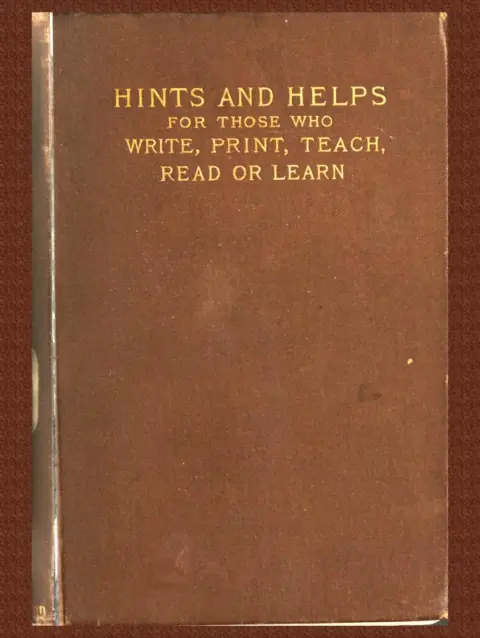
"PENS AND TYPES" by Benjamin Drew is a practical guide for aspiring authors, printers, and educators, likely written in the late 19th century. This text serves both as a manual and a reference work, aimed at offering practical advice on writing, printing, and teaching the English language. It covers various topics including proof-reading, punctuation, orthography, and capitalization, making it beneficial for anyone involved in the creation or dissemination of written content. At the start of the book, Drew emphasizes the critical role of clear and legible writing for effective communication in printing and publishing. Through examples of humorous misprints and errors caused by illegibility, he illustrates how a writer's carelessness can lead to significant misunderstandings. This opening section sets the tone for the rest of the work, establishing the importance of clarity and professionalism in written documents. Drew's insights not only cater to individuals directly involved with the press but also extend to those teaching language skills, highlighting the interconnectedness of reading and writing proficiency.
Introduction adapted from the source catalogue; source summaries may be automatically generated.
Free to read · English · 51,463 words · No account needed
MAKE TIME FOR A GOOD BOOK
On by default. Untick to stop anonymous reading totals. Each page counts after 10 seconds in view. How this works.
Anonymous counting is on unless you have switched it off.
“Sussex Co., Del., July 5, 1776. We are sorry to say, that it is our opinion that they (viz: the enemies of the war) are not better affected than they were before the troops came.”—Am. Archives, 5th series, Vol. 1, p. 10.
I never depended on him for any men, or for any participation in the Georgia Campaign. Soon after, viz., May 8th, that department was transferred, etc.—Memoirs Gen. Sherman. {p83}
There is one case in which it is never right to do this; viz., when the opposite party, etc.—Cavendish’s style.
The library is open every secular day throughout the year, except the legal holidays, viz.,—Washington’s Birthday, Fast Day, Decoration Day, Fourth of July, Labor Day, Thanksgiving, and Christmas.—Brookline, Mass., Pub. Lib. Report, 1887.
Seven of the bishops lived to be over 80—viz. Llandaff 84, Winchester 84, etc.—Nineteenth Century, March, ’88.
Woburn has a population of about 12,000, grouped at four principal centers: namely, Woburn Centre, about 8000, etc.—Mass. Drainage Comm.
The Dawes bill deals with two subjects only, namely, the ownership of land and citizenship.—N. A. Review, March, ’88.
This, then, is the upshot of the second part of the law, namely: (1) that all to whom land is patented become at once citizens of the United States; (2) that all, etc.—ib.
There are four seasons, namely: spring, summer, autumn, winter.
Four administrative areas are thus created: two primary areas—namely, counties at large, and boroughs of 100,000 inhabitants and upwards.—Nineteenth Century Maga.
Annapolis, June 25, 1776. That four battalions be instantly raised . . . . each company to consist of ninety men, to wit: one captain, two lieutenants, etc.—Am. Archives.
When viz. or namely or as follows ends a paragraph, the colon is commonly inserted; but the dash or comma-dash or colon-dash may sometimes be noticed,—it is a matter of office style. (See Punctuation, Rule 8, post.)
But if, referring to a succeeding sentence or paragraph, the words “the following” or “as follows” appear, the sentence in which they occur should be closed with the colon or colon-dash, as in the following examples: {p84}
The description given of the English Nonconformists in many pages that stand for history, is as follows: That they started forth under a well-settled order of constitution and discipline of the Church of England, etc.—Ellis’s Puritan Age.
Mr. Faulkner, from the Committee on Pensions, to whom were referred the following bills, reported them severally without amendment, and submitted reports thereon:
A bill (H. R. 10318) granting a pension to Mary C. Davis; and
A bill (H. R. 8400) to place the name of John J. Mitchell on the pension-roll.—Congressional Record, July 22, ’88.
Your reading position is saved on this browser. Take it to another device with a library code. Reading pages adapt to text, rather than matching a printed edition.
BEHIND THE BOOK
This eBook is for the use of anyone anywhere in the United States and most other parts of the world at no cost and with almost no restrictions whatsoever. You may copy it, give it away or re-use it under the terms of the Project Gutenberg License included with this eBook or online at www.gutenberg.org. If you are not located in the United States, you will have to check the laws of the country where you are located before using this eBook. Read the source licence.
The original source file, including credits and licence, is retained by this library. Request an original-format copy at no charge. Please include the book title and Project Gutenberg identifier #60126.
KEEP YOUR CURIOSITY GOING
Charles G. (Charles Griffith) Ross
Hannah Webster Foster

Emily Lawless
Edwin Hamlin Carr

Charles De Lano Hine
Andrew Ure