
The Writing of News A Handbook with Chapters on Newspaper Correspondence and Copy Reading
Charles G. (Charles Griffith) Ross
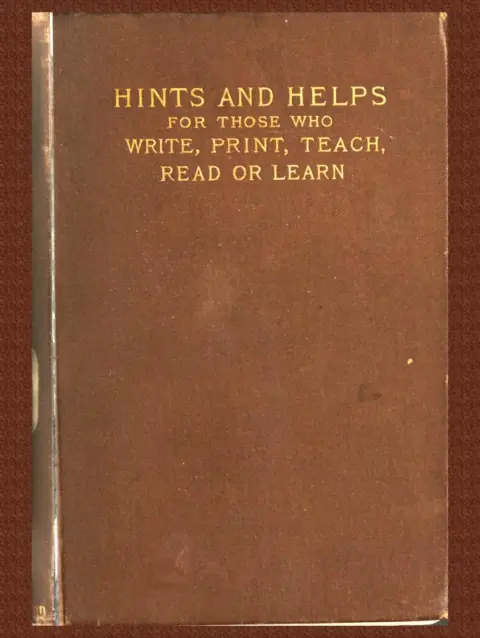
THE CLASSIC COLLECTION · 1872
"PENS AND TYPES" by Benjamin Drew is a practical guide for aspiring authors, printers, and educators, likely written in the late 19th century. This text serves both as a manual and a reference work, aimed at offering practical advice on writing, printing, and teaching the English language. It covers various topics including proof-reading, punctuation, orthography, and capitalization, making it beneficial for anyone involved in the creation or dissemination of written content. At the start of the book, Drew emphasizes the critical role of clear and legible writing for effective communication in printing and publishing. Through examples of humorous misprints and errors caused by illegibility, he illustrates how a writer's carelessness can lead to significant misunderstandings. This opening section sets the tone for the rest of the work, establishing the importance of clarity and professionalism in written documents. Drew's insights not only cater to individuals directly involved with the press but also extend to those teaching language skills, highlighting the interconnectedness of reading and writing proficiency.
Introduction adapted from the source catalogue; source summaries may be automatically generated.
Free to read · English · 51,463 words · No account needed
MAKE TIME FOR A GOOD BOOK
On by default. Untick to stop anonymous reading totals. Each page counts after 10 seconds in view. How this works.
Anonymous counting is on unless you have switched it off.
We recollect that a printer once received a manuscript accompanied with minute directions, extending even to syllabication. It was given out to the compositors, and a rough manuscript it was; one found in his take, “One Spanish Mc Krel” and “One caperamber,”—as he and the others in his chapel read the words,—conundrums which after hard study of characteristics and comparison of letters were, by an ingenious old typographic Champollion, solved as “One Spanish mackerel” and “One café-au-lait.”
If Gunther’s “Catalogue of Fishes, British Museum” is to be written, it is proper to abbreviate it to “Gunther’s Cat. Fish., Brit. Mus.” An author who undertook so to write it, jammed the Cat. close to the Fish, and placed the first period above the line. He should not have been surprised when he read in his proof-sheet, “Gunther’s Cat-Fish., Brit. Mus.”,—which, although apparently according to copy, was not “according to Gunther.”
The use of commas and other pause-marks is to bring out the sense, and when capitals will subserve the same purpose it is well to use them also,—whether one finds a printed Rule directing it or not. Thus Stedman writes:
“In his verse, Emerson’s spiritual philosophy and laws of conduct appear again, but transfigured. Always the idea of Soul, central and pervading, of which Nature’s forms are but the created symbols. As in his early discourse he recognized {p69} two entities, Nature and the Soul, so to the last he believed Art to be simply the union of Nature with man’s will—Thought symbolizing itself by Nature’s aid.”
Names of States and Territories, when following names of cities, towns, and post-offices, are usually contracted; as:
Savannah, Ga.; Brunswick, Me.; San Diego, Cal.; New Orleans, La.;
Plymouth, Mass.
But in any other connection, names of States and Territories are
spelled in full; as:
Mendocino County, California. We crossed Nevada Territory. We visited
Luray Cave, Virginia.
In an office where the employees are accustomed to the above rules, absolute uniformity would be attainable, if it were not for the interference of specialists. If, from such office, a book is issued in which you find “Richmond, Virginia,” and, farther on, “Richmond, Va.,” you may be sure that a “direction” to “spell out, in all cases, names of States and Territories” accompanied the manuscript; that one reader, mindful, as it happened, of the important direction, spelled “Virginia,” while another, from force of habit, followed the office style, and made no change from the customary “Va.”; and you may further conclude, that the author of the work, when examining the proof-sheets, had himself become oblivious of the direction he had given.
Your reading position is saved on this browser. Take it to another device with a library code. Reading pages adapt to text, rather than matching a printed edition.
BEHIND THE BOOK
This eBook is for the use of anyone anywhere in the United States and most other parts of the world at no cost and with almost no restrictions whatsoever. You may copy it, give it away or re-use it under the terms of the Project Gutenberg License included with this eBook or online at www.gutenberg.org. If you are not located in the United States, you will have to check the laws of the country where you are located before using this eBook. Read the source licence.
The original source file, including credits and licence, is retained by this library. Request an original-format copy at no charge. Please include the book title and Project Gutenberg identifier #60126.
KEEP YOUR CURIOSITY GOING
Charles G. (Charles Griffith) Ross
Hannah Webster Foster

Emily Lawless
Edwin Hamlin Carr

Charles De Lano Hine
Andrew Ure