
The Writing of News A Handbook with Chapters on Newspaper Correspondence and Copy Reading
Charles G. (Charles Griffith) Ross
THE CLASSIC COLLECTION · 1872
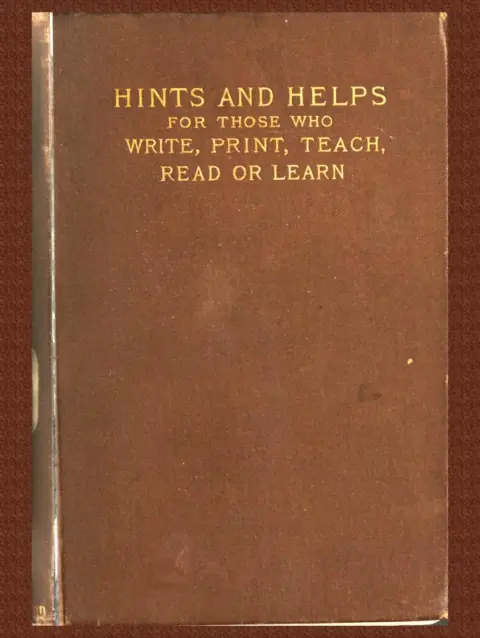
"PENS AND TYPES" by Benjamin Drew is a practical guide for aspiring authors, printers, and educators, likely written in the late 19th century. This text serves both as a manual and a reference work, aimed at offering practical advice on writing, printing, and teaching the English language. It covers various topics including proof-reading, punctuation, orthography, and capitalization, making it beneficial for anyone involved in the creation or dissemination of written content. At the start of the book, Drew emphasizes the critical role of clear and legible writing for effective communication in printing and publishing. Through examples of humorous misprints and errors caused by illegibility, he illustrates how a writer's carelessness can lead to significant misunderstandings. This opening section sets the tone for the rest of the work, establishing the importance of clarity and professionalism in written documents. Drew's insights not only cater to individuals directly involved with the press but also extend to those teaching language skills, highlighting the interconnectedness of reading and writing proficiency.
Introduction adapted from the source catalogue; source summaries may be automatically generated.
Free to read · English · 51,463 words · No account needed
MAKE TIME FOR A GOOD BOOK
On by default. Untick to stop anonymous reading totals. Each page counts after 10 seconds in view. How this works.
Anonymous counting is on unless you have switched it off.
The compositor and proof-reader should be careful that accented letters are used according to the copy, as in many cases the difference of accentuation serves also to mark the difference of signification. Thus, νέος signifies new; νεὸς, a field: ἴον, a violet; ἰὸν, going.
ᾳ, ῃ, ῳ, are diphthongs; their second vowel (ι), being silent, is placed underneath, or subscribed. These should be read thus: ᾳ, “a, subscript”; ῃ, “long e, subscript”; ῳ, “long o, subscript.”
In Greek, only four points or stops are used: the comma (,); the note of interrogation (;); the colon, or point at top (·); and the full stop (.). These should be mentioned as they occur. {p56}
Αντὶ τάφου λιτοῖο θὲς Ἑλλάδα, θὲς δ’ ὲπι ταύταν Δούρατα, βαρβαρικᾶς σύμβολα ναυφθορίας, Καὶ τύμβῳ κρηπῖδα περίγραφε Περσικὸν Ἄρη Καὶ Ξέρξην· τούτοις θάπτε Θεμιστοκλέα. Στάλα δ’ ἁ Σαλαμὶς ἐπικείσεται, ἔργα λέγουσα Τἀμά· τί με σμὶκροῖς τὸν μέγαν ἐντίτθετε;
The method of reading will, we think, be sufficiently exemplified if we give but one line. We select the third, which should be read by the copy-holder, as follows:
Cap. K, a, grave i; t, acute u, m, b, long o subscript; k, r, long e, p, circumflex i, d, a; p, short e, r, acute i, g, r, a, ph, short e; cap. P, short e, r, s, i, k, grave short o, n; cap. smooth acute A, r, long e.
Words from dead and foreign languages, introduced into English text, are printed in italics, until, being frequently met, they cease to be strangers; then printers and proof-readers anglicify them as much as possible, by printing them in roman; but some of these retain certain accents which indicate their alien origin. The Spanish cañon is completely anglicized into “canyon” (o as in no); our miners write “arrastra” in roman, although the term has not yet found its way into our most popular dictionaries; our dreadful accident-makers have set afloat so many “canards,” that that word has become better English than French; “papier-mache” usually appears in roman without the accent on the final e; employé {p57} has become a good “employee” in our workshops; and at an early day, every “protégé” and “protégée,” already roman, will throw off the foreign accents, and remain none the less acute “protegees”; “éclat,” “régime,” and “résumé” still cling to their acute e’s. Many words and phrases are hesitating whether to remain foreigners, or to become naturalized. They have “taken out their first papers,” as it were, having at times appeared in English garb.
Your reading position is saved on this browser. Take it to another device with a library code. Reading pages adapt to text, rather than matching a printed edition.
BEHIND THE BOOK
This eBook is for the use of anyone anywhere in the United States and most other parts of the world at no cost and with almost no restrictions whatsoever. You may copy it, give it away or re-use it under the terms of the Project Gutenberg License included with this eBook or online at www.gutenberg.org. If you are not located in the United States, you will have to check the laws of the country where you are located before using this eBook. Read the source licence.
The original source file, including credits and licence, is retained by this library. Request an original-format copy at no charge. Please include the book title and Project Gutenberg identifier #60126.
KEEP YOUR CURIOSITY GOING
Charles G. (Charles Griffith) Ross
Hannah Webster Foster

Emily Lawless
Edwin Hamlin Carr

Charles De Lano Hine
Andrew Ure