THE CLASSIC COLLECTION✦My diaries, being a personal narrative of events 1888-1914, Part 2 (1900-1914)CLASSIC FREE BOOKS
My diaries, being a personal narrative of events 1888-1914, Part 2 (1900-1914)
Wilfrid Scawen Blunt
THE CLASSIC COLLECTION · 1862
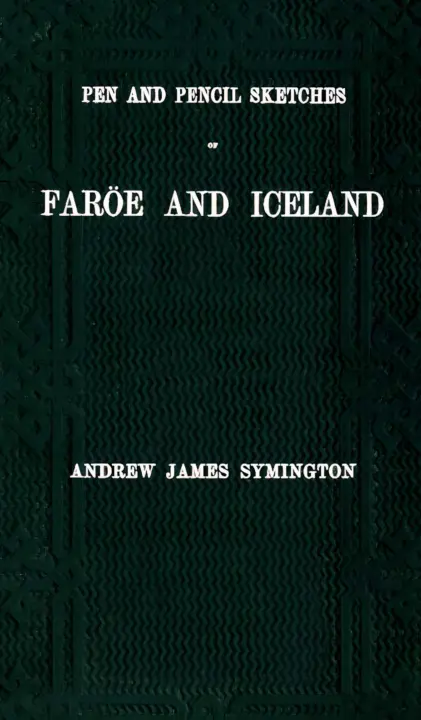
"Pen and Pencil Sketches of Faröe and Iceland" by Andrew James Symington is a travelogue written in the mid-19th century. This work combines personal diary entries with observations made during Symington's journey to the remote islands of Faröe and Iceland, aiming to capture the natural beauty and cultural richness of these northern climes. The book features sketches and insights about Icelandic life, landscapes, and the author's interactions with local inhabitants, all presented in an engaging and picturesque style. The opening portion of the travelogue introduces readers to Symington's preparations for his voyage to Iceland, detailing his contemplation of different travel options and the eventual choice to board the mail steamer "Arcturus." He vividly describes the ship's departure from Leith, the atmosphere on board with fellow passengers, and his feelings of anticipation and wonder as they journey through the North Sea. In addition, Symington begins to share his impressions of the landscapes, local life, and the natural phenomena that characterize both Faröe and Iceland, setting the stage for a rich exploration of these extraordinary places throughout the remainder of his narrative.
Introduction adapted from the source catalogue; source summaries may be automatically generated.
Free to read · English · 85,163 words · No account needed
MAKE TIME FOR A GOOD BOOK
On by default. Untick to stop anonymous reading totals. Each page counts after 10 seconds in view. How this works.
Anonymous counting is on unless you have switched it off.
The Norman outgoing is the last to which we shall here allude. In A.D. 876 the Northmen, under Rollo, wrested Normandy from the Franks; and from thence, in A.D. 1065, William, sprung from the same stock, landed at Hastings, vanquished Harold, and to this day is known as the Conqueror of England. It was a contest of Northmen with Northmen, where diamond cut diamond.
Instead of a chapter, this subject, we feel, would require a volume. At the outset we asserted that northern subjects possessed singular interest for the British race. In a very cursory manner we have endeavoured to prove it, by shewing that to Scandinavia, as its cradle, we must look for the germs of that spirit of enterprise which has peopled America, raised an Indian empire, and colonised Australia, and which has bound together, as one, dominions on which the sun never sets; all, too, either speaking, or fast acquiring, a noble language, which bids fair one day to become universal.
The various germs, tendencies, and traits of Scandinavian character, knit together and amalgamated in the British race, go to form the essential elements of greatness and success, and, where sanctified and directed into right channels, are noble materials to work upon.
It is Britain’s pride to be at once the mistress of the seas, the home of freedom, and the sanctuary of the oppressed. May it also be her high honour, by wisely improving outward privileges, and yet further developing her inborn capabilities, pre-eminently to become the torch-bearer of pure Christianity—with its ever-accompanying freedom and civilisation—to the whole world!
Footnote 56:
This chapter, written in December 1859, has already appeared in the pages of a periodical.—A.J.S.
Footnote 57:
These journals, while admitting, in a general though apologetic way, that great evils exist in connection with slavery, yet, somehow, on every occasion, systematically and persistently uphold pro-slavery measures and interests.
Footnote 58:
Fuller information and subsequent events in America have justified and amply confirmed this estimate of Brown, formed at the time. Having had access to documents, published and unpublished, and being in a position to judge, we would confidently refer the reader to a volume of 452 pp. 8vo., since published by Smith, Elder & Co.—“The Life and Letters of Captain John Brown, edited by Richard D. Webbe”—as presenting a fair statement of the facts of the case. From Brown’s deeds and words, therein recorded, it will be clearly seen, how calm, noble and dignified was the bearing of the man whom short-sighted trimmers, on both sides the Atlantic, have attempted to brand as a fanatic.
Footnote 59:
See “Lay of the Vikings,” p. 278.
Footnote 60:
Your reading position is saved on this browser. Take it to another device with a library code. Reading pages adapt to text, rather than matching a printed edition.
BEHIND THE BOOK
This eBook is for the use of anyone anywhere in the United States and most other parts of the world at no cost and with almost no restrictions whatsoever. You may copy it, give it away or re-use it under the terms of the Project Gutenberg License included with this eBook or online at www.gutenberg.org. If you are not located in the United States, you will have to check the laws of the country where you are located before using this eBook. Read the source licence.
The original source file, including credits and licence, is retained by this library. Request an original-format copy at no charge. Please include the book title and Project Gutenberg identifier #71936.
KEEP YOUR CURIOSITY GOING
Wilfrid Scawen Blunt
Wilfrid Scawen Blunt

E. W. (Edgar Watson) Howe

Maurice Baring
Francis Greenleaf Allinson & Anne C. E. (Anne Crosby Emery) Allinson
Cyrenus Cole