THE CLASSIC COLLECTION✦My diaries, being a personal narrative of events 1888-1914, Part 2 (1900-1914)CLASSIC FREE BOOKS
My diaries, being a personal narrative of events 1888-1914, Part 2 (1900-1914)
Wilfrid Scawen Blunt
THE CLASSIC COLLECTION · 1862
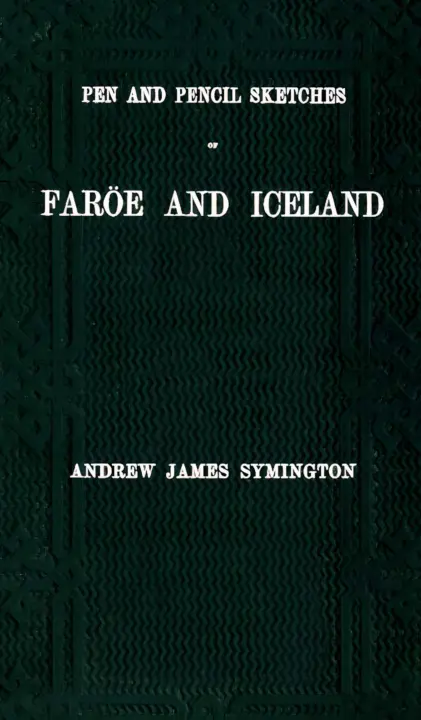
"Pen and Pencil Sketches of Faröe and Iceland" by Andrew James Symington is a travelogue written in the mid-19th century. This work combines personal diary entries with observations made during Symington's journey to the remote islands of Faröe and Iceland, aiming to capture the natural beauty and cultural richness of these northern climes. The book features sketches and insights about Icelandic life, landscapes, and the author's interactions with local inhabitants, all presented in an engaging and picturesque style. The opening portion of the travelogue introduces readers to Symington's preparations for his voyage to Iceland, detailing his contemplation of different travel options and the eventual choice to board the mail steamer "Arcturus." He vividly describes the ship's departure from Leith, the atmosphere on board with fellow passengers, and his feelings of anticipation and wonder as they journey through the North Sea. In addition, Symington begins to share his impressions of the landscapes, local life, and the natural phenomena that characterize both Faröe and Iceland, setting the stage for a rich exploration of these extraordinary places throughout the remainder of his narrative.
Introduction adapted from the source catalogue; source summaries may be automatically generated.
Free to read · English · 85,163 words · No account needed
MAKE TIME FOR A GOOD BOOK
On by default. Untick to stop anonymous reading totals. Each page counts after 10 seconds in view. How this works.
Anonymous counting is on unless you have switched it off.
Away to the north-west, bounding this icy region on the west, rises Skaptár Jökul, by far the most destructive volcano in the island.[33] And “in no part of the world,” remarks Dr. Lindsay, “are volcano phenomena on so gigantic a scale as in Iceland. In it there are lava streams fifty miles long, twelve to fifteen miles broad and six hundred feet deep. Portions of these streams sometimes form hills as high as Arthur’s Seat or Salisbury Crags; and such is the persistence of the heat, that rents in the lava have been found still smoking, or filled with hot water, so long as eleven years after an eruption. In no part of the world of the same extent, are there so many widely separate vents or foci—about twenty—of subterranean igneous action. The boiling springs which are most numerous, show of themselves that such action is going on under the whole island. The calculations of Professor Bischoff show, that the mass of lava thrown up by the eruption of Skaptár Jökul, A.D. 1783, was greater in bulk than Mont Blanc. A larger mass of lava by far, than was ever thrown out from a single volcano, at any time, in any part of the world.”
As a particular example of the ravages produced by these terrible convulsions of nature may give the reader a clearer and more vivid idea of their action, than any general description, we shall select the
in 1783; it having been not only very violent, but the one of which we possess the fullest and most authentic accounts.
“The preceding winter and the spring of that year had been unusually mild, and nothing seemed to foretell the approaching danger, till towards the end of May, when a light bluish fog was seen floating along the ground, succeeded in the beginning of June by earthquakes, which daily increased in violence till the 8th of that month. At nine in the morning of that day numerous pillars of smoke were noticed rising in the hill country towards the north, which, gradually gathering into a dark bank, obscured the atmosphere, and proceeding in a southerly direction against the wind, involved the whole district of Sida in darkness, showering down sand and ashes to the thickness of an inch. This cloud continued to increase till the 10th, when fire-spouts were observed in the mountains, accompanied by earthquakes. Next day the large river Skaptaá, which in the spring had discharged a vast quantity of fetid water, mixed with gravel or dust, and had lately been much swollen, totally disappeared. This incident was fully accounted for on the 12th, when a huge current of lava, burst from one side of the volcano, and rushed with a loud crashing noise down the channel of the river, which it not only filled, but even overflowed, though in many places from four to six hundred feet deep and two hundred broad. The fiery stream after leaving the hills, threatened to deluge the low country of Medalland, when a lake that lay in its way intercepted it during several days. But at length the incessant torrents filled the basin, and proceeded in two streams, one to the east, where its progress was for a short time interrupted by the Skalarfiall, up which, however, the accumulating flood soon forced its way, rolling the mossy covering over the mountain before it like a large piece of cloth. The other current directed its progress towards the south, through the district of Medalland, passing over some old tracts of lava, which again began to burn, whilst the air in its cavities escaped with a strange whistling noise, or suddenly expanding, threw up immense masses into the air to the height of more than 120 feet. The waters of the rivers, swollen by the melting of the Jökuls in the interior, and intercepted in their course by the glowing lava, were thrown into a state of violent ebullition, and destroyed many spots spared by the fire. In this district, the liquid matter continued to flow to the 20th of July, following principally the course of the Skaptaá, where it poured over the lofty cataract of Stapafoss, filling up the enormous cavity the waters had been hollowing out for ages. During the whole of this eruption, the atmosphere was filled with mephitic vapours, or darkened with clouds of ashes, by which the sun was either concealed from the miserable inhabitants, or appeared like a blood-red globe, adding to their terror and consternation.
Your reading position is saved on this browser. Take it to another device with a library code. Reading pages adapt to text, rather than matching a printed edition.
BEHIND THE BOOK
This eBook is for the use of anyone anywhere in the United States and most other parts of the world at no cost and with almost no restrictions whatsoever. You may copy it, give it away or re-use it under the terms of the Project Gutenberg License included with this eBook or online at www.gutenberg.org. If you are not located in the United States, you will have to check the laws of the country where you are located before using this eBook. Read the source licence.
The original source file, including credits and licence, is retained by this library. Request an original-format copy at no charge. Please include the book title and Project Gutenberg identifier #71936.
KEEP YOUR CURIOSITY GOING
Wilfrid Scawen Blunt
Wilfrid Scawen Blunt

E. W. (Edgar Watson) Howe

Maurice Baring
Francis Greenleaf Allinson & Anne C. E. (Anne Crosby Emery) Allinson
Cyrenus Cole