THE CLASSIC COLLECTION✦My diaries, being a personal narrative of events 1888-1914, Part 2 (1900-1914)CLASSIC FREE BOOKS
My diaries, being a personal narrative of events 1888-1914, Part 2 (1900-1914)
Wilfrid Scawen Blunt
THE CLASSIC COLLECTION · 1862
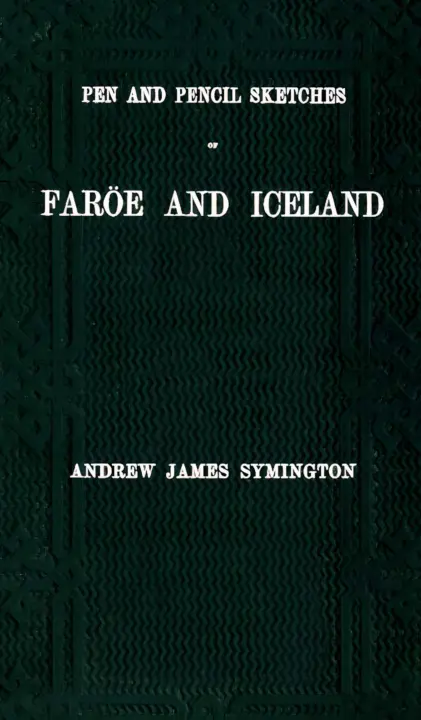
"Pen and Pencil Sketches of Faröe and Iceland" by Andrew James Symington is a travelogue written in the mid-19th century. This work combines personal diary entries with observations made during Symington's journey to the remote islands of Faröe and Iceland, aiming to capture the natural beauty and cultural richness of these northern climes. The book features sketches and insights about Icelandic life, landscapes, and the author's interactions with local inhabitants, all presented in an engaging and picturesque style. The opening portion of the travelogue introduces readers to Symington's preparations for his voyage to Iceland, detailing his contemplation of different travel options and the eventual choice to board the mail steamer "Arcturus." He vividly describes the ship's departure from Leith, the atmosphere on board with fellow passengers, and his feelings of anticipation and wonder as they journey through the North Sea. In addition, Symington begins to share his impressions of the landscapes, local life, and the natural phenomena that characterize both Faröe and Iceland, setting the stage for a rich exploration of these extraordinary places throughout the remainder of his narrative.
Introduction adapted from the source catalogue; source summaries may be automatically generated.
Free to read · English · 85,163 words · No account needed
MAKE TIME FOR A GOOD BOOK
On by default. Untick to stop anonymous reading totals. Each page counts after 10 seconds in view. How this works.
Anonymous counting is on unless you have switched it off.
The sixth, A.D. 1416. The lava or water-floods took the direction of Hjörleifshöfdi, an isolated hill and promontory on the coast of the Myrdals-sand, considerably to the south-east of Kötlugjá.
The seventh, A.D. 1580. During this eruption it is stated that Myrdals Jökul was rent asunder, and as the name Kötlugjá is now first given to the crater or fissure of eruption, it is probable that at this date the chasm was first recognised or discovered, if not formed. This eruption was characterized by fire, darkness, and a rain of ashes, as well as by water-floods; one of which latter went eastward toward the monastery of Thyckvaboe, and another southward to Myrdal. Many farms were destroyed, but there appears to have been no loss of human life.
The eighth, in 1612, was attended, it is conjectured, by a subsidence to some extent of the Fall-Jökul, which is situated between Eyafialla and Myrdals Jökul, as well as of the lower lands between Langanes and Thorsmerkr. The accompanying fire was such, that the eruption was visible extensively in the north of Iceland.
The ninth, in A.D. 1625, was “one of the grandest and most devastating eruptions of Kötlugjá that has ever occurred.” Its historian is Thorsteinn Magnússon, at the time sysselman or sheriff of Skaptafells-syssel (or district), who lived in the monastery of Thyckvaboe. His account was published in Copenhagen in A.D. 1627. According to him, ‘at daybreak on the second of September it began to thunder in the Jökul; and about 8 o’clock A.M. floods of water and ice were poured down upon the low country, and carried away upwards of 200 loads of hay[23] which lay in the fields about Thyckvaboe. These floods continued to be poured forth like a raging sea till past one o’clock in the afternoon, when they gradually diminished, but were succeeded by terrible darkness, earthquakes, thunder, flames, and showers of sand. Nor was it in the immediate vicinity of the crater alone that the fire appeared, but down in the inhabited tract, at the distance of nearly twenty miles from the mountain, igneous vapours were seen attaching themselves to the clothes of the inhabitants. (?) This dreadful scene continued, with little variation, till the 13th of the month. It was frequently so clear at night that the mountains, with all their clefts and divisions, were seen as distinctly at the distance of twenty miles as they were in the clearest day. Sometimes the flames were pure as the sun, sometimes they were red, and at others they discovered all the colours of the rainbow. The lightenings were visible now in the air, and now running over the surface of the ground; and such as witnessed them were more or less affected in such parts of their bodies as were uncovered. [!] These flashes were accompanied by the loudest claps of thunder, and darted backwards and forwards; now to the ground, and now into the air, dividing sometimes into separate bolts, each of which appeared to be followed by a separate report; and after shooting in different directions, they instantly collected again, when a dreadful report was heard, and the igneous appearance fell like a waterspout to the ground, and became invisible. While the showers of sand lasted, it was frequently so dark in the day time that two individuals holding each other by the hand could not discover each other’s face.’ Dr. Hjaltalin states that the water-floods, bearing large masses of ice, ‘surrounded the monastery of Thyckvaboe, with its adjacent farms, one of which was overflowed by the stream; but the people saved themselves on a high hill, where the flood could not reach them. The flood was followed by such heavy shots and continual thunder, that the people thought the heavens would burst to pieces, and they were surrounded with continual flashes of lightning. The pasturages were so covered with ashes and pumice, that cattle, horses, and sheep could not get any food, and were seen running about in wild confusion. During the eruption such a darkness prevailed sometimes that days were darker than nights; and it is related that showers of ashes from this eruption reached the town of Bergen in Norway, which is the greatest distance to which volcanic ashes were ever thrown from Iceland.’ The account in the ‘Islendingur’ of June 16, p. 45, mentions further, that the mixed water and ice flood flowed in cascades and waves over Myrdals-sand; that the inhabitants fled to the heights for safety; that the depth of the water-flood, which surrounded the monastery of Thyckvaboe, was such that a large ocean-vessel might have sailed between the byres and the principal building, and that there was an excessive falling of sand in the district to the north-east of Kötlugjá, called the Skaptártunga. This eruption thus lasted for about twelve days, wholly destroying many farms, and partially destroying or rendering temporarily useless others. The damage done was greatest in the low lands to east, north-east, and south-east of Kötlugjá.
Your reading position is saved on this browser. Take it to another device with a library code. Reading pages adapt to text, rather than matching a printed edition.
BEHIND THE BOOK
This eBook is for the use of anyone anywhere in the United States and most other parts of the world at no cost and with almost no restrictions whatsoever. You may copy it, give it away or re-use it under the terms of the Project Gutenberg License included with this eBook or online at www.gutenberg.org. If you are not located in the United States, you will have to check the laws of the country where you are located before using this eBook. Read the source licence.
The original source file, including credits and licence, is retained by this library. Request an original-format copy at no charge. Please include the book title and Project Gutenberg identifier #71936.
KEEP YOUR CURIOSITY GOING
Wilfrid Scawen Blunt
Wilfrid Scawen Blunt

E. W. (Edgar Watson) Howe

Maurice Baring
Francis Greenleaf Allinson & Anne C. E. (Anne Crosby Emery) Allinson
Cyrenus Cole