THE CLASSIC COLLECTION✦Unwritten Literature of Hawaii: The Sacred Songs of the HulaCLASSIC FREE BOOKS
Unwritten Literature of Hawaii: The Sacred Songs of the Hula
Nathaniel Bright Emerson
THE CLASSIC COLLECTION · 1915
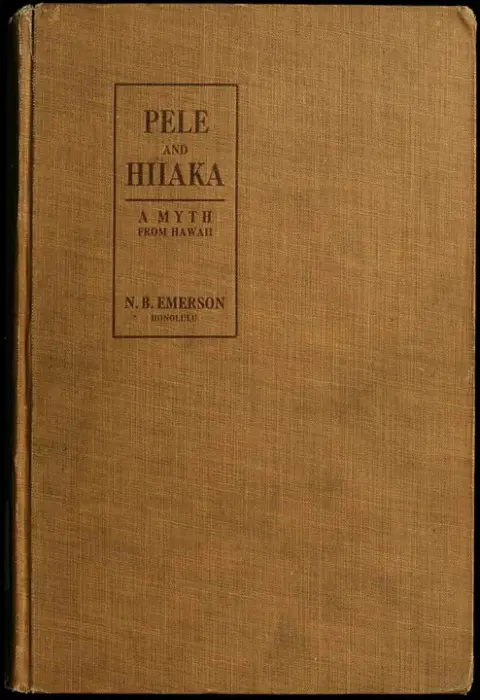
"Pele and Hiiaka: A Myth From Hawaii" by Nathaniel Bright Emerson is a collection of Hawaiian myths and folklore written in the early 20th century. The narrative centers around the volcanic goddess Pele and her sister Hiiaka, delving into their familial relationships and adventures as they traverse the islands of Hawaii. This rich tapestry of myth captures not only the essence of Hawaiian culture and beliefs but also highlights the complexities of love, duty, and rivalry among its characters. The opening of the work introduces us to the world of Pele, the fire goddess, and her kin, particularly focusing on Hiiaka, who becomes a central figure in the unfolding narrative. It begins with Pele awakening in the crater of Kilauea, suggesting her dominance and connection to the land. As she ventures with her sisters to enjoy the ocean, Hiiaka impresses everyone with her talent in song and dance, gaining crucial attention from Pele. The chapter sets the stage for Hiiaka's eventual mission to retrieve her beloved Lohiau, showcasing the themes of loyalty and the trials that will follow in their mythical journey. The rich language and vivid descriptions draw the reader into a captivating narrative infused with the spirit of Hawaiian mythology.
Introduction adapted from the source catalogue; source summaries may be automatically generated.
Free to read · English · 79,938 words · No account needed
MAKE TIME FOR A GOOD BOOK
On by default. Untick to stop anonymous reading totals. Each page counts after 10 seconds in view. How this works.
Anonymous counting is on unless you have switched it off.
[84] Ua, literally, rain, is by a much employed figure of speech used to mean the guests or people of a house. Thus, if one sees a great number of guests arriving to share the hospitality of a house, he might say, "kuaua ua nui ho'i keia e hele mai nei."
[85] Pua-lehei, a pali mauka of Wai-he'e.
[86] Olohe, an expert in the hula.
[87] Aoaoa, an imitative word, meaning dog.
[88] The most acceptable bonne bouche that could be offered to Pele, or to Hiiaka, by way of refreshment, was the tender leaf of the taro plant. We of this day and generation eat it when cooked under the name of lu-au. In the old old times, when the gods walked on the earth, it was acceptable in the raw state under the name of paha; but, when cooked, it was called pe'u. The word luau seems to be modern.
[89] Po'ipo'i. Po'i uhane, soul catching, was one of the tricks of Hawaiian black art and sorcery.
[90] There seems to be a disagreement in the different versions as to who is the king with whom Hiiaka is now contending, whether Ole-pau or Ka-ula-hea. For historical reasons I deem it to be Ole-pau, unless, indeed, the two names represent the same person.
[91] Kau, offered, literally put upon the altar.
[92] Lohelohe. By some inadvertence, this word was wrongly written as kohekohe, and I was cudgelling my wits and searching heaven and earth, and all the dictionaries, to learn the meaning of this artifact, this false thing. After having vainly inquired of more than a score of Hawaiians, one man, wiser than the rest, suggested that it should be lohelohe, not kohekohe, meaning underdone, or half-baked dog. The word-fit was perfect; the puzzle was solved.
[93] Kanaloa, a name given to Kaho'olawe, the island that faces East Maui, lying opposite to Lahaina, and acts as a sort of buffer against the blasts of the south wind, allusion to which is made, as I believe, in the word A-a, in the same line.
[94] Ele. Some critics claim that ka and ele properly form one word (kaele), meaning overturned. The grammatical construction of the sentence forbids this claim, and favors the interpretation I have given it. The figure is that of a canoe whose black body has turned turtle.
[95] Pa'iauma. This is a word that has presented some difficulties in the discovery of its meaning. The reference, I believe, is to breast-beating practiced by persons distracted with grief. Uma, the final part of the word, I take to be the shortened form of umauma, the bosom.
[96] Pili, to meet, the point or line of meeting, the boundaries of a land, therefore, the whole land.
Your reading position is saved on this browser. Take it to another device with a library code. Reading pages adapt to text, rather than matching a printed edition.
BEHIND THE BOOK
This eBook is for the use of anyone anywhere in the United States and most other parts of the world at no cost and with almost no restrictions whatsoever. You may copy it, give it away or re-use it under the terms of the Project Gutenberg License included with this eBook or online at www.gutenberg.org. If you are not located in the United States, you will have to check the laws of the country where you are located before using this eBook. Read the source licence.
The original source file, including credits and licence, is retained by this library. Request an original-format copy at no charge. Please include the book title and Project Gutenberg identifier #60279.
KEEP YOUR CURIOSITY GOING

Maurice Baring
Francis Greenleaf Allinson & Anne C. E. (Anne Crosby Emery) Allinson
Stuart Dodgson Collingwood
Percy Keese Fitzhugh
Mary Macleod & Edmund Spenser

Cooke Don-Carlos