THE CLASSIC COLLECTION✦Unwritten Literature of Hawaii: The Sacred Songs of the HulaCLASSIC FREE BOOKS
Unwritten Literature of Hawaii: The Sacred Songs of the Hula
Nathaniel Bright Emerson
THE CLASSIC COLLECTION · 1915
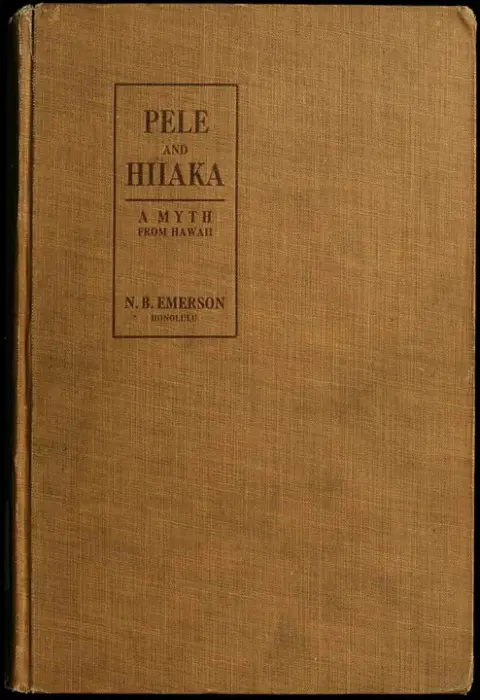
"Pele and Hiiaka: A Myth From Hawaii" by Nathaniel Bright Emerson is a collection of Hawaiian myths and folklore written in the early 20th century. The narrative centers around the volcanic goddess Pele and her sister Hiiaka, delving into their familial relationships and adventures as they traverse the islands of Hawaii. This rich tapestry of myth captures not only the essence of Hawaiian culture and beliefs but also highlights the complexities of love, duty, and rivalry among its characters. The opening of the work introduces us to the world of Pele, the fire goddess, and her kin, particularly focusing on Hiiaka, who becomes a central figure in the unfolding narrative. It begins with Pele awakening in the crater of Kilauea, suggesting her dominance and connection to the land. As she ventures with her sisters to enjoy the ocean, Hiiaka impresses everyone with her talent in song and dance, gaining crucial attention from Pele. The chapter sets the stage for Hiiaka's eventual mission to retrieve her beloved Lohiau, showcasing the themes of loyalty and the trials that will follow in their mythical journey. The rich language and vivid descriptions draw the reader into a captivating narrative infused with the spirit of Hawaiian mythology.
Introduction adapted from the source catalogue; source summaries may be automatically generated.
Free to read · English · 79,938 words · No account needed
MAKE TIME FOR A GOOD BOOK
On by default. Untick to stop anonymous reading totals. Each page counts after 10 seconds in view. How this works.
Anonymous counting is on unless you have switched it off.
[67] Hinihini, a poetical name for a land-shell, probably one of the genus Achatinella, which was popularly believed to give a shrill piping note.
[68] Mapu, one of the trumpeters.
[69] Ale ula, a cloud of steam and smoke, such as accompanied an
eruption.
[70] Ale lani, the patches of blue sky between masses of clouds.
[71] Pu-ko'a, a column of steam and smoke bursting up from a volcanic
eruption.
[72] A'aka, a column of lapillae, accompanied by hot vapor and smoke, such as jet up from a volcanic crater or fissure.
[73] Lono, a message; to hear a message, i.e., to receive it. The expression ahu a lono is at first a little puzzling. It means the visible bulk, or sign, of the message.
[74] Au-hula-ana. This is the term applied to such a break in a seaside trail as is above described. The word hula indicates the billowy toss of the ocean or of the swimmer's body while making the passage. The term, following Hawaiian usage, is employed either as a noun or as a verb.
[75] Maka'u-kiu, afeared-o-a-spy.
[76] Ma-hi-ki (mahiti, mawhiti), to leap, to skip, to spring up suddenly. The Maori Comp. Dict. E. Tregear.
[77] Wai-luku, water of destruction.
[78] Mo'o-puna, a grandchild, nephew or niece.
[79] Kahuli-huli. Kahuli, or its intensive, kahuli-huli, primarily means to upset, to overturn. A secondary meaning, much employed in the argot of hula folk, is to hand over, to pass this way; as when one guest at table might say to a neighbor, "hand me the salt (if you please)."
[80] Nuku-o-ka-manu, literally, the beak of the bird; said to be a cape in the neighborhood of Hilo.
[81] Hala. The fruit of the hala was so often worn in the form of a wreath by Kapo that it came to be looked upon almost as her emblem. To ordinary mortals this practice savored of bad luck. If a fisherman traveling on his way to the ocean were to meet a person wearing a lei of this description he would feel compelled to turn back and give over his excursion for that day. In this instance Kapo was on her way to visit a sick man--a bad omen for him.
[82] Kapo-ula-kina'u. This was the full name of Kapo, who was one of the goddesses of the kahunas who practiced anaana (po'e kahuna anaana). Ula-kina'u is a term applied to a feather cloak or cape made of yellow feathers which had in them black spots.
[83] Makani. The reference is to the halitus, spirit, or influence that was supposed to rest upon and take possession of one obsessed, even as the tongues of fire rested upon the multitude in Pentecostal times. Kapo herself had this power.
Your reading position is saved on this browser. Take it to another device with a library code. Reading pages adapt to text, rather than matching a printed edition.
BEHIND THE BOOK
This eBook is for the use of anyone anywhere in the United States and most other parts of the world at no cost and with almost no restrictions whatsoever. You may copy it, give it away or re-use it under the terms of the Project Gutenberg License included with this eBook or online at www.gutenberg.org. If you are not located in the United States, you will have to check the laws of the country where you are located before using this eBook. Read the source licence.
The original source file, including credits and licence, is retained by this library. Request an original-format copy at no charge. Please include the book title and Project Gutenberg identifier #60279.
KEEP YOUR CURIOSITY GOING

Maurice Baring
Francis Greenleaf Allinson & Anne C. E. (Anne Crosby Emery) Allinson
Stuart Dodgson Collingwood
Percy Keese Fitzhugh
Mary Macleod & Edmund Spenser

Cooke Don-Carlos