THE CLASSIC COLLECTION✦Unwritten Literature of Hawaii: The Sacred Songs of the HulaCLASSIC FREE BOOKS
Unwritten Literature of Hawaii: The Sacred Songs of the Hula
Nathaniel Bright Emerson
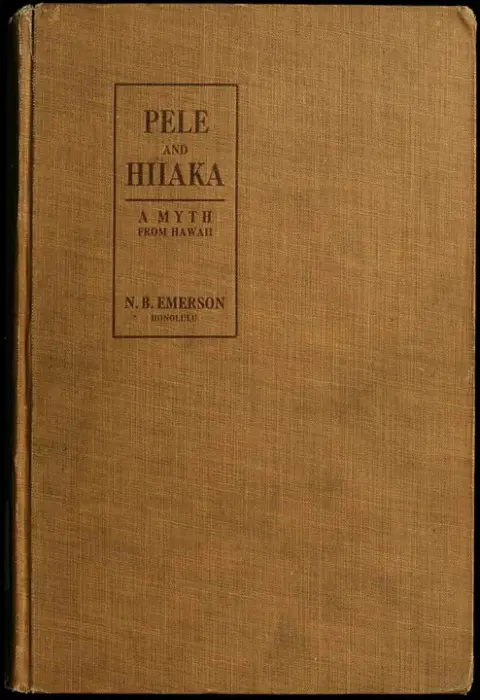
THE CLASSIC COLLECTION · 1915
"Pele and Hiiaka: A Myth From Hawaii" by Nathaniel Bright Emerson is a collection of Hawaiian myths and folklore written in the early 20th century. The narrative centers around the volcanic goddess Pele and her sister Hiiaka, delving into their familial relationships and adventures as they traverse the islands of Hawaii. This rich tapestry of myth captures not only the essence of Hawaiian culture and beliefs but also highlights the complexities of love, duty, and rivalry among its characters. The opening of the work introduces us to the world of Pele, the fire goddess, and her kin, particularly focusing on Hiiaka, who becomes a central figure in the unfolding narrative. It begins with Pele awakening in the crater of Kilauea, suggesting her dominance and connection to the land. As she ventures with her sisters to enjoy the ocean, Hiiaka impresses everyone with her talent in song and dance, gaining crucial attention from Pele. The chapter sets the stage for Hiiaka's eventual mission to retrieve her beloved Lohiau, showcasing the themes of loyalty and the trials that will follow in their mythical journey. The rich language and vivid descriptions draw the reader into a captivating narrative infused with the spirit of Hawaiian mythology.
Introduction adapted from the source catalogue; source summaries may be automatically generated.
Free to read · English · 79,938 words · No account needed
MAKE TIME FOR A GOOD BOOK
On by default. Untick to stop anonymous reading totals. Each page counts after 10 seconds in view. How this works.
Anonymous counting is on unless you have switched it off.
"Go back to Haena," said Pele, "and when you hear that Lohiau lives again, then will be the time for you to come and take him home."
"That would be well, then," said Paoa.
A spell of confusion, of enchantment, seemed now to fall upon the man whilom so boastful. "But where is Pele?" he asked, looking from face to face.
"That is Pele," said the goddess, pointing to her sister Wave
(Hiiaka-i-ka-ale-i).
"I have a sign by which I may know Pele; let me apply the test to
these women," said Paoa.
The company could but agree to this; whereupon, beginning with Wave, he took each one of them in turn by the hand, carrying it to his cheek, the better to test its warmth, holding the hollow to his ear to catch any murmur that might reverberate from it. Each hand he found to be only of natural heat. Turning, then, to Pele herself, he proposed to inspect her hand. At this the goddess drew back.
"If none of these beautiful women is Pele, how can you think that a wrinkled old woman like me is the divine and beautiful Pele?"
Paoa insisted and Pele had to consent. He reached out and took her hand and, on the instant, dropped it; it was burning hot.
"This is Pele!" he exclaimed.
Paoa stood in awed silence before the goddess. Resentment and thoughts of revenge, like evil birds, had taken flight.
At Pele's command, the women led him away to take refreshment in the sacred dining hall of Mauli-ola. Before seating himself, Paoa uttered this memorable pule, a mele that has drifted down to us from the wa po:
Hulihia ke au, ka papa honua o kona moku;
Hulihia, kulia mai ka moku o Kahiki--
Aina no Kahiki i ka la kahi,
Aina ho'owali'a e Haumea:
Ho-omoe aku la Kahiki-ku,
Kulapa mai ka ulu wela, o mai ke ahi.
Keehi aku la no e nalo [494] kapua'i, e--
Kapua'i akua no Pele.
Ke ke'ekeehi wale la no i ka lani;
Haule, u'ina i Polapola;
Noho i ka lau ha'a o ka moku.
Hina Kukulu o Kahiki;
Hina ka omuku i ka makani;
Hina ka pae opua ki'i ke ao;
Hina ka onohi ula [495] i ka lani;
Kanewenewe opua i ke kai.
Eä mai ana ma Nihoa,
Ma ka mole mai o Lehua,
Mai Kaua'i nui a Oahu, a Moloka'i,
Lana'i a Kanaloa, mai Maui a Hawaii,
Ka Wahine--o Pele--i hi'a i kana ahi
A á pulupulu, kukuni, wela ka lani:
He uwila ku'i no ka honua;
Hekili pa'apa'ina i ke ao;
Pohaku puoho, lele iluna;
Opa'ipa'i wale ka Mauna;
Pipili ka lani, pa'a iä moku.
Nalo Hawaii i ka uahi a ka Wahine,
I ka lili a ke Akua.
Oliliku ka ua mai ka lani;
Lili ana ho'i i kana ahi;
Lili ana ho'i Pele
Hama-hamau ka leo, mai pane!
Eia Pele, ko'u Akua!
Ke lauwili nei ka makani;
Hoanoano mai ana na eho lapa uwila;
Hekili wawahi ka lani;
Ku loloku ka ua i uka;
Ku'i ka hekili, nei ke ola'i;
Lele kapu i kai. [496]
Hiki lele ai i lalo o Kane-lu-honua.
O Kane-pua-hiöhiö, wili,--
Wili ia i uka, wili ia i kai;
Wili ia i luna, wili ia i lalo;
Wili ia i ka uä,
I ka hoöle akua, hoöle mana-- [497]
Ka ho'o-malau, [498] e, ka ho'o-maloka; [499]
Ke A-papa-nu'u, [500] ke A-papa-lani. [501]
O Mano-ka-lani-po, [502] o ke aka lei-hulu--
Hulu o manu kiü, o manu ahiahi;
O manu aha'i lono:--
Ha'ina a'e ana ka mana o ko'u Akua
Iwaho nei la, e; ha'ina ho'i!
Kukulu ka pahu kapu a ka leo: [503]
He ala [504] hele, he ala muku,
No Kane, laua o Kanaloa;
He ki [505] ho'iho'i kanawai;
He kai [506] oki'a kanawai;
He kua [507] a kanawai --
No Pele, no ko'u Akua, la!
Your reading position is saved on this browser. Take it to another device with a library code. Reading pages adapt to text, rather than matching a printed edition.
BEHIND THE BOOK
This eBook is for the use of anyone anywhere in the United States and most other parts of the world at no cost and with almost no restrictions whatsoever. You may copy it, give it away or re-use it under the terms of the Project Gutenberg License included with this eBook or online at www.gutenberg.org. If you are not located in the United States, you will have to check the laws of the country where you are located before using this eBook. Read the source licence.
The original source file, including credits and licence, is retained by this library. Request an original-format copy at no charge. Please include the book title and Project Gutenberg identifier #60279.
KEEP YOUR CURIOSITY GOING

Maurice Baring
Francis Greenleaf Allinson & Anne C. E. (Anne Crosby Emery) Allinson
Stuart Dodgson Collingwood
Percy Keese Fitzhugh
Mary Macleod & Edmund Spenser

Cooke Don-Carlos