THE CLASSIC COLLECTION✦Unwritten Literature of Hawaii: The Sacred Songs of the HulaCLASSIC FREE BOOKS
Unwritten Literature of Hawaii: The Sacred Songs of the Hula
Nathaniel Bright Emerson
THE CLASSIC COLLECTION · 1915
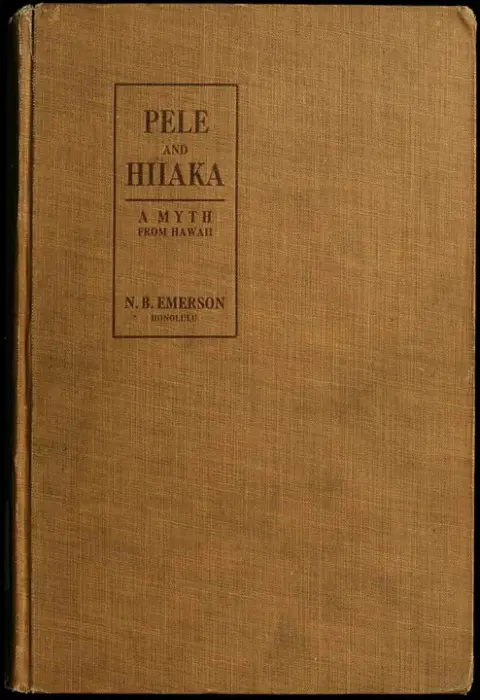
"Pele and Hiiaka: A Myth From Hawaii" by Nathaniel Bright Emerson is a collection of Hawaiian myths and folklore written in the early 20th century. The narrative centers around the volcanic goddess Pele and her sister Hiiaka, delving into their familial relationships and adventures as they traverse the islands of Hawaii. This rich tapestry of myth captures not only the essence of Hawaiian culture and beliefs but also highlights the complexities of love, duty, and rivalry among its characters. The opening of the work introduces us to the world of Pele, the fire goddess, and her kin, particularly focusing on Hiiaka, who becomes a central figure in the unfolding narrative. It begins with Pele awakening in the crater of Kilauea, suggesting her dominance and connection to the land. As she ventures with her sisters to enjoy the ocean, Hiiaka impresses everyone with her talent in song and dance, gaining crucial attention from Pele. The chapter sets the stage for Hiiaka's eventual mission to retrieve her beloved Lohiau, showcasing the themes of loyalty and the trials that will follow in their mythical journey. The rich language and vivid descriptions draw the reader into a captivating narrative infused with the spirit of Hawaiian mythology.
Introduction adapted from the source catalogue; source summaries may be automatically generated.
Free to read · English · 79,938 words · No account needed
MAKE TIME FOR A GOOD BOOK
On by default. Untick to stop anonymous reading totals. Each page counts after 10 seconds in view. How this works.
Anonymous counting is on unless you have switched it off.
Paoa, well versed in the wiles of Woman, adept in the logomachies and etiquettes of court-life, was quite put to his trumps and found it necessary to summon all his diplomacy and exercise all his power of self-command in dealing with the shrewd and attractive women that surrounded him. It was evident to the watchful eye of our heroine--Hiiaka--that he was dangerously attracted by the voluptuous beauty of her sister, Hiiaka-of-the-waves. In the persistent silence of Pele, upon her fell the leading part of the conversation with Paoa:
"What might be the purpose of your pilgrimage?" she asked.
"I come in answer to the call of my friend, Lohiau."
"But Lohiau is dead," chorused the women.
"Yes, dead! And what was the cause of his death?"
"He kissed Hiiaka," the woman answered.
"Ah! but who killed him?"
"Pele." Her voice sank to a whisper, and the name she uttered was to be made out, or guessed at, rather by a study of the protruding lips and the sympathetic arching of the brow than by any sound emitted. Her eyes also made a half-turn in the direction of Pele's cave.
"He came to Hawaii in the expectation that Pele would be his life." Paoa spoke with thoughtful deliberation. "How came it about that she should cause his death?" ... After a moment's pause, he continued: "He tasted death once at Haena and, now, again, here, on this barren ... a second death, and through the wrath of Pele!"
Pele roused herself at this and spoke up: "What is that you say? that
Lohiau died at Haena?"
"Yes, he tasted of death there," Paoa answered firmly.
"How, then, did he become alive again?" asked Pele sharply.
"Hiiaka, she treated him, and by her gracious skill and power brought
his soul and body together again. That done, they sailed away for
Hawaii."
The eyes of Pele were literally, as well as metaphorically, opened. She turned herself about and, in a lowered voice, with a show of astonishment, for the first time, addressed Hiiaka: "Is this true, that you worked over Lohiau and restored him to life?"
"It is true, and it is also true that, not until you had put to death Hopoe, did I bestow any dalliance or caress of love upon Lohiau."
Hiiaka's expression as she faced Pele was such as might have sat upon the countenance of a judge passing sentence on a confessed criminal at the bar.
Pele sat impenetrable, sphinxlike, deep in her own labyrinthine philosophy of the obligations due to a social autocrat and a goddess.
Paoa broke the silence: "Shall not Lohiau, then, live again?"
Your reading position is saved on this browser. Take it to another device with a library code. Reading pages adapt to text, rather than matching a printed edition.
BEHIND THE BOOK
This eBook is for the use of anyone anywhere in the United States and most other parts of the world at no cost and with almost no restrictions whatsoever. You may copy it, give it away or re-use it under the terms of the Project Gutenberg License included with this eBook or online at www.gutenberg.org. If you are not located in the United States, you will have to check the laws of the country where you are located before using this eBook. Read the source licence.
The original source file, including credits and licence, is retained by this library. Request an original-format copy at no charge. Please include the book title and Project Gutenberg identifier #60279.
KEEP YOUR CURIOSITY GOING

Maurice Baring
Francis Greenleaf Allinson & Anne C. E. (Anne Crosby Emery) Allinson
Stuart Dodgson Collingwood
Percy Keese Fitzhugh
Mary Macleod & Edmund Spenser

Cooke Don-Carlos