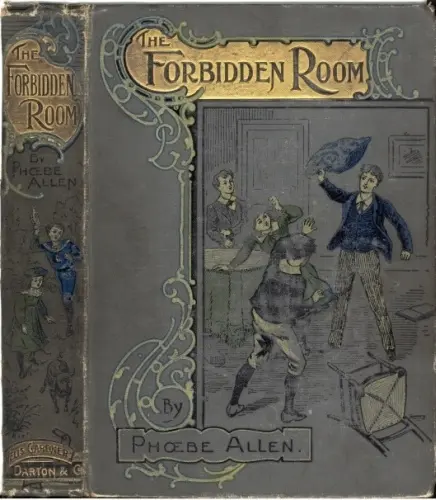
The Forbidden Room; Or, “Mine Answer was My Deed”
Phoebe Allen
THE CLASSIC COLLECTION · 1912
"Peeps at Heraldry" by Phoebe Allen is an educational work written in the early 20th century. This book serves as an introductory guide to heraldry, exploring the art of blazoning coats of arms and the significance of various heraldic symbols and colors. It aims to make the intricate subject accessible and engaging, detailing the fascinating connections between images, stories, and the history they convey. The opening of the book establishes heraldry as a unique language made up of pictorial signs, with a rich history tied to chivalry and military exploits. The author emphasizes the appeal of learning this art, promising that it is both interesting and amusing. Allen explains that heraldic devices act as markers to distinguish between families and individuals while also recounting the stories behind specific coats of arms. The introductory chapter sets the tone for the rest of the work, inviting readers to delve into the colorful and storied world of heraldry, where every symbol conveys a deeper meaning.
Introduction adapted from the source catalogue; source summaries may be automatically generated.
Free to read · English · 23,114 words · No account needed
MAKE TIME FOR A GOOD BOOK
On by default. Untick to stop anonymous reading totals. Each page counts after 10 seconds in view. How this works.
Anonymous counting is on unless you have switched it off.
As regards military flags, the cavalry standards--banners properly--are the true survivals of the knightly banners of the Middle Ages. The colour of the field repeats that of the regimental facings, and each standard bears the number, motto, and specific title of its own regiment, as well as its own heraldic badge. Upon these standards are also blazoned the regimental "honours," such as "Waterloo," "Alma," "Lucknow," thus commemorating the services rendered by that corps to their country.
Infantry regiments have their "colours," or, properly, pair of colours. One of these is the sovereign's colour, always crimson, displaying a Union Jack, charged with the regimental device; the other is the regimental colour, repeating the tincture of the facings. Upon this the "honours" and "devices" of the regiment are charged, whilst a small "jack" is cantoned on the dexter side of the flag.
The regimental "colours" of the Guards is the Union Jack.
The Royal Artillery have neither colours nor standards.
It would be curious to note the various forms of banners which have been in use since the days when the old Roman general hoisted a small truss of hay as his ensign, but surely one of the queerest flags that ever found its way into history was that displayed by our own Henry V., when, in 1420, he made his entry into Paris, riding between Charles VI. and Philippe, Duke of Burgundy. For then, we are told, that, amongst other banners, the English monarch bore a lance with a fox-tail attached to it, for being "a great hunter of foxes," this was his own personal badge.
Here we must close our "Peeps at Heraldry," but please, dear eyes, that have been peeping with me up to this point, do not close too.
Otherwise the object with which this little book has been written--namely, to open your eyes to the rudiments of heraldry, so that, having begun with a peep, you may go on to take an exhaustive view of the art and its developments--will be sadly defeated.
For this small volume pretends to be nothing more than a simple introduction, a path-finder, to that fascinating language, in which the golden deeds of chivalry and patriotism, of science and philanthropy, are kept alive from age to age in all quarters of the civilized world.
=Abased=, applied to a charge placed lower than its usual
position.
=Accollée=, side by side.
=Accrued=, fully grown.
=Achievement=, complete heraldic emblazonment.
=Addorsed=, back to back.
=Agroupment=, grouping of two or more shields to form one
achievement.
=Ailettes=, part of mail armour for protecting neck.
=Appaumée=, open hand, showing palm (Fig. 51).
=Arménie=, ermine.
Your reading position is saved on this browser. Take it to another device with a library code. Reading pages adapt to text, rather than matching a printed edition.
BEHIND THE BOOK
This eBook is for the use of anyone anywhere in the United States and most other parts of the world at no cost and with almost no restrictions whatsoever. You may copy it, give it away or re-use it under the terms of the Project Gutenberg License included with this eBook or online at www.gutenberg.org. If you are not located in the United States, you will have to check the laws of the country where you are located before using this eBook. Read the source licence.
The original source file, including credits and licence, is retained by this library. Request an original-format copy at no charge. Please include the book title and Project Gutenberg identifier #55439.
KEEP YOUR CURIOSITY GOING
Cécile Tormay

Moritz Busch
John L. Ransom
Frances Wright
Cécile Tormay

Mabel Potter Daggett