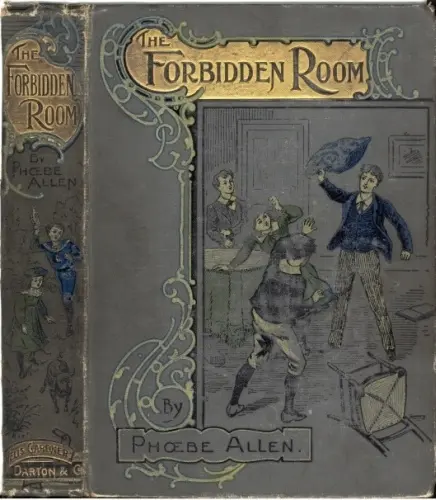
The Forbidden Room; Or, “Mine Answer was My Deed”
Phoebe Allen
THE CLASSIC COLLECTION · 1912
"Peeps at Heraldry" by Phoebe Allen is an educational work written in the early 20th century. This book serves as an introductory guide to heraldry, exploring the art of blazoning coats of arms and the significance of various heraldic symbols and colors. It aims to make the intricate subject accessible and engaging, detailing the fascinating connections between images, stories, and the history they convey. The opening of the book establishes heraldry as a unique language made up of pictorial signs, with a rich history tied to chivalry and military exploits. The author emphasizes the appeal of learning this art, promising that it is both interesting and amusing. Allen explains that heraldic devices act as markers to distinguish between families and individuals while also recounting the stories behind specific coats of arms. The introductory chapter sets the tone for the rest of the work, inviting readers to delve into the colorful and storied world of heraldry, where every symbol conveys a deeper meaning.
Introduction adapted from the source catalogue; source summaries may be automatically generated.
Free to read · English · 23,114 words · No account needed
MAKE TIME FOR A GOOD BOOK
On by default. Untick to stop anonymous reading totals. Each page counts after 10 seconds in view. How this works.
Anonymous counting is on unless you have switched it off.
One family of Palmers charges their shield with three palmer's staves; another has a pilgrim's scrip. The Spences bear three penny-pieces, this latter charge symbolizing commerce.
Workman's tools--pickaxes, hammers, levels, squares, hatchets, nails, plummets, etc.--had all great heraldic significance. The pickaxe was to remind its bearer "whence he was digged"; the level that his actions must be justified by the rule of reason and justice; the square taught the cultivation of an even judgment; the nails, fixity of purpose; the plummet, prudence in fathoming the problems of life.
The objects wrought by these tools follow. First, come works of
masonry.
One Oldcastle bears a "tower triple-towered"; Sir Edward Mansel, a tower with a scaling ladder against it; whilst three castles occur in the arms of the Scarborough family. The heralds, be it noted, made a great distinction between a tower and a castle, when charging either upon a shield. For, whereas a tower must never occupy the whole of the field, a castle "extendeth itself all over the shield from one side to the other." Three arches are borne by the Archers; the Trowbridges bear a bridge.
Keys occur fairly often, being borne either singly or in threes. The Bells very properly bear bells, and these latter we also find in the Dobell coat of arms, which affords an excellent example of canting heraldry (Fig. 53). One, Stratford, bears three trestles meant to imply their bearer's love of hospitality.
Amongst other inanimate charges are flesh-pots, bellows, lamps. The Lamplaws bear three lamps; cups are borne by Bowles, Warcupp, and Butler; dishes are borne by the Standish family (a boar's head in a golden dish was a rather favourite charge), as were also clocks, watches, dials, etc.
Next we find ships and all things pertaining to them.
The Earl of Caithness bears a ship; the Cavells bear three sails; the Chappels have an anchor. Three anchors are a fairly common charge.
Objects connected with hunting, hawking, and fishing come next. The Hatheways bear a hunter's horn; the Langhornes three bugles; the Plankes, three hawk-bells, whilst a lure with a line and ring, "all a falconer's decoy," are borne by one, Lie, "a suitable name, seeing that a falconer is ever used to deceive." Three mascles, representing the meshes of a net, are borne by the Belgraves, whilst a net enclosing three sturgeons is introduced into the Sturgeons' coat of arms, and is blazoned as a "fret." The Medvilles bear three fishing-hooks.
Now we come to objects associated with games--chessmen, dice, balls, etc. One of Charles V.'s generals bore as his arms a ball with two balloons, with the motto, "The harder I am struck, the higher I mount."
Your reading position is saved on this browser. Take it to another device with a library code. Reading pages adapt to text, rather than matching a printed edition.
BEHIND THE BOOK
This eBook is for the use of anyone anywhere in the United States and most other parts of the world at no cost and with almost no restrictions whatsoever. You may copy it, give it away or re-use it under the terms of the Project Gutenberg License included with this eBook or online at www.gutenberg.org. If you are not located in the United States, you will have to check the laws of the country where you are located before using this eBook. Read the source licence.
The original source file, including credits and licence, is retained by this library. Request an original-format copy at no charge. Please include the book title and Project Gutenberg identifier #55439.
KEEP YOUR CURIOSITY GOING
Cécile Tormay

Moritz Busch
John L. Ransom
Frances Wright
Cécile Tormay

Mabel Potter Daggett