THE CLASSIC COLLECTION✦An outlaw’s diary: the CommuneCLASSIC FREE BOOKS
An outlaw’s diary: the Commune
Cécile Tormay
THE CLASSIC COLLECTION · 1813
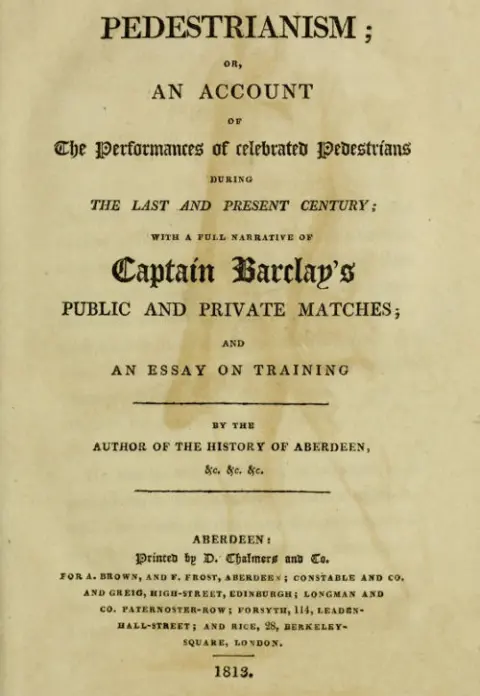
"Pedestrianism; or, An Account of the Performances of Celebrated Pedestrians…" by Walter Thom is a historical account written in the early 19th century. This work chronicles the remarkable feats of pedestrianism, particularly the public and private matches of Captain Barclay, while also offering insights into the physical training and capabilities of men during the recent and current centuries. The book focuses on the art of walking and running as a sport, exploring how these exercises were valued in both ancient and modern contexts. The opening of the book sets the stage by discussing the significance of gymnastic exercises in ancient Greece and their importance in fostering physical strength and agility essential for both sport and warfare. The author critiques contemporary military practices in Britain that neglect proper training and exercise for soldiers, arguing that adopting a regimen akin to the ancient Greek methods could enhance the physical readiness of troops. As the narrative progresses, it hints at a variety of pedestrian matches, promising a detailed account of the capabilities and triumphs of celebrated pedestrians, starting with Captain Barclay and his legendary performances.
Introduction adapted from the source catalogue; source summaries may be automatically generated.
Free to read · English · 45,055 words · No account needed
MAKE TIME FOR A GOOD BOOK
On by default. Untick to stop anonymous reading totals. Each page counts after 10 seconds in view. How this works.
Anonymous counting is on unless you have switched it off.
(5.) Alexander de Berkeley succeeded his father, Hugh, and to the paternal estates added Mathers, in consequence of his marrying Catharine, sister to William de Keith, marischal of Scotland, as vouched by a charter, dated anno 1351, granted by William de Keith, “with consent (as the deed expresses it) of Margaret, my wife, to Alexander de Berkeley, and Catharine, my sister, his spouse, and the longest liver of them two, and the heirs male of their bodies, my lands of Mathers, datum apud mansum capitale nostrum de Strathekin, die Martii inventione sanctæ crucis, anno 1351. Coram test. reverendo in Christo patr. Dom. Philippo, Dei gratia, Episc. Brechin. Dom. Willielmo eædem gratia Abbato de Aberbrothwick, David de Fleming, Willielmo de Liddel, militibus; Johan. de Seton, et aliis.” This charter is confirmed by King David Bruce, at Perth, the 18th of March, and twenty-first of his reign: coram test. Roberto seneschallo, nepote nostro, (the first king of Scotland of the Stewart race,) Tho. Seneschal, comite de Angus, Tho. de Moravii panacri nostro Scotiæ, Roberto de Erskine, et Tho. de Falside, militibus.
The original charter from William de Keith, and the confirmation by David Bruce, are both in the possession of Mr. Barclay of Ury.
(6.) David de Berkeley, 2d of Mathers, succeeded to his father Alexander; and he married the daughter of John de Seton, who witnessed the above charter from William de Keith. His son,
(7.) Alexander de Berkeley, 3d of Mathers, was his successor, and he married Helen, the daughter of Græme of Morphy. Their son,
(8.) David de Berkeley, 4th of Mathers, succeeding, built the castle, called the Keim of Mathers. He married Elisabeth, the daughter of Strachan of Thornton, then an ancient and flourishing family in the Mearns.
(9.) Alexander Barclay, 5th of Mathers, succeeded his father, David de Berkeley: and he was the first of the family who spelled the name as it is done at present. He married Catharine Wishart, the daughter of Wishart of Pitarrow, and was succeeded by his son,
(10.) David Barclay, 6th of Mathers, who married Janet, daughter of Irvine of Drum, then one of the most considerable families in the shire of Aberdeen. His eldest son was
(11.) Alexander Barclay, 7th of Mathers, who married Marjory, daughter of James Auchinleck of Glenbervie. Auchinleck obtained the estate of Glenbervie, by marrying the daughter of Melvil, the proprietor, who was sheriff of the Mearns, and murdered by the barons. James Auchinleck had two daughters, but no male heir; and the elder was married to Sir William Douglas, the second son of the famous Earl of Angus, called Bell the Cat. By this marriage, the Douglasses got the estate of Glenbervie.
Your reading position is saved on this browser. Take it to another device with a library code. Reading pages adapt to text, rather than matching a printed edition.
BEHIND THE BOOK
This eBook is for the use of anyone anywhere in the United States and most other parts of the world at no cost and with almost no restrictions whatsoever. You may copy it, give it away or re-use it under the terms of the Project Gutenberg License included with this eBook or online at www.gutenberg.org. If you are not located in the United States, you will have to check the laws of the country where you are located before using this eBook. Read the source licence.
The original source file, including credits and licence, is retained by this library. Request an original-format copy at no charge. Please include the book title and Project Gutenberg identifier #55644.
KEEP YOUR CURIOSITY GOING
Cécile Tormay

Moritz Busch
John L. Ransom
Frances Wright
Cécile Tormay

Mabel Potter Daggett