THE CLASSIC COLLECTION✦An outlaw’s diary: the CommuneCLASSIC FREE BOOKS
An outlaw’s diary: the Commune
Cécile Tormay
THE CLASSIC COLLECTION · 1813
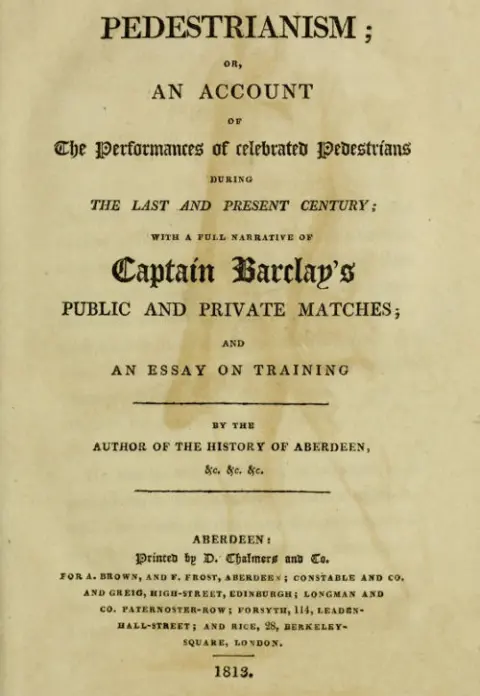
"Pedestrianism; or, An Account of the Performances of Celebrated Pedestrians…" by Walter Thom is a historical account written in the early 19th century. This work chronicles the remarkable feats of pedestrianism, particularly the public and private matches of Captain Barclay, while also offering insights into the physical training and capabilities of men during the recent and current centuries. The book focuses on the art of walking and running as a sport, exploring how these exercises were valued in both ancient and modern contexts. The opening of the book sets the stage by discussing the significance of gymnastic exercises in ancient Greece and their importance in fostering physical strength and agility essential for both sport and warfare. The author critiques contemporary military practices in Britain that neglect proper training and exercise for soldiers, arguing that adopting a regimen akin to the ancient Greek methods could enhance the physical readiness of troops. As the narrative progresses, it hints at a variety of pedestrian matches, promising a detailed account of the capabilities and triumphs of celebrated pedestrians, starting with Captain Barclay and his legendary performances.
Introduction adapted from the source catalogue; source summaries may be automatically generated.
Free to read · English · 45,055 words · No account needed
MAKE TIME FOR A GOOD BOOK
On by default. Untick to stop anonymous reading totals. Each page counts after 10 seconds in view. How this works.
Anonymous counting is on unless you have switched it off.
[1] Its height was sixty-eight feet; its breadth, ninety-five; and its length, two hundred and thirty.
[2] Pausanias, lib. v.
[3] Pausanias, lib. vi.
[4] West’s Dissertation on the Olympic Games, p. 61.
[5] West’s Dissertation, p. 176.
[6] West’s Dissertation.
[7] The odes of Pindar, which have been handed down to us, were made for
these occasions.
[8] Gillies’ History, vol. i. c. 6.
[9] West’s Diss., p. 243.
[10] Gillies’ Hist. chap. vi.
[11] Rollin, vol. v. p. 54.
[12] Dissertation on the Olympic Games, last paragraph.
[13] Edgeworth’s Essays on Professional Education, p. 166.
[14] Genuine Guide to Health.
[15] Chap. vii. p. 447.
[16] Code of Health, vol. i. p. 494.
[17] It is a curious fact remarked by Mr. Jackson, and founded on the experience of all swift runners, that “for the first two or three hundred yards one feels very much distressed, but after that a second wind comes, which lasts until one is spent with bodily fatigue.”--Code of Health, vol. ii. p. 100.
[18] See Appendix.
[19] A learned antiquary has obligingly communicated to the author the following etymon of the name Barclay:
“Barclay is a compound word, and pure Gaelic. Bar is borrowed from the Gaelic, and adopted into the English language. In both, the signification is the same, i. e. the bar or bolt of a door, gate, &c. Clay is the Gaelic Cladh, pronounced clay, and signifying a sword. Every one knows that Cladh Mor, pronounced Claymore, signifies the great or broad sword. As C and G are commutable letters in the Gaelic, it is generally written Cladh, though, sometimes Gladh. Gladh is the radix of the Latin Gladius; and Cladh, perhaps, of the Latin Clades. The name Barclay, then, literally imports, ‘The Bar Sword,’ or ‘Sword of Defence.’
“Previous to the use of gunpowder, when every thing depended on personal strength and individual exertion, the single arm of a hero often decided the fate of the battle. Many of our ancient families derived their names from feats of prowess; and there is no doubt that the Barclays received their name from some singular act of heroism performed with the sword.”
[20] Mr. Molyson has often walked thirty-six miles to breakfast, and thirty farther to dinner. He attended Capt. Barclay when he went to Dr. Grant’s house at Kirkmichael, in August 1800, (see page 108); and in less than three days walked one hundred and eighty miles, without sleeping during that time. Mr. Molyson was then forty-eight years of age; but his athletic powers are astonishing, and he is a true lover of gymnastic sports.
[21] See page 124.
[22] Code of Health, vol. ii. p. 118.
[23] Code of Health, vol. ii. p. 120.
[24] Ibid. p. 121.
[25] Code of Health, vol. ii. p. 84.
[26] Code of Health, vol. ii. p. 89.
Your reading position is saved on this browser. Take it to another device with a library code. Reading pages adapt to text, rather than matching a printed edition.
BEHIND THE BOOK
This eBook is for the use of anyone anywhere in the United States and most other parts of the world at no cost and with almost no restrictions whatsoever. You may copy it, give it away or re-use it under the terms of the Project Gutenberg License included with this eBook or online at www.gutenberg.org. If you are not located in the United States, you will have to check the laws of the country where you are located before using this eBook. Read the source licence.
The original source file, including credits and licence, is retained by this library. Request an original-format copy at no charge. Please include the book title and Project Gutenberg identifier #55644.
KEEP YOUR CURIOSITY GOING
Cécile Tormay

Moritz Busch
John L. Ransom
Frances Wright
Cécile Tormay

Mabel Potter Daggett