THE CLASSIC COLLECTION✦The Montessori Elementary Material The Advanced Montessori MethodCLASSIC FREE BOOKS
The Montessori Elementary Material The Advanced Montessori Method
Maria Montessori
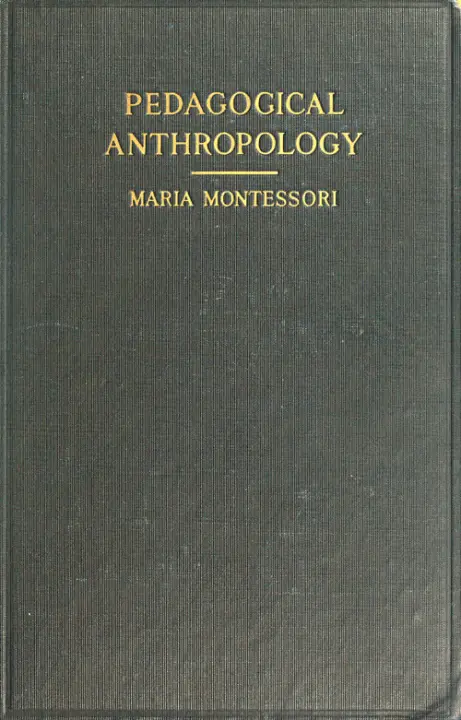
THE CLASSIC COLLECTION · 1913
"Pedagogical Anthropology" by Maria Montessori is a scientific publication written in the early 20th century. This work delves into the intersection of anthropology and pedagogy, aiming to establish a new educational philosophy based on the scientific study of human development. The text suggests a methodical approach to understanding individuals in an educational context, focusing on their physiological, psychological, and social characteristics. The beginning of the volume outlines Montessori's intent to define a new domain within anthropology that directly serves educational purposes. She emphasizes the importance of understanding human biology and variations to enhance pedagogical methods and improve education systems. In the preface, Montessori describes her lectures at the University of Rome, which form the foundation of the work, highlighting the crucial connection between scientific discovery and educational reform. She underscores the necessity of developing a science that can foster the improvement and moral evolution of humanity, thus framing education as an essential tool for societal transformation.
Introduction adapted from the source catalogue; source summaries may be automatically generated.
Free to read · English · 175,121 words · No account needed
MAKE TIME FOR A GOOD BOOK
On by default. Untick to stop anonymous reading totals. Each page counts after 10 seconds in view. How this works.
Anonymous counting is on unless you have switched it off.
Specific gravity, of body, 178
of brain, 229
Spirometry, 288-294, 385
Stature, 106-171
of abnormals, 167
according to sex, 80 et seq.
of American children, 128
brachyscelous type of, 75
cycle of, 363
definition of, 70, 106, 362
in relation to dimensions of thorax, 295-297
effect of nutrition on, 124-132
of erect position on, 120
of heat on, 132-136
essential, 73
mean average, of European, 459
growth in, during first year, 112-113
index of, 84, 366, 367
involution of, 114
of Italians, mean average, 392
Stature, Livi's charts of, 110-111
macroscelous type of, 76
maximums and minimums, compared
with cranial circumference, 238-242
measurement of, 362
parabolic curve of, 112, 114
pathological variations of, 145-170
of rachitic children, 165
racial limits of, 108-111
in relation to sex, 111-112
rhythm of, 86
summary of, 170-171
terminology of, 110
total, at different ages, 85
triennial rhythm of growth of, 113-114
types of, 67 et seq.
abnormal, 91
according to age, 81
in art, 80
according to race, 77
according to social conditions, 79
summary of, 105-106
variations in, according to age, 112-118
according to seasons, 138
due to mechanical causes of adaptation, 119-124
night and morning, 119
transitory, 120
Sterility of dwarfs and giants, 104
due to precocious marriage, 117
due to work in rice-fields, 121
Stigmata of degeneration, 342
among beggars, 348
among orphans, 348
Stimulants poisons for children, 127
Studious children, denutrition of, 185
physical inferiority of, 25, 159, 185, 293
Sun-baths, 137
Superiority, social, 258
of women, moral, 259
Suprarenal capsule, 152, 154
Surprise, expression of, 279-280
Syndactylism, 317
Syphilis, abortion due to, 157
symptoms of, 157-158
TASMANIAN, civilization of, 92-93
most macroscelous race, 77
Teacher of the future, the, 360
of abnormal pupils, 449
responsibility of the, 116
Teeth, anomalies of the, 336
first and second dentition, 336
Temperaments, De Giovanni's doctrine of, 12-14
Thermal gymnastics, 133-134
Thermic conditions of schools, 132-135
Thoracic index, 299
perimeter, 368
Thorax, the, 284-303
anatomical parts of, 284-286
anomalies of shape of, 301
descent of, 294
dimensions of, in relation to stature, 295, 297
growth of, 294
measurement of, 385
physiological importance of, 286
shape of, 299
triangulation of, 295
Thought, expression of, 280
Thymus gland, 152, 153
Thyroid gland, 152-153
Toe, opposable big, 311
Tongue, the, 338
Total spread of arms, 367
Tuberculosis, 291
Type of civilized man, 468
UVULA, double, 338
VERTEBRAL column, normal curves of, 107-108
Visage, index of, 263
normal, 262
Roman, 263
Vital index, 296, 368
Voice, education of the, 287-288
WARMTH, fallacy of demoralizing effect of, 133-134
Weight, the, 172-185, 368
of brain, 224
the, as exponent of health, 172
of new-born child, 172
of child, effect of too frequent pregnancy on, 173
of child, effect of mother's age on, 173
child's gain in, 174
and growth of separate organs, comparative, 180
child's loss in, significance of, 176
increase according to sex, 179
Women, fallacy of pretended cerebral inferiority of, 256
Wrinkles, anomalies of, 329
precocity of, 326, 329
Transcriber's Notes:
Simple spelling, grammar, and typographical errors were corrected.
Punctuation normalized.
Anachronistic and non-standard spellings retained as printed.
Simple division equations with numerators over denominators were reformatted as numerators/denominators. If multiple terms are involved then parenthesis were added, e.g. (numerator 1+numerator 2)/(denominator 1+denominator 2).
Your reading position is saved on this browser. Take it to another device with a library code. Reading pages adapt to text, rather than matching a printed edition.
Maria Montessori
Maria Montessori
Maria Montessori
BEHIND THE BOOK
This eBook is for the use of anyone anywhere in the United States and most other parts of the world at no cost and with almost no restrictions whatsoever. You may copy it, give it away or re-use it under the terms of the Project Gutenberg License included with this eBook or online at www.gutenberg.org. If you are not located in the United States, you will have to check the laws of the country where you are located before using this eBook. Read the source licence.
The original source file, including credits and licence, is retained by this library. Request an original-format copy at no charge. Please include the book title and Project Gutenberg identifier #46643.
KEEP YOUR CURIOSITY GOING

Charles G. (Charles Griffith) Ross
Hannah Webster Foster

Emily Lawless
Edwin Hamlin Carr

Charles De Lano Hine
Andrew Ure