THE CLASSIC COLLECTION✦A Christmas Carol The original manuscriptCLASSIC FREE BOOKS
A Christmas Carol The original manuscript
Charles Dickens
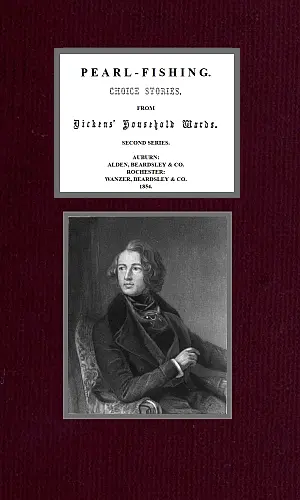
THE CLASSIC COLLECTION · 1854
"Pearl-Fishing; Choice Stories from Dickens' Household Words; Second Series" is a collection of short stories written in the mid-19th century. This anthology features tales that stem from Charles Dickens' literary magazine, "Household Words", combining social commentary with storytelling. The stories delve into various themes of morality, class, and personal ambition, exploring the human experience through a series of engaging narratives. The opening of this collection introduces us to "The Young Advocate," where we meet Antoine de Chaulieu, a down-and-out law student of noble descent, who finds himself pitted against his former schoolmate, Jacques Rollet. Their enmity is rooted in class rivalry and personal misfortunes. As Antoine rises to prominence in the legal world, he becomes embroiled in a high-profile murder trial where moral dilemmas and the search for justice intertwine. Antoine’s ambitions are put to the test, especially when he grapples with the implications of his actions on his conscience and personal relationships, particularly as he is about to marry the love of his life, Natalie de Bellefonds. This well-crafted narrative sets the stage for poignant explorations of ambition, guilt, and the true price of success.
Introduction adapted from the source catalogue; source summaries may be automatically generated.
Free to read · English · 63,059 words · No account needed
MAKE TIME FOR A GOOD BOOK
On by default. Untick to stop anonymous reading totals. Each page counts after 10 seconds in view. How this works.
Anonymous counting is on unless you have switched it off.
Ramin returned to the charge, heedless of the hint to depart. “The fact is, my good old friend, ready money is not my strong point just now. But if you wish very much to be relieved of the concern, what say you to a life annuity? I could manage that.”
Monsieur Bonelle gave a short, dry, churchyard cough, and looked as if his life were not worth an hour’s purchase. “You think yourself immensely clever, I dare say,” he said. “They have persuaded you that I am dying. Stuff! I shall bury you yet.”
The mercer glanced at the thin fragile frame, and exclaimed to himself, “Deluded old gentleman!” “My dear Bonelle,” he continued, aloud, “I know well the strength of your admirable constitution; but allow me to observe that you neglect yourself too much. Now, suppose a good sensible doctor--”
“Will you pay him?” interrogated Bonelle sharply.
“Most willingly,” replied Ramin, with an eagerness that made the old man smile. “As to the annuity, since the subject annoys you, we will talk of it some other time.”
“After you have heard the doctor’s report,” sneered Bonelle.
The mercer gave him a stealthy glance, which the old man’s keen look immediately detected. Neither could repress a smile; these good souls understood one another perfectly, and Ramin saw that this was not the Excellent Opportunity he desired, and departed.
The next day Ramin sent a neighboring medical man, and heard it was his opinion that if Bonelle held on for three months longer, it would be a miracle. Delightful news!
Several days elapsed, and although very anxious, Ramin assumed a careless air, and did not call upon his landlord, or take any notice of him. At the end of the week old Marguerite entered the shop to make a trifling purchase.
“And how are we getting on up-stairs?” negligently asked Monsieur Ramin.
“Worse and worse, my good Sir,” she sighed. “We have rheumatic pains, which make us often use expressions the reverse of Christian-like, and yet nothing can induce us to see either the lawyer or the priest; the gout is getting nearer to our stomach every day, and still we go on talking about the strength of our constitution. Oh, Sir, if you have any influence with us, do, pray do, tell us how wicked it is to die without making one’s will or confessing one’s sins.”
“I shall go up this very evening,” ambiguously replied Monsieur Ramin.
He kept his promise, and found Monsieur Bonelle in bed, groaning with pain, and in the worst of tempers.
Your reading position is saved on this browser. Take it to another device with a library code. Reading pages adapt to text, rather than matching a printed edition.
Charles Dickens
Samuel McChord Crothers & Charles Dickens

Rebecca Harding Davis & Thomas De Quincey & Charles Dickens & Nathaniel Hawthorne & Edward Bulwer Lytton, Baron Lytton & Edgar Allan Poe & Harriet Elizabeth Prescott Spofford

Charles Dickens
BEHIND THE BOOK
This eBook is for the use of anyone anywhere in the United States and most other parts of the world at no cost and with almost no restrictions whatsoever. You may copy it, give it away or re-use it under the terms of the Project Gutenberg License included with this eBook or online at www.gutenberg.org. If you are not located in the United States, you will have to check the laws of the country where you are located before using this eBook. Read the source licence.
The original source file, including credits and licence, is retained by this library. Request an original-format copy at no charge. Please include the book title and Project Gutenberg identifier #50334.
KEEP YOUR CURIOSITY GOING
Coulson Kernahan

Maurice Baring
Frances Wright
Cécile Tormay

Frederic Jesup Stimson

W. H. P. (William Henry Pope) Jarvis