THE CLASSIC COLLECTION✦A Christmas Carol The original manuscriptCLASSIC FREE BOOKS
A Christmas Carol The original manuscript
Charles Dickens
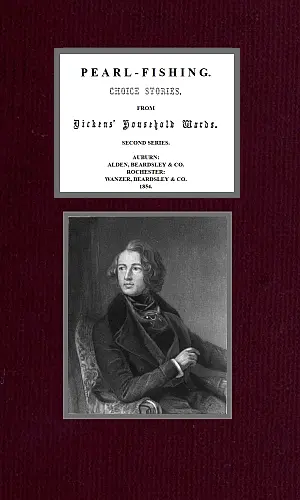
THE CLASSIC COLLECTION · 1854
"Pearl-Fishing; Choice Stories from Dickens' Household Words; Second Series" is a collection of short stories written in the mid-19th century. This anthology features tales that stem from Charles Dickens' literary magazine, "Household Words", combining social commentary with storytelling. The stories delve into various themes of morality, class, and personal ambition, exploring the human experience through a series of engaging narratives. The opening of this collection introduces us to "The Young Advocate," where we meet Antoine de Chaulieu, a down-and-out law student of noble descent, who finds himself pitted against his former schoolmate, Jacques Rollet. Their enmity is rooted in class rivalry and personal misfortunes. As Antoine rises to prominence in the legal world, he becomes embroiled in a high-profile murder trial where moral dilemmas and the search for justice intertwine. Antoine’s ambitions are put to the test, especially when he grapples with the implications of his actions on his conscience and personal relationships, particularly as he is about to marry the love of his life, Natalie de Bellefonds. This well-crafted narrative sets the stage for poignant explorations of ambition, guilt, and the true price of success.
Introduction adapted from the source catalogue; source summaries may be automatically generated.
Free to read · English · 63,059 words · No account needed
MAKE TIME FOR A GOOD BOOK
On by default. Untick to stop anonymous reading totals. Each page counts after 10 seconds in view. How this works.
Anonymous counting is on unless you have switched it off.
“Ramin,” said he, at length, laying his thin hand on the arm of his guest, and peering with his keen glance into the mercer’s purple face, “you are a funny fellow, but I know you; you cannot make me believe you have called just to see how I am, and to amuse me. Come, be candid for once; what do you want?”
Ramin threw himself back in his chair, and laughed blandly, as much as to say, “Can you suspect me?”
“I have no shop now out of which you can wheedle me,” continued the old man; “and surely you are not such a fool as to come to me for money.”
“Money?” repeated the draper, as if his host had mentioned something he never dreamt of. “Oh no!”
Ramin saw it would not do to broach the subject he had really come about, too abruptly, now that suspicion seemed so wide awake--the opportunity had not arrived.
“There is something up, Ramin, I know; I see it in the twinkle of your eye; but you can’t deceive me again.”
“Deceive you?” said the jolly schemer, shaking his head reverentially. “Deceive a man of your penetration and depth? Impossible! The bare supposition is flattery. My dear friend,” he continued, soothingly, “I did not dream of such a thing. The fact is, Bonelle, though they call me a jovial, careless, rattling dog, I have a conscience; and, somehow, I have never felt quite easy about the way in which I became your successor downstairs. It was rather sharp practice, I admit.”
Bonelle seemed to relent.
“Now for it,” said the Opportunity-hunter to himself--“By-the-by,” (speaking aloud,) “this house must be a great trouble to you in your present weak state? Two of your lodgers have lately gone away without paying--a great nuisance, especially to an invalid.”
“I tell you I’m as sound as a colt.”
“At all events, the whole concern must be a great bother to you. If I were you, I would sell the house.”
“And if I were you,” returned the landlord, dryly, “I would buy it--”
“Precisely,” interrupted the tenant, eagerly.
“That is, if you could get it. Phoo! I knew you were after something. Will you give eighty thousand francs for it?” abruptly asked Monsieur Bonelle.
“Eighty thousand francs!” echoed Ramin. “Do you take me for Louis Philippe or the Bank of France?”
“Then, we’ll say no more about it--are you not afraid of leaving your
shop so long?”
Your reading position is saved on this browser. Take it to another device with a library code. Reading pages adapt to text, rather than matching a printed edition.
Charles Dickens
Samuel McChord Crothers & Charles Dickens

Rebecca Harding Davis & Thomas De Quincey & Charles Dickens & Nathaniel Hawthorne & Edward Bulwer Lytton, Baron Lytton & Edgar Allan Poe & Harriet Elizabeth Prescott Spofford

Charles Dickens
BEHIND THE BOOK
This eBook is for the use of anyone anywhere in the United States and most other parts of the world at no cost and with almost no restrictions whatsoever. You may copy it, give it away or re-use it under the terms of the Project Gutenberg License included with this eBook or online at www.gutenberg.org. If you are not located in the United States, you will have to check the laws of the country where you are located before using this eBook. Read the source licence.
The original source file, including credits and licence, is retained by this library. Request an original-format copy at no charge. Please include the book title and Project Gutenberg identifier #50334.
KEEP YOUR CURIOSITY GOING
Coulson Kernahan

Maurice Baring
Frances Wright
Cécile Tormay

Frederic Jesup Stimson

W. H. P. (William Henry Pope) Jarvis