THE CLASSIC COLLECTION✦A Christmas Carol The original manuscriptCLASSIC FREE BOOKS
A Christmas Carol The original manuscript
Charles Dickens
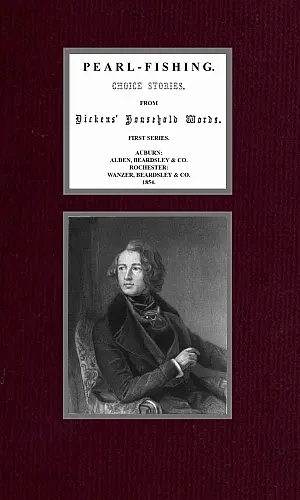
THE CLASSIC COLLECTION · 1854
"Pearl-Fishing; Choice Stories from Dickens' Household Words; First Series" is a collection of short stories compiled from the publication "Dickens’ Household Words," likely written in the mid-19th century. The stories reflect themes of human experience and emotion, with an emphasis on social commentary and moral lessons, typical of Charles Dickens’ work. The opening piece sets the tone, focusing on complex characters and their intertwined fates, particularly exploring the notions of love, deception, and societal expectations. The beginning of the collection introduces a narrative titled "Loaded Dice," where two friends, Mrs. Markham and her companion, embark on a journey to visit a place from their past. They discover the tragic backstory of Mr. Lovell, a clergyman who once enjoyed a simple life filled with contentment and love but is now engulfed in despair and loss. As the story unfolds, it reveals the detrimental impact of gambling on the family, leading to a tragic end for young Charles Lovell and deepening the overarching themes of sacrifice and the consequences of one's choices. The story establishes a glimpse into the emotional depths and social struggles that will be explored throughout the collection.
Introduction adapted from the source catalogue; source summaries may be automatically generated.
Free to read · English · 60,738 words · No account needed
MAKE TIME FOR A GOOD BOOK
On by default. Untick to stop anonymous reading totals. Each page counts after 10 seconds in view. How this works.
Anonymous counting is on unless you have switched it off.
“My dear Sir,” I replied, “let me be frank with you. I have arrived here unexpectedly out of another world. Of the manners and customs, nay, of the very nature of the people who inhabit this country, I know nothing. For any information you can give me, I shall be very grateful.”
My friend smiled incredulity, and said,
“Whatever you are pleased to profess, I will believe. What you are pleased to feign a wish for, I am proud to furnish. In Skitzland, the inhabitants, until they come of age, retain that illustrious appearance which you have been so fortunate as never to have lost. During the night of his twenty-first birthday, each Skitzlander loses the limbs which up to that period have received from him no care, no education. Of those neglected parts the skeletons alone remain, but all those organs which he has employed sufficiently continue unimpaired. I, for example, devoted to the study of the law, forgot all occupation but to think, to use my senses, and to write. I rarely used my legs, and therefore Nature has deprived me of them.”
“But,” I observed, “it seems that in Skitzland you are able to take yourselves to pieces.”
“No one has that power more largely than yourself. What organs we have we can detach on any service. When dispersed, a simple force of Nature directs all corresponding members whither to fly that they may re-assemble.”
“If they can fly,” I asked, “why are they sent in coaches? There were a pair of eyes on the box-seat.”
“Simply for safety against accidents. Eyes flying alone are likely to be seized by birds, and incur many dangers. They are sent, therefore, usually under protection, like any other valuable parcel.”
“Do many accidents occur?”
“Very few. For mutual protection, and also because a single member is often all that has been left existing of a fellow Skitzlander, our laws, as you, Sir, know much better than myself, estimate the destruction of any part absent on duty from its skeleton as a crime equivalent to murder----”
After this I held my tongue. Presently my friend again inquired whether
I was going up to Court?
“Why should I go to Court?”
“Oh, Sir, it pleases you to be facetious. You must be aware that any Skitzlander who has been left by Nature in possession of every limb, sits in the Assembly of the Perfect, or the Upper House, and receives many State emoluments and dignities.”
“Are there many members of that Upper Assembly?”
“Sir, there were forty-two. But if you are now travelling to claim your seat, the number will be raised to forty-three.”
“The Baron Terroro--” I hinted.
Your reading position is saved on this browser. Take it to another device with a library code. Reading pages adapt to text, rather than matching a printed edition.
Charles Dickens
Samuel McChord Crothers & Charles Dickens

Rebecca Harding Davis & Thomas De Quincey & Charles Dickens & Nathaniel Hawthorne & Edward Bulwer Lytton, Baron Lytton & Edgar Allan Poe & Harriet Elizabeth Prescott Spofford

Charles Dickens
BEHIND THE BOOK
This eBook is for the use of anyone anywhere in the United States and most other parts of the world at no cost and with almost no restrictions whatsoever. You may copy it, give it away or re-use it under the terms of the Project Gutenberg License included with this eBook or online at www.gutenberg.org. If you are not located in the United States, you will have to check the laws of the country where you are located before using this eBook. Read the source licence.
The original source file, including credits and licence, is retained by this library. Request an original-format copy at no charge. Please include the book title and Project Gutenberg identifier #49927.
KEEP YOUR CURIOSITY GOING
Coulson Kernahan

Maurice Baring
Frances Wright
Cécile Tormay

Frederic Jesup Stimson

W. H. P. (William Henry Pope) Jarvis