THE CLASSIC COLLECTION✦A Christmas Carol The original manuscriptCLASSIC FREE BOOKS
A Christmas Carol The original manuscript
Charles Dickens
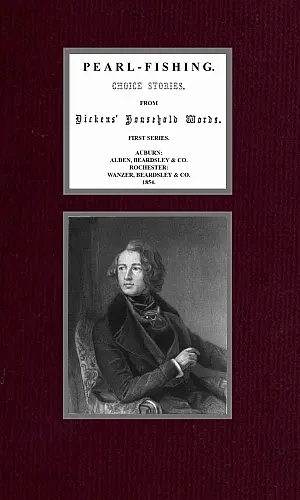
THE CLASSIC COLLECTION · 1854
"Pearl-Fishing; Choice Stories from Dickens' Household Words; First Series" is a collection of short stories compiled from the publication "Dickens’ Household Words," likely written in the mid-19th century. The stories reflect themes of human experience and emotion, with an emphasis on social commentary and moral lessons, typical of Charles Dickens’ work. The opening piece sets the tone, focusing on complex characters and their intertwined fates, particularly exploring the notions of love, deception, and societal expectations. The beginning of the collection introduces a narrative titled "Loaded Dice," where two friends, Mrs. Markham and her companion, embark on a journey to visit a place from their past. They discover the tragic backstory of Mr. Lovell, a clergyman who once enjoyed a simple life filled with contentment and love but is now engulfed in despair and loss. As the story unfolds, it reveals the detrimental impact of gambling on the family, leading to a tragic end for young Charles Lovell and deepening the overarching themes of sacrifice and the consequences of one's choices. The story establishes a glimpse into the emotional depths and social struggles that will be explored throughout the collection.
Introduction adapted from the source catalogue; source summaries may be automatically generated.
Free to read · English · 60,738 words · No account needed
MAKE TIME FOR A GOOD BOOK
On by default. Untick to stop anonymous reading totals. Each page counts after 10 seconds in view. How this works.
Anonymous counting is on unless you have switched it off.
One evening, as the two sisters were hastening along the road through the woods on their way homewards, a young farmer drove up in his spring-cart, cast a look at them, stopped, and said: “Young women, if you are going my way, I shall be glad of your company. You are quite welcome to ride.”
The sisters looked at each other. “Dunna be afreed,” said the young farmer; “my name’s James Cheshire. I’m well known in these parts; you may trust yersens wi’ me, if it’s agreeable.”
To James’ surprise, Nancy said, “No, sir, we are not afraid; we are much
obliged to you.”
The young farmer helped them up into the cart, and away they drove.
“I’m afraid we shall crowd you,” said Jane.
“Not a bit of it,” replied the young farmer. “There’s room for three bigger nor us in this seat, and I’m no ways tedious.”
The sisters saw nothing odd in his use of the word “tedious,” as strangers would have done; they knew it merely meant “not at all particular.” They were soon in active talk. As he had told them who he was, he asked them in their turn if they worked at the mills there. They replied in the affirmative, and the young man said:--
“I thought so. I’ve seen you sometimes going along together. I noticed you because you seemed so sisterly like, and you are sisters, I reckon.”
They said “Yes.”
“I’ve a good spanking horse, you see,” said James Cheshire. “I shall get over th’ ground rayther faster than you done a-foot, eh? My word, though, it must be nation cold on these bleak hills i’ winter.”
The sisters assented, and thanked the young farmer for taking them up.
“We are rather late,” said they, “for we looked in on a friend, and the rest of the mill-hands were gone on.”
“Well,” said the young farmer, “never mind that. I fancy Bess, my mare here, can go a little faster nor they can. We shall very likely be at Tidser as soon as they are.”
“But you are not going to Tidser,” said Jane, “your farm is just before
us there.”
“Yay, I’m going to Tidser though. I’ve a bit of business to do there
before I go hom.”
On drove the farmer at what he called a spanking rate; presently they saw the young mill-people on the road before them.
“There are your companions,” said James Cheshire, “we shall cut past them like a flash of lightning.
“Oh,” exclaimed Jane Dunster, “what will they say at seeing us riding here?” and she blushed brightly.
Your reading position is saved on this browser. Take it to another device with a library code. Reading pages adapt to text, rather than matching a printed edition.
Charles Dickens
Samuel McChord Crothers & Charles Dickens

Rebecca Harding Davis & Thomas De Quincey & Charles Dickens & Nathaniel Hawthorne & Edward Bulwer Lytton, Baron Lytton & Edgar Allan Poe & Harriet Elizabeth Prescott Spofford

Charles Dickens
BEHIND THE BOOK
This eBook is for the use of anyone anywhere in the United States and most other parts of the world at no cost and with almost no restrictions whatsoever. You may copy it, give it away or re-use it under the terms of the Project Gutenberg License included with this eBook or online at www.gutenberg.org. If you are not located in the United States, you will have to check the laws of the country where you are located before using this eBook. Read the source licence.
The original source file, including credits and licence, is retained by this library. Request an original-format copy at no charge. Please include the book title and Project Gutenberg identifier #49927.
KEEP YOUR CURIOSITY GOING
Coulson Kernahan

Maurice Baring
Frances Wright
Cécile Tormay

Frederic Jesup Stimson

W. H. P. (William Henry Pope) Jarvis