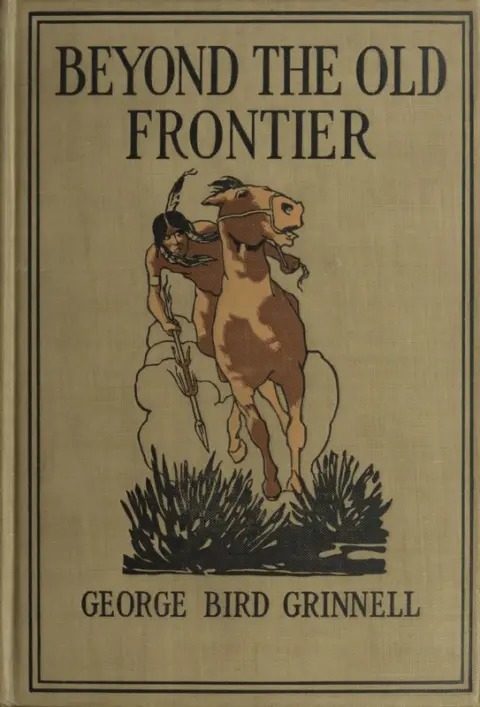
Beyond the Old Frontier: Adventures of Indian-Fighters, Hunters, and Fur-Traders
George Bird Grinnell
THE CLASSIC COLLECTION · 1889
"Pawnee Hero Stories and Folk-Tales" by George Bird Grinnell is a collection of indigenous narratives written in the late 19th century. This work presents the rich oral tradition of the Pawnee people, chronicling their legends, hero stories, and folk tales, while also providing insights into their customs, beliefs, and way of life. It reflects on the transformation of the Pawnee community as they adapt to changing times and the importance of preserving their stories for future generations. The opening of the book introduces Grinnell’s journey to the Pawnee Agency where he seeks to document the tribe’s stories before they are lost forever. He recounts a significant meeting with Eagle Chief, reflecting the deep connection between the storyteller and the traditions being passed down orally through generations. The text struggles with the loss of heritage as the younger generation moves toward a more modern existence, emphasizing the importance of recording these tales not just for historical value but to maintain the cultural identity of the Pawnee people. Grinnell’s mission as a recorder of these narratives is clear, aiming to present the tales in their purest form, offering readers a genuine glimpse into the Pawnee's character and worldview.
Introduction adapted from the source catalogue; source summaries may be automatically generated.
Free to read · English · 85,106 words · No account needed
MAKE TIME FOR A GOOD BOOK
On by default. Untick to stop anonymous reading totals. Each page counts after 10 seconds in view. How this works.
Anonymous counting is on unless you have switched it off.
Number of Indians 1,045 998 918 869
Number of male Indians .... 483 414 ....
Number of female Indians .... 515 504 ....
Number speaking English .... 289 .... 225
Number can read (youths) .... 100 90 100
Number can read (adults) .... 58 60 75
Number wearing citizen's
dress wholly .... 300 350 200
Number wearing citizen's
dress in part .... 400 450 600
Number doing some farming .... 324 400 *125
Number having other
civilized work .... 5 6 *7
Number of births .... 28 45 54
Number of deaths .... 77 125 106
Houses occupied by
Indians .... 61 82 98
Proportion of Indians
self-supporting .... 2/3 1/2 2/3
Farming operations--
Number of acres cultivated by Indians 971 1,360 2,094 2,560
Number of acres broken by
Indians .... 67 310 340
Number of acres under
fence 400 1,597 2,597 5,200
Number of rods fencing put up during year 200 4,435 2,181 2,975
Produce raised by Indians--
Number bushels of wheat 1,177 1,273 5,000 2,500
Number bushels of corn,
estimated 35,000 26,120 30,000 60,000
Number bushels of oats 969 .... 640 2,300
Est.
Number bushels of potatoes 100 100 2,500 ....
Number bushels of onions 10 50 100 150
Number bushels of beans 300 .... 500 750
Number of melons 5,225 50,000 50,000 ....
Number of pumpkins 3,000 5,000 .... ....
Number tons of hay 500 .... 600 800
Live stock owned by Indians--
Horses, estimated .... 1,200 1,400 1,500
Mules, estimated 15 20 20 25
Cattle, estimated 300 380 575 500
Hogs, estimated 100 .... 200 ....
Fowls, estimated 200 2,500 2,500 3,000
* Families.
Twelve allotments of land made 1888. Whole number allotments to date (1888), 175. In 1885 Indians sawed 50,050 feet of lumber, and cut 126 cords of wood.
In 1886 the Indians hauled 83,814 pounds of freight, for
which they were paid $541.54.
During the year 1888 three Indian apprentices learned a
trade.
Besides the crops raised, the Indians during 1888 sawed 50,000 feet of lumber, and cut 300 cords of wood.
In 1886 a severe cyclone and hail storm destroyed the growing crops, and in 1887 a prolonged drought again ruined them. During these two years it was necessary to issue to the Indians half rations and one-third rations respectively. This year (1888-89) no rations have been issued.
As will be seen by these figures, corn is the principal crop raised by the Pawnees, and a large part of the surplus beyond their own wants is sold at from twenty-five to fifty cents a bushel to the dealers in Arkansas City, or to the cattlemen in the neighborhood. The Pawnees have as yet few cattle, their old meat-eating habits have not yet been overcome, and there is a tendency among them to eat any cattle they may obtain rather than to use them for breeding purposes. They ought to be encouraged to keep cattle, to which they could feed their corn, and in this way obtain a better return for their labor than is yielded by the direct sale of the grain. They are fairly well provided with horses, but most of these are small, and of the old-fashioned Indian pony type. They should be encouraged to raise a better class of horses, and at least two well bred heavy stallions should be kept by the Government at Pawnee for Indian use. There is one now at Ponca, thirty-five miles away, but the Pawnees will not take their mares so far.
Your reading position is saved on this browser. Take it to another device with a library code. Reading pages adapt to text, rather than matching a printed edition.
George Bird Grinnell
George Bird Grinnell

Caspar Whitney & George Bird Grinnell & Owen Wister
George Bird Grinnell
BEHIND THE BOOK
This eBook is for the use of anyone anywhere in the United States and most other parts of the world at no cost and with almost no restrictions whatsoever. You may copy it, give it away or re-use it under the terms of the Project Gutenberg License included with this eBook or online at www.gutenberg.org. If you are not located in the United States, you will have to check the laws of the country where you are located before using this eBook. Read the source licence.
The original source file, including credits and licence, is retained by this library. Request an original-format copy at no charge. Please include the book title and Project Gutenberg identifier #36923.
KEEP YOUR CURIOSITY GOING

Maurice Baring
Francis Greenleaf Allinson & Anne C. E. (Anne Crosby Emery) Allinson
Stuart Dodgson Collingwood
Percy Keese Fitzhugh
Mary Macleod & Edmund Spenser

Cooke Don-Carlos