
Last letters from the living dead man
David Patterson (Spirit) Hatch
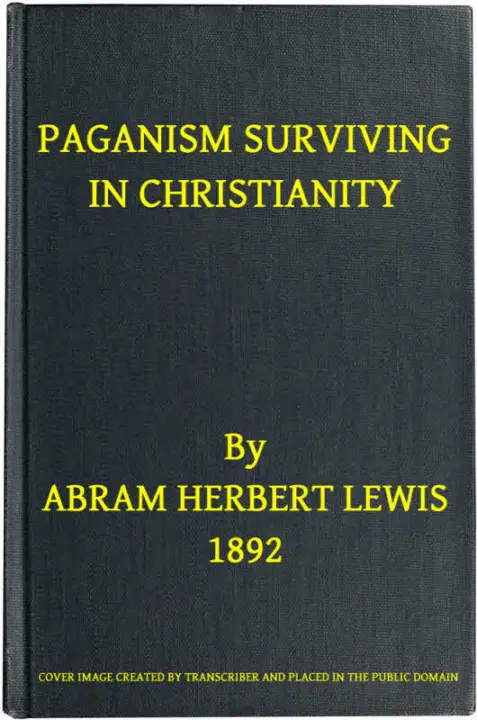
THE CLASSIC COLLECTION · 1892
"Paganism Surviving in Christianity" by Abram Herbert Lewis is a historical analysis written in the late 19th century. The book delves into the persistence of pagan influences within Christianity, exploring how these remnants have shaped the development of Christian practices and beliefs. Through a systematic examination, it aims to uncover the complex interplay between early Christianity and the surrounding pagan cultures." "At the start of the work, the author emphasizes the necessity of understanding the distinct contexts of early Christianity compared to later forms of the faith. Lewis argues that modern interpretations often project contemporary beliefs onto the ancient Christian experience, leading to misconceptions. He explores the historical struggle between adherence to original Christianity and the corrupting effects of pagan practices, asserting that a strong pagan influence was already evident in the Christianity of the third through fifth centuries. By citing various historical figures and their critiques, Lewis sets the stage for a deeper examination of how pagan rituals and philosophies have infiltrated Christian doctrines and customs."
Introduction adapted from the source catalogue; source summaries may be automatically generated.
Free to read · English · 80,786 words · No account needed
MAKE TIME FOR A GOOD BOOK
On by default. Untick to stop anonymous reading totals. Each page counts after 10 seconds in view. How this works.
Anonymous counting is on unless you have switched it off.
“Marcion, of Smyrna, who has written a work on the virtues of simples, informs that the sea scolopendra will burst asunder if spit upon; and that the same is the case with bramble frogs, and other kinds of frogs. Opilius says that serpents will do the same if a person spits into their open mouth; and Salpe tells us that when any part of the body is asleep the numbness may be got rid of by the person spitting into his lap, or touching the upper eyelid with his spittle. If we are ready to give faith to such statements as these, we must believe also in the efficacy of the following practices: upon the entrance of a stranger, or when a person looks at an infant while asleep, it is usual for the nurse to spit three times upon the ground; and this, although infants are under the special guardianship of the god Fascinus, the protector, not of infants only, but of generals as well, and a divinity whose worship is entrusted to the vestal virgins, and forms a part of the Roman rites.”[125]
[103] Antiquities of Greece, by John Potter, D.D., vol. i., pp.
261-263, Edinburgh, 1832.
[104] See Satire vi., line 522.
[105] The Origin and Development of Religious Belief, by S. Baring Gould, M.A., vol. i., p. 397, London, 1869.
[106] See Keil, Attische Culte aus Inschriften, Philologus, bd. xxiii., 212, 259, 592, 622; also Weingarten, Histor. Zeitschrift, bd. xlv., 1881, p. 441 ff.
[107] See Tertullian, De Baptismo, chap. v.; and Clem. of Alex.,
Strom., book v., chap. iv.
[108] Cf. Hatch, Influence of Greek Ideas and Usages upon the
Christian Church.
[109] Cf. Clem. of Alex., Exhortation to the Heathen, chap. xii.
[110] Cf. Hatch as above; and Lenormant, in Contemporary Review for
September, 1880.
[111] “The objection which Celsus makes (c. Cels., i., 1, Keim, p. 3) to the secrecy of the Christian associations would hardly have held good in the apostolic age. Origen admits (c. Cels., i., 7) that there are exoteric and esoteric doctrines in Christianity, and justifies it by (1) the philosophies, (2) the mysteries. On the rise of this conception of Christian teaching as something to be hidden from the mass, cf. the Valentians in Tert., c. Valent., i., where there is a direct parallel drawn between them and the mysteries; also the distinction of men into two classes--πνευματικοὶ and ψυχικοὶ or ὑλικοί,--among the Gnostics. Yet this very secrecy was naturalized in the Church. Cf. Cyril Hier., Catech., vi., 30; Aug. in Psalm ciii.; Hom., xcvi., in Joan; Theodoret, Quæst. xv., in Num., and Dial., ii., (Inconfusus); Chry., Hom., xix., in Matt. Sozomen’s (i., 20, 3) reason for not giving the Nicene creed is significant alike as regards motive and language.”--Hibbert Lectures, 1888, p. 293 and footnote.
[112] Cf. Hatch, p. 294 ff.
[113] Apol., i., 61.
Your reading position is saved on this browser. Take it to another device with a library code. Reading pages adapt to text, rather than matching a printed edition.
BEHIND THE BOOK
This eBook is for the use of anyone anywhere in the United States and most other parts of the world at no cost and with almost no restrictions whatsoever. You may copy it, give it away or re-use it under the terms of the Project Gutenberg License included with this eBook or online at www.gutenberg.org. If you are not located in the United States, you will have to check the laws of the country where you are located before using this eBook. Read the source licence.
The original source file, including credits and licence, is retained by this library. Request an original-format copy at no charge. Please include the book title and Project Gutenberg identifier #56650.
KEEP YOUR CURIOSITY GOING
David Patterson (Spirit) Hatch

David Patterson (Spirit) Hatch

David Patterson (Spirit) Hatch
Cécile Tormay

Moritz Busch
John L. Ransom