
Last letters from the living dead man
David Patterson (Spirit) Hatch
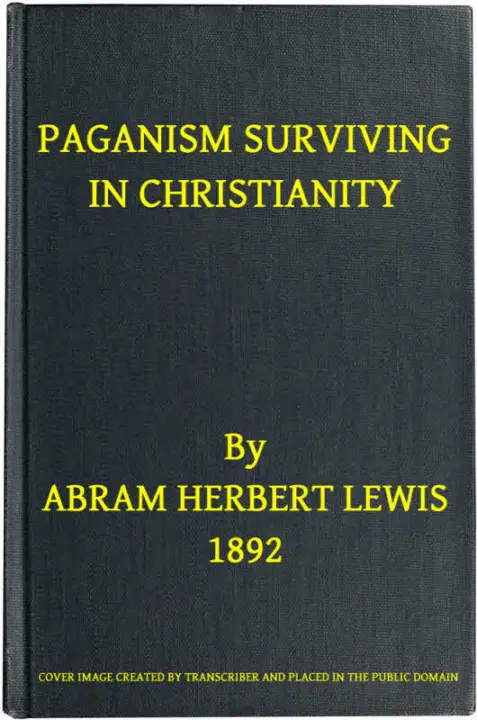
THE CLASSIC COLLECTION · 1892
"Paganism Surviving in Christianity" by Abram Herbert Lewis is a historical analysis written in the late 19th century. The book delves into the persistence of pagan influences within Christianity, exploring how these remnants have shaped the development of Christian practices and beliefs. Through a systematic examination, it aims to uncover the complex interplay between early Christianity and the surrounding pagan cultures." "At the start of the work, the author emphasizes the necessity of understanding the distinct contexts of early Christianity compared to later forms of the faith. Lewis argues that modern interpretations often project contemporary beliefs onto the ancient Christian experience, leading to misconceptions. He explores the historical struggle between adherence to original Christianity and the corrupting effects of pagan practices, asserting that a strong pagan influence was already evident in the Christianity of the third through fifth centuries. By citing various historical figures and their critiques, Lewis sets the stage for a deeper examination of how pagan rituals and philosophies have infiltrated Christian doctrines and customs."
Introduction adapted from the source catalogue; source summaries may be automatically generated.
Free to read · English · 80,786 words · No account needed
MAKE TIME FOR A GOOD BOOK
On by default. Untick to stop anonymous reading totals. Each page counts after 10 seconds in view. How this works.
Anonymous counting is on unless you have switched it off.
Dead, baptism for, of pagan origin, 83;
was transferred to Christianity, 84;
praying for, was borrowed from paganism, 275.
Decalogue, gnostic exposition of, by Clement of Alex., 60; allegorically compared with man’s senses, 61; Christ enforced obedience to it, 167, 168; Paul declared it to be binding, 169; if it be abolished there can be no sin, 170; how it was perverted by gnostic exposition, 184.
Demi-gods, the pagan, were the progenitors of Christian “saints,” 16.
Demiurge, the, was creator of “matter” and author of evil, 48.
Devil, the, cast out by anointing one possessed, with oil, and tears
of a presbyter, 261.
Diocletian, emperor, a devotee of the Sun-god, 200.
Diseases, miraculous curing of, in connection with baptism, 258 f.
Domville, Sir William, shows that early Sunday observance was not
Sabbatic, 180.
Dyer, Thomas H., describes introduction of paganism into
Christianity, 3.
Earth, sacred, from Jerusalem, cures paralysis, 260.
Easter, grew in part from Jewish passover, 279 f;
changed so as to coincide with festival of Goddess of
Spring, 279 f;
primarily a Chaldean sun-worship festival, 280.
“Eighth Day,” pagan origin of argument for, 184, 185; a day of “indulgence for the flesh,” 187.
Eleusis, city of, the chief seat of Greek “mysteries,” 117.
Elviri, synod of, condemned use of “lights” in cemeteries, 263.
Empire, the Roman, disintegrated under decay of pagan
religion, 203 f.
Europe, Northern, pagan water-worship in, 98.
Eusebius, his dishonest eulogy of Constantine, 215.
Exorcism, used in baptism, 138;
resorted to in preparing “holy water,” 149.
Facts, denying does not remove them, 29.
Farrar, Canon, describes corruption of Christianity through
syncretism, 22;
on Cyprian’s theories concerning baptism, 252.
“Fasts,” the pagan, transferred to Christianity, 26.
“Fathers,” the, were uncritical in exegesis of Scripture, 66, 67.
Fauchet, defends the introduction of paganism into Christianity, 8.
Festivals, those of pagans transferred to Christianity, 5, 28.
Fires, “Easter,” borrowed from sun-worship, 267; described by Grimm, 268, 269; “Midsummer,” a pagan festival identical with “St. John’s Day,” 270; “Baal,” yet continued in Scotland, 271.
Gale, Theophilus, on pagan origin of “orientation,” 265.
Galerius, emperor, persecution of Christians by, and death of, 205.
Ganges, the most sacred stream in India, 88 f.
Geikie, Rev. Cunningham, shows union of sun-worship cultus with
Christianity, 201.
Gibbon, Edward, describes sun-worship under Heliogabalus, 197 f; recounts devotion of Aurelian to sun-worship, 199 f.
Gnostics, the link between Christianity and Greek culture, 37.
Gnosticism, the product of Oriental philosophy, 34;
effect on Jewish thought, 34;
claimed a hidden meaning in all things, 34, 35;
destroyed authority of the O. T. by false exegesis, 35;
permeated Greek philosophy, 35;
assailed infant Christianity, 36;
Schaff’s description of, 36, 37;
generally antinomian, 36;
“vulgarized” Christianity, and made it “worldly,” 37;
Baur’s description of, 38;
introduced allegory into N. T. exegesis, 40, 41;
sought a hidden meaning in N. T., 44;
applied numerical mysteries to the Psalms, 58;
widely spread in second century, 69;
complete supremacy would have annihilated Christianity, 69;
fundamentally antinomian, 159;
destructively applied to the Decalogue, 184.
Your reading position is saved on this browser. Take it to another device with a library code. Reading pages adapt to text, rather than matching a printed edition.
BEHIND THE BOOK
This eBook is for the use of anyone anywhere in the United States and most other parts of the world at no cost and with almost no restrictions whatsoever. You may copy it, give it away or re-use it under the terms of the Project Gutenberg License included with this eBook or online at www.gutenberg.org. If you are not located in the United States, you will have to check the laws of the country where you are located before using this eBook. Read the source licence.
The original source file, including credits and licence, is retained by this library. Request an original-format copy at no charge. Please include the book title and Project Gutenberg identifier #56650.
KEEP YOUR CURIOSITY GOING
David Patterson (Spirit) Hatch

David Patterson (Spirit) Hatch

David Patterson (Spirit) Hatch
Cécile Tormay

Moritz Busch
John L. Ransom