
Last letters from the living dead man
David Patterson (Spirit) Hatch
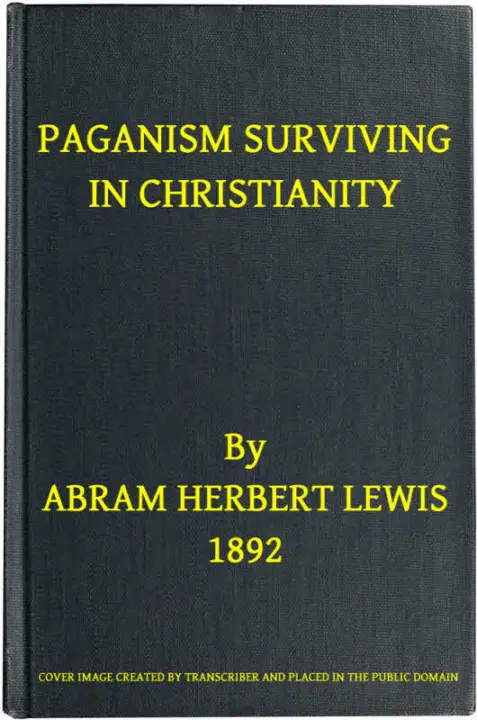
THE CLASSIC COLLECTION · 1892
"Paganism Surviving in Christianity" by Abram Herbert Lewis is a historical analysis written in the late 19th century. The book delves into the persistence of pagan influences within Christianity, exploring how these remnants have shaped the development of Christian practices and beliefs. Through a systematic examination, it aims to uncover the complex interplay between early Christianity and the surrounding pagan cultures." "At the start of the work, the author emphasizes the necessity of understanding the distinct contexts of early Christianity compared to later forms of the faith. Lewis argues that modern interpretations often project contemporary beliefs onto the ancient Christian experience, leading to misconceptions. He explores the historical struggle between adherence to original Christianity and the corrupting effects of pagan practices, asserting that a strong pagan influence was already evident in the Christianity of the third through fifth centuries. By citing various historical figures and their critiques, Lewis sets the stage for a deeper examination of how pagan rituals and philosophies have infiltrated Christian doctrines and customs."
Introduction adapted from the source catalogue; source summaries may be automatically generated.
Free to read · English · 80,786 words · No account needed
MAKE TIME FOR A GOOD BOOK
On by default. Untick to stop anonymous reading totals. Each page counts after 10 seconds in view. How this works.
Anonymous counting is on unless you have switched it off.
“Gnosticism extended far and wide in the second century. There was something very imposing in those mighty systems which embraced heaven and earth. How plain and meagre in comparison seemed simple Christianity! There was something remarkably attractive in the breadth and liberality of gnosticism. It seemed completely to have reconciled Christianity with culture. How narrow the Christian Church appeared! Even noble souls might be captivated by the hope of winning the world over to Christianity in this way; while the multitude was attracted by the dealing in mysteries with which the gnostic sects fortified themselves by offering mighty spells and amulets, thus pandering to the popular taste. Finally some were no doubt drawn in by the fact that less strictness of life was required, and that they could thus be Christians without suffering martyrdom.
“But the victory of gnosticism would have been the ruin of Christianity. Christianity would have split into a hundred sects, its line of division from heathenism would have been erased, its inmost essence would have been lost, and instead of producing something really new, it would have become only an element of the melting mass, an additional ingredient in the fermenting chaos of religions which characterized the age.”[61]
When the fountain of formative Christianity was thus widely and early corrupted, what wonder that the banks of the stream are covered with pagan débris, and that the waters are yet turbid from its sediment?
[25] Cf. Hibbert Lectures for 1888, by Edwin Hatch, D.D., Lecture i.
[26] See The Gnostics and Their Remains, by C. W. King, M.A., p. 5,
London, 1887.
[27] See Harnack, Dogmengeschichte, vol. i., chap. 4.
[28] Church History, vol. i., p. 566, N. Y., 1882.
[29] Dogmengeschichte, vol. i., chap. 4.
[30] Bauer, Church Hist., vol. i., p. 191, London, 1878.
[31] Hom., Il., ii., 204.
[32] Ps. Justin. (probably Apollonius, see Dräseke, in the Jahrb. f. protestant. Theologie, 1885, p. 144), chap. xvii.
[33] Hom., Il., xviii., 483.
[34] Ps. Justin., chap. xxviii.
[35] Hom., Il., xiv., 206; also Clem. Alex., Stroma., v., 14.
[36] Il., xxii., 8; Clem. Alex., Stroma., v., 14.
[37] Hippol., Philosophoumena, vi., 14.
[38] Herod., iv., 8-10.
[39] Hippol., v., 21.
[40] Hibbert Lectures for 1888, Lecture iii., pp. 69, 70, 72.
[41] Irenæus, Against Heresies, book i., chap. viii.
[42] Irenæus, Against Heresies, book i., chap. viii.
[43] Stroma., book i., chap. iii.
[44] Strom., bk. vi., ch. xi.
[45] Influence of Greek Thought, etc., p. 77.
[46] In quotations from the Fathers, words and clauses in brackets are thus printed as “supplied words” in the Ante-Nicene Library of T. & T. Clark, Edinburgh.
[47] Epistle, ch. viii.
[48] Epistle, ch. ix.
[49] Epistle, chap. x.
[50] This is a real or pretended quotation from some unknown
Apochryphal book.
[51] Epistle, chap. xii.
[52] Dialogue with Trypho, chap. lxxxvi.
Your reading position is saved on this browser. Take it to another device with a library code. Reading pages adapt to text, rather than matching a printed edition.
BEHIND THE BOOK
This eBook is for the use of anyone anywhere in the United States and most other parts of the world at no cost and with almost no restrictions whatsoever. You may copy it, give it away or re-use it under the terms of the Project Gutenberg License included with this eBook or online at www.gutenberg.org. If you are not located in the United States, you will have to check the laws of the country where you are located before using this eBook. Read the source licence.
The original source file, including credits and licence, is retained by this library. Request an original-format copy at no charge. Please include the book title and Project Gutenberg identifier #56650.
KEEP YOUR CURIOSITY GOING
David Patterson (Spirit) Hatch

David Patterson (Spirit) Hatch

David Patterson (Spirit) Hatch
Cécile Tormay

Moritz Busch
John L. Ransom