
Last letters from the living dead man
David Patterson (Spirit) Hatch
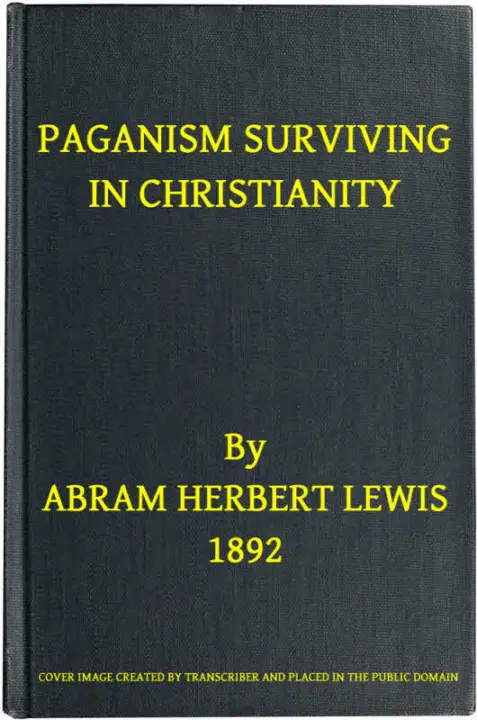
THE CLASSIC COLLECTION · 1892
"Paganism Surviving in Christianity" by Abram Herbert Lewis is a historical analysis written in the late 19th century. The book delves into the persistence of pagan influences within Christianity, exploring how these remnants have shaped the development of Christian practices and beliefs. Through a systematic examination, it aims to uncover the complex interplay between early Christianity and the surrounding pagan cultures." "At the start of the work, the author emphasizes the necessity of understanding the distinct contexts of early Christianity compared to later forms of the faith. Lewis argues that modern interpretations often project contemporary beliefs onto the ancient Christian experience, leading to misconceptions. He explores the historical struggle between adherence to original Christianity and the corrupting effects of pagan practices, asserting that a strong pagan influence was already evident in the Christianity of the third through fifth centuries. By citing various historical figures and their critiques, Lewis sets the stage for a deeper examination of how pagan rituals and philosophies have infiltrated Christian doctrines and customs."
Introduction adapted from the source catalogue; source summaries may be automatically generated.
Free to read · English · 80,786 words · No account needed
MAKE TIME FOR A GOOD BOOK
On by default. Untick to stop anonymous reading totals. Each page counts after 10 seconds in view. How this works.
Anonymous counting is on unless you have switched it off.
“A single letter of Hadrian presented by Vopiscus will show the confusion of thought and intermixture of religions which prevailed in that cosmopolitan city, and the aspect presented by its religious syncretism to a cool and cynical observer. ‘Those who worship Serapis,’ he says in a letter to a friend, ‘are Christians, and those who call themselves Bishops of Christ are votaries of Serapis. There is no ruler of a synagogue there, no Samaritan, no presbyter of the Christians, who is not an astrologer, who is not a soothsayer, who is not a gymnast. The patriarch of the Jews himself when he comes to Egypt is forced by one party to worship Serapis, by the other Christ. They have but one God who is no God; him Christians, him Jews, him all races worship alike.’ To the disdainful and sceptical mind of the emperor, who deified his own unhappy minion, Christianity, gnosticism, Judaism, paganism were all forms of one universal charlatanry and sham.”[21]
In writing of Leo the Great (440-461) founder of the papacy, Dean MERIVALE gives a graphic picture of the state of Christianity at that time. Space is here taken for a copious extract that the weight of Merivale’s name and words may add force to the facts. He says:
“It will be admitted, I trust, without entering upon disquisitions which would be inappropriate to this occasion, that the corruptions of Christian faith against which our own national Church and many others rose indignantly at the Reformation had for the most part struck their foundations deep in the course of the fifth century; that though they had sprung up even from an earlier period, and though they developed more in some directions, and assumed more fixity in the darker times that followed, yet the working of the true Christian leaven among the masses was never more faint, the approximation of Christian usage to the manners and customs of paganism never really closer, than in the age of which we are now speaking. We have before us many significant examples of the facility with which the most intelligent of the pagans accepted the outward rite of Christian baptism, and made a nominal profession of the faith, while they retained and openly practised, without rebuke, without remark, with the indulgence even of genuine believers, the rites and usages of the paganism they pretended to have abjured. We find abundant records of the fact that personages high in office, such as consuls and other magistrates, while administering the laws by which the old idolatries were proscribed, actually performed pagan rites, and even erected public statues to pagan divinities. Still more did men, high in the respect of their fellow-Christians, allow themselves to cherish sentiments utterly at variance with the definitions of the Church. Take the instance of the illustrious Bishop Synesius. Was he a Christian, was he a pagan; who shall say? He was famous in the schools of Alexandria as a man of letters, a teacher of the ancient philosophies, an admirer of the pagan Hypatia. The Christian people of Ptolemais, enchanted with his talents, demanded him for their bishop. He protests not indeed that he is an unbeliever--but that his life and habits are not suitable to so high an office. He has a wife whom he cannot abandon, as the manners of the age might require of him; whom he will not consort with secretly, as the manners of the age would, it seems, allow. ‘But further I cannot believe,’ he adds, ‘that the human soul has been breathed into flesh and blood; I will not teach that this everlasting world of matter is destined to annihilation; the resurrection, as taught by the Church, seems to me a doubtful and questionable doctrine. I am a philosopher, and cannot preach to the people popularly.’ In short, he maintains to all appearance that if he is a believer in Jesus Christ, he is a follower of Plato; and such doubtless were many others. The people leave him his wife and his opinions, and insist that he shall be their bishop. He retains his family ties, his philosophy, his Platonism, his rationalism, and accepts the government of the Church notwithstanding. Again we ask, was Synesius a Christian or a pagan? The instance of such a bishop, one probably among many, is especially significant; but the same question arises with regard to other men of eminence of the period. Was Boëthius, a century later, the imitator of Cicero, Christian or pagan? Was Simplicius, the commentator on Plato? Was Ausonius, the playful poet and amiable friend of the Bishop Paulinus, who celebrates Christ in one poem, and scatters his allusions to pagan mythology indiscriminately in many others? We know that Libanius, the intimate friend and correspondent of Basil, was a pagan of the pagans; but he did not on that account forfeit the confidence of a sainted father of the Christian Church. So indifferent as Christians seem to have been at this period to their own creed, so indifferent to the creed of their friends and associates, we cannot wonder if it has left us few or but slight traces of a vital belief in the principles of divine redemption.
Your reading position is saved on this browser. Take it to another device with a library code. Reading pages adapt to text, rather than matching a printed edition.
BEHIND THE BOOK
This eBook is for the use of anyone anywhere in the United States and most other parts of the world at no cost and with almost no restrictions whatsoever. You may copy it, give it away or re-use it under the terms of the Project Gutenberg License included with this eBook or online at www.gutenberg.org. If you are not located in the United States, you will have to check the laws of the country where you are located before using this eBook. Read the source licence.
The original source file, including credits and licence, is retained by this library. Request an original-format copy at no charge. Please include the book title and Project Gutenberg identifier #56650.
KEEP YOUR CURIOSITY GOING
David Patterson (Spirit) Hatch

David Patterson (Spirit) Hatch

David Patterson (Spirit) Hatch
Cécile Tormay

Moritz Busch
John L. Ransom