
Last letters from the living dead man
David Patterson (Spirit) Hatch
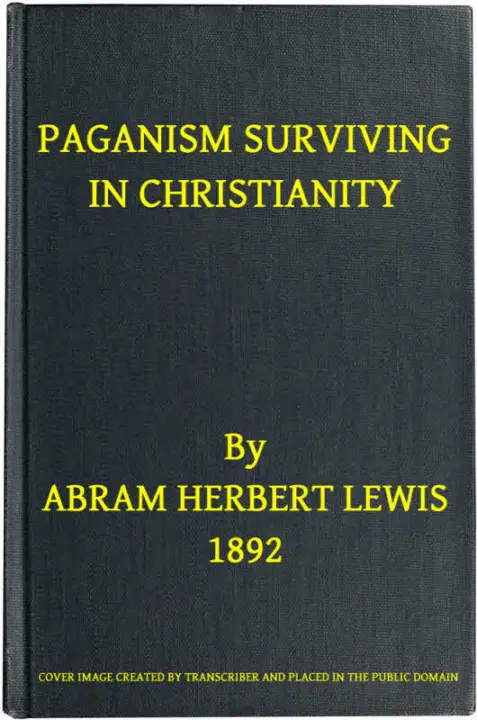
THE CLASSIC COLLECTION · 1892
"Paganism Surviving in Christianity" by Abram Herbert Lewis is a historical analysis written in the late 19th century. The book delves into the persistence of pagan influences within Christianity, exploring how these remnants have shaped the development of Christian practices and beliefs. Through a systematic examination, it aims to uncover the complex interplay between early Christianity and the surrounding pagan cultures." "At the start of the work, the author emphasizes the necessity of understanding the distinct contexts of early Christianity compared to later forms of the faith. Lewis argues that modern interpretations often project contemporary beliefs onto the ancient Christian experience, leading to misconceptions. He explores the historical struggle between adherence to original Christianity and the corrupting effects of pagan practices, asserting that a strong pagan influence was already evident in the Christianity of the third through fifth centuries. By citing various historical figures and their critiques, Lewis sets the stage for a deeper examination of how pagan rituals and philosophies have infiltrated Christian doctrines and customs."
Introduction adapted from the source catalogue; source summaries may be automatically generated.
Free to read · English · 80,786 words · No account needed
MAKE TIME FOR A GOOD BOOK
On by default. Untick to stop anonymous reading totals. Each page counts after 10 seconds in view. How this works.
Anonymous counting is on unless you have switched it off.
“The degrees of worship and adoration, since defined with fatal precision by the Romish Church, were not then fixed; and the heathen, even less willing than the Christian laity to enter into refinements on the subject, saw no distinction between one form and another. The consequences were disastrous in the extreme; the charge of idolatry, mutually urged by the contending parties, lost the force, or rather was effectively employed by the pagans, after it had become powerless in Christian hands. Thus it was that, although the pure doctrines of our faith speedily displaced the profligate polytheism of the empire, the after conflict was long doubtful, being maintained by a religion enfeebled by admixture with foreign elements, against one that had profited by adversity, and had not scrupled to borrow largely from its rival. We read in fable of the struggle between the man and the serpent, in which at length the combatants become transformed into the shapes of each other. In the last contest between paganism and Christianity we find the sophist contending for the unity of God, and accusing the Christian of undisguised polytheism; and on the other side the Christian insisting on the tutelary powers of glorified mortals, and the omniscience of departed spirits.”[16]
Similar testimony is borne by SEYMORE, who says:
“The apostasy of the Church of Rome will be more apparent when we reflect that the character of the mediation which Romanism ascribes to its saints is precisely the same as that which heathenism ascribes to its demi-gods. It was believed among the heathen that when a man became illustrious for his deeds, his conquests, his inventions, or aught else that distinguished him as a benefactor of mankind, he could be canonized and enrolled among inferior deities. He thus became a mediator whose sympathies with his fellow-men on the one hand, and whose merits with the gods on the other fitted him for the mediatorial office of bearing the prayers and wants of mortals to the presence of the gods. The heathen philosophers, Hesiod, Plato, and Apuleius, all thus speak of those persons. The last named philosopher says: ‘They are intermediate intelligences, by whom our prayers and wants pass unto the gods. They are mediators between the inhabitants of the earth and the inhabitants of heaven, carrying thither our prayers, and drawing down their blessings. They bear back and forwards prayers for us, and supplies for them; or they are those that explain between both parties, and who carry our adorations.’ This was the creed of heathenism, and in nothing but the name does it differ from the corresponding creed of Romanism. When the Church of Rome finds members of her communion whom she regards as signally pious, or illustrious for supposed miraculous powers, she holds that they be canonized and enrolled among her saints; that they can mediate between God and man; that they have sufficient favor or influence with God to obtain compliance with our prayers, and therefore they are fitting objects to whom our confessions, invocations, and prayers may be offered; or, as she expresses it in her creed, ‘that the saints reigning with Christ are to be honored and invoked, and that they offer prayers to God for us.’ The principle of heathen Romanism, and the principle of Christian Romanism are one and the same, the only difference is in the details of the names. And the origin of the practice is demonstrative of this; for when it was found, after the establishment of Christianity in the times of Constantine, when the great object of the court was to promote uniformity of religion, that many of the heathen would outwardly conform to Christianity if allowed to retain in private their worship of their guardian or tutelar divinities, they were so allowed, merely on changing the names of Jupiter to Peter, or Juno to Mary, still worshipping their old divinities under new names, and even retaining old images that were baptized with Christian names. This is apparent in the writings of those times, and was thought a measure of wisdom, a stroke of profound policy, as tending to produce a uniformity of religion among the unthinking masses. The invocations of Juno have been transferred to Mary; the prayers to Mercury have been transferred to Paul. We see not how the substitution of the names of Damian or Cosmo, for those of Mercury or Apollo, or how the substitution of the names of Lucy or Cecelia, for those of Minerva or Diana, can alter the idolatrous character of the practice. In some instances they have not even changed the names, and Romulus and Remus are still worshipped in Italy, under the more modern names of St. Romulo and St. Remugio. The simple people believe them to have been two holy bishops. I have myself witnessed this near Florence, and even Bacchus is not without his votaries, under the ecclesiastical name of St. Bacco. The principle and practice of papal Rome are identical with the principle and practice of pagan Rome. Every argument to justify one may be equally urged to justify or extenuate the other. And if the principle and practice of pagan Rome are to be pronounced as idolatrous, I see not why the very same principle and practice in papal Rome should not be pronounced as idolatrous likewise.”[17]
Your reading position is saved on this browser. Take it to another device with a library code. Reading pages adapt to text, rather than matching a printed edition.
BEHIND THE BOOK
This eBook is for the use of anyone anywhere in the United States and most other parts of the world at no cost and with almost no restrictions whatsoever. You may copy it, give it away or re-use it under the terms of the Project Gutenberg License included with this eBook or online at www.gutenberg.org. If you are not located in the United States, you will have to check the laws of the country where you are located before using this eBook. Read the source licence.
The original source file, including credits and licence, is retained by this library. Request an original-format copy at no charge. Please include the book title and Project Gutenberg identifier #56650.
KEEP YOUR CURIOSITY GOING
David Patterson (Spirit) Hatch

David Patterson (Spirit) Hatch

David Patterson (Spirit) Hatch
Cécile Tormay

Moritz Busch
John L. Ransom