THE CLASSIC COLLECTION✦The Story of Francis CluddeCLASSIC FREE BOOKS
The Story of Francis Cludde
Stanley John Weyman
THE CLASSIC COLLECTION · 1922
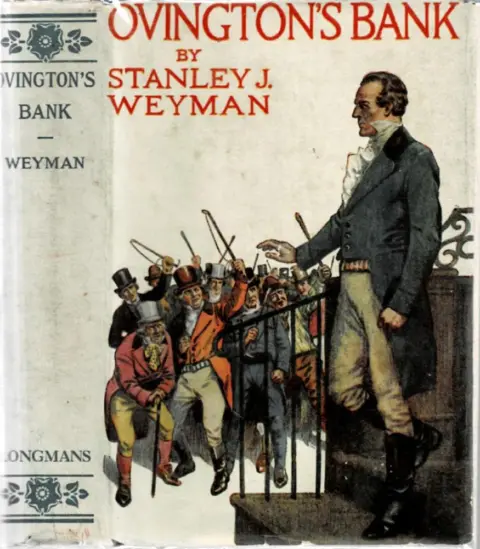
"Ovington's Bank" by Stanley John Weyman is a novel published in 1922. Set during the British Panic of 1825, the story follows two English communities as a banking crisis threatens to destroy their way of life. Weyman explores the clash between traditional landed gentry and the rising business class, as customers' panic endangers a carefully run bank. This tale of honesty, love, and social transformation depicts how fear and self-interest can drive even solvent institutions toward ruin during financial turmoil.
Introduction adapted from the source catalogue; source summaries may be automatically generated.
Free to read · English · 162,553 words · No account needed
MAKE TIME FOR A GOOD BOOK
On by default. Untick to stop anonymous reading totals. Each page counts after 10 seconds in view. How this works.
Anonymous counting is on unless you have switched it off.
“Isn’t Rodd here? Ah!” to a second young man, plainer, darker, and more soberly garbed, who had silently appeared at his forerunner’s elbow. “Take this, Rodd, will you?” handing him a small leather case. “Don’t let it go, until it is on my table. All well?”
“All well, sir, thank you.”
“Then go on at once, will you? I will follow with Mr. Bourdillon. Give me your arm, Arthur.” He looked about him as he spoke. One or two hats were lifted, he acknowledged the courtesy with a smile. “Betty well?”
“You’ll find her at the window looking out. All gone swimmingly, I
hope, sir?”
“Swimmingly?” The traveller paused on the word, perhaps questioning its propriety; and he did not continue until they had disengaged themselves from the group round the coach. He and the young man came, though there was nothing to show this, from different grades of society, and the one was thirty years older than the other and some inches shorter. Yet there was a likeness. The lower part of the face in each was strong, and a certain brightness in the eyes, that was alertness in the younger man and keenness in the elder, told of a sanguine temperament; and they were both good-looking. “Swimmingly?” the traveller repeated when they had freed themselves from their immediate neighbors. “Well, if you choose to put it that way, yes. But, it’s wonderful, wonderful,” in a lower tone, as he paused an instant to acknowledge an acquaintance, “the state of things up there, my boy.”
“Still rising?”
“Rising as if things would never fall. And upon my word I don’t know why, with the marvellous progress everything is making—but I’ll tell you all that later. It’s a full market. Is Acherley at the bank?”
“Yes, and Sir Charles. They came a little before time.”
“Clement is with them, I suppose?”
“Well, no, sir.”
“Don’t say he’s away to-day!” in a tone of vexation.
“I’m afraid he is,” Arthur admitted. “But they are all right. I offered Sir Charles the paper, but they preferred to wait outside.”
“D——n!” muttered the other, nodding right and left. “Too bad of the boy! Too bad! No,” to the person who had lain in wait for Bourdillon and now put himself in their way, “I can’t stop now, Mr. Broadway.”
“But, Mr. Ovington! Just a——”
“Not now!” Ovington answered curtly. “Call to-morrow.” And when they had left the man behind, “What does he want?”
“What they all want,” Arthur answered, smiling. “A good thing, sir.”
“But he isn’t a customer.”
Your reading position is saved on this browser. Take it to another device with a library code. Reading pages adapt to text, rather than matching a printed edition.
Stanley John Weyman

Stanley John Weyman
Stanley John Weyman
Stanley John Weyman
BEHIND THE BOOK
This eBook is for the use of anyone anywhere in the United States and most other parts of the world at no cost and with almost no restrictions whatsoever. You may copy it, give it away or re-use it under the terms of the Project Gutenberg License included with this eBook or online at www.gutenberg.org. If you are not located in the United States, you will have to check the laws of the country where you are located before using this eBook. Read the source licence.
The original source file, including credits and licence, is retained by this library. Request an original-format copy at no charge. Please include the book title and Project Gutenberg identifier #38990.
KEEP YOUR CURIOSITY GOING
Cécile Tormay

Moritz Busch
Coulson Kernahan
John L. Ransom

Maurice Baring
Frances Wright