THE CLASSIC COLLECTION✦Letters to His ChildrenCLASSIC FREE BOOKS
Letters to His Children
Theodore Roosevelt
THE CLASSIC COLLECTION · 1908
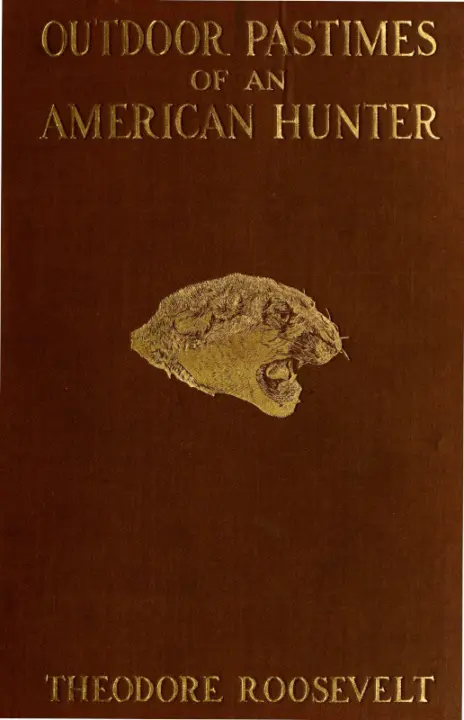
"Outdoor Pastimes of an American Hunter" by Theodore Roosevelt is a collection of personal accounts and observations regarding hunting and outdoor life written in the late 19th century. The book reflects Roosevelt's passion for nature and wildlife, showcasing his hunting experiences on various adventures, particularly focusing on cougars and other big game in the American wilderness. It serves as both a memoir and a commentary on the natural world, steeped in the author's vivid recollections and insights into the behavior of both the animals and the ecosystem. The opening of the book presents an engaging narrative of Roosevelt's winter cougar hunt in the harsh terrain of Northwest Colorado, accompanied by companions and expertly trained hounds. He recounts the challenges they faced from the cold weather and rugged environment while illustrating the unique bond between the hunters and their dogs, who play a vital role in the chase. Roosevelt takes the reader through the thrilling experiences of tracking and confronting cougars, weaving in descriptions of the majestic landscape and the importance of conservation for wildlife. This initial chapter sets the tone for the rest of the book, blending adventure with an appreciation for the wilderness.
Introduction adapted from the source catalogue; source summaries may be automatically generated.
Free to read · English · 122,861 words · No account needed
MAKE TIME FOR A GOOD BOOK
On by default. Untick to stop anonymous reading totals. Each page counts after 10 seconds in view. How this works.
Anonymous counting is on unless you have switched it off.
In Albemarle County, Virginia, we have a little place called Pine Knot, where we sometimes go, taking some or all of the children, for a three or four days’ outing. It is a mile from the big stock farm, Plain Dealing, belonging to an old friend, Mr. Joseph Wilmer. The trees and flowers are like those of Washington, but their general close resemblance to those of Long Island is set off by certain exceptions. There are osage orange hedges, and in spring many of the roads are bordered with bands of the brilliant yellow blossoms of the flowering broom, introduced by Jefferson. There are great willow oaks here and there in the woods or pastures, and occasional groves of noble tulip trees in the many stretches of forest; these tulip trees growing to a much larger size than on Long Island. As at Washington, among the most plentiful flowers are the demure little Quaker Ladies, which are not found at Sagamore Hill—where we also miss such northern forms as the wake robin and the other trilliums, which used to be among the characteristic marks of spring-time at Albany. At Pine Knot the red bug, dogwood and laurel are plentiful; though in the case of the last two no more so than at Sagamore Hill. The azalea—its Knickerbocker name in New York was pinkster—grows and flowers far more luxuriantly than on Long Island. The moccasin flower, the china-blue Virginia cowslip with its pale pink buds, the blood-red Indian pink, the painted columbine and many, many other flowers somewhat less showy carpet the woods.
The birds are, of course, for the most part the same as on Long Island, but with some differences. These differences are, in part, due to the more southern locality; but in part I cannot explain them, for birds will often be absent from one place seemingly without any real reason. Thus around us in Albemarle County song-sparrows are certainly rare and I have not seen savanna sparrows at all; but the other common sparrows, such as the chippy, field sparrow, vesper sparrow, and grasshopper sparrow abound; and in an open field where bind-weed morning glories and evening primroses grew among the broom sedge, I found some small grass-dwelling sparrows, which with the exercise of some little patience I was able to study at close quarters with the glasses; as I had no gun I could not be positive about their identification, though I was inclined to believe that they were Henslow’s sparrows. Of birds of brilliant color there are six species—the cardinal, the summer redbird and the scarlet tanager, in red, and the bluebird, indigo bunting, and blue grossbeak, in blue. I saw but one pair of blue grossbeaks; but the little indigo buntings abound, and bluebirds are exceedingly common, breeding in numbers. It has always been a puzzle to me why they do not breed around us at Sagamore Hill, where I only see them during the migrations. Neither the rosy summer redbirds nor the cardinals are quite as brilliant as the scarlet tanagers, which fairly burn like live flames; but the tanager is much less common than either of the others in Albemarle County, and it is much less common than it is at Sagamore Hill. Among the singers the wood thrush is not common, but the meadow lark abounds. The yellow-breasted chat is everywhere and in the spring its clucking, whistling and calling seem never to stop for a minute. The white-eyed vireo is found in the same thick undergrowth as the chat and among the smaller birds it is one of those most in evidence to the ear. In one or two places I came across parties of the long-tailed Bewick’s wren, as familiar as the house wren but with a very different song. There are gentle mourning doves; and black-billed cuckoos seem more common than the yellow-bills. The mocking-birds are, as always, most interesting. I was much amused to see one of them following two crows; when they lit in a plowed field the mocking-bird paraded alongside of them six feet off, and then fluttered around to the attack. The crows, however, were evidently less bothered by it than they would have been by a kingbird. At Plain Dealing many birds nest within a stone’s throw of the rambling attractive house, with its numerous outbuildings, old garden, orchard, and venerable locusts and catalpas. Among them are Baltimore and orchard orioles, purple grackles, flickers and red-headed woodpeckers, bluebirds, robins, kingbirds and indigo buntings. One observation which I made was of real interest. On May 18, 1907, I saw a small party of a dozen or so of passenger pigeons, birds I had not seen for a quarter of a century and never expected to see again. I saw them two or three times flying hither and thither with great rapidity, and once they perched in a tall dead pine on the edge of an old field. They were unmistakable; yet the sight was so unexpected that I almost doubted my eyes, and I welcomed a bit of corroborative evidence coming from Dick, the colored foreman at Plain Dealing. Dick is a frequent companion of mine in rambles around the country, and he is an unusually close and accurate observer of birds, and of wild things generally. Dick had mentioned to me having seen some “wild carrier pigeons,” as he called them; and, thinking over this remark of his, after I had returned to Washington, I began to wonder whether he too might not have seen passenger pigeons. Accordingly I wrote to Mr. Wilmer, asking him to question Dick and find out what the “carrier pigeons” looked like. His answering letter runs in part as follows:
Your reading position is saved on this browser. Take it to another device with a library code. Reading pages adapt to text, rather than matching a printed edition.
Theodore Roosevelt
Theodore Roosevelt
Theodore Roosevelt

Theodore Roosevelt & Kermit Roosevelt
BEHIND THE BOOK
This eBook is for the use of anyone anywhere in the United States and most other parts of the world at no cost and with almost no restrictions whatsoever. You may copy it, give it away or re-use it under the terms of the Project Gutenberg License included with this eBook or online at www.gutenberg.org. If you are not located in the United States, you will have to check the laws of the country where you are located before using this eBook. Read the source licence.
The original source file, including credits and licence, is retained by this library. Request an original-format copy at no charge. Please include the book title and Project Gutenberg identifier #61935.
KEEP YOUR CURIOSITY GOING

Fanny Van de Grift Stevenson

Isabel Anderson
Charles King
Henry Vizetelly
Randall Parrish
James De Mille