THE CLASSIC COLLECTION✦Letters to His ChildrenCLASSIC FREE BOOKS
Letters to His Children
Theodore Roosevelt
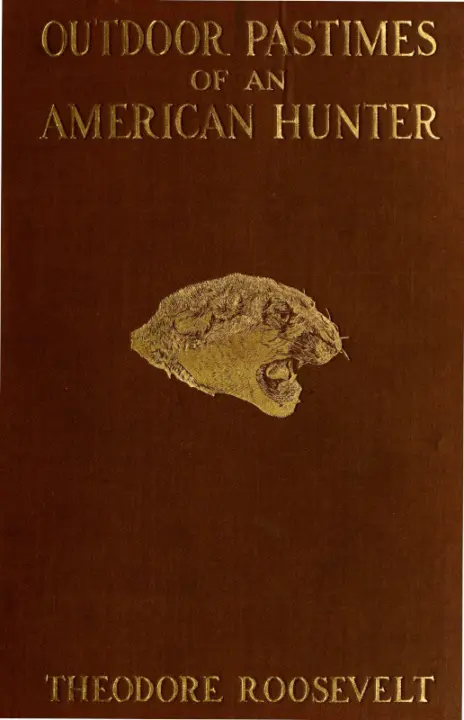
THE CLASSIC COLLECTION · 1908
"Outdoor Pastimes of an American Hunter" by Theodore Roosevelt is a collection of personal accounts and observations regarding hunting and outdoor life written in the late 19th century. The book reflects Roosevelt's passion for nature and wildlife, showcasing his hunting experiences on various adventures, particularly focusing on cougars and other big game in the American wilderness. It serves as both a memoir and a commentary on the natural world, steeped in the author's vivid recollections and insights into the behavior of both the animals and the ecosystem. The opening of the book presents an engaging narrative of Roosevelt's winter cougar hunt in the harsh terrain of Northwest Colorado, accompanied by companions and expertly trained hounds. He recounts the challenges they faced from the cold weather and rugged environment while illustrating the unique bond between the hunters and their dogs, who play a vital role in the chase. Roosevelt takes the reader through the thrilling experiences of tracking and confronting cougars, weaving in descriptions of the majestic landscape and the importance of conservation for wildlife. This initial chapter sets the tone for the rest of the book, blending adventure with an appreciation for the wilderness.
Introduction adapted from the source catalogue; source summaries may be automatically generated.
Free to read · English · 122,861 words · No account needed
MAKE TIME FOR A GOOD BOOK
On by default. Untick to stop anonymous reading totals. Each page counts after 10 seconds in view. How this works.
Anonymous counting is on unless you have switched it off.
Footnote 4:
While the situation thus described was an impossible one, the purpose of Mr. Warner’s article was excellent, it being intended as a protest against hunting deer while the fawns are young, and against killing them in the water.
By the end of the rut the old bucks are often exhausted, their sides are thin, their necks swollen; though they are never as gaunt as wapiti bulls at this time. They then rest as much as possible, feeding all the time to put on fat before winter arrives, and rapidly attaining a very high condition.
Except in dire need no one would kill a deer after the hard weather of winter begins or before the antlers of the buck are full-grown and the fawns are out of the spotted coat. Even in the old days we, who lived in the ranch country, always tried to avoid killing deer in the spring or early summer, though we often shot buck antelope at those times. The close season for deer varies in different States, and now there is generally a limit set to the number any one hunter can kill; for the old days of wasteful plenty are gone forever.
To my mind there is a peculiar fascination in hunting the mule-deer. By the time the hunting season has arrived the buck is no longer the slinking beast of the thicket, but a bold and yet wary dweller in the uplands. Frequently he can be found clear of all cover, often at midday, and his habits at this season are, from the hunter’s standpoint, rather more like those of the wapiti than of the whitetail; but each band, though continually shifting its exact position, stays permanently in the same tract of country, whereas wapiti are apt to wander.
In the old days, when mule-deer were plentiful in country through which a horse could go at a fair rate of speed, it was common for the hunter to go on horseback, and not to dismount save at the moment of the shot. In the early eighties, while on my ranch on the Little Missouri, this was the way in which I usually hunted. When I first established my ranch I often went out, in the fall, after the day’s work was over, and killed a deer before dark. If it was in September, I would sometimes start after supper. Later in the year I would take supper when I got back. Under such circumstances my mode of procedure was simple. Deer were plentiful. Every big tangle of hills, every set of grassy coulees winding down to a big creek bottom, was sure to contain them. The time being short, with at most only an hour or two of light, I made no effort to find the tracks of a deer or to spy one afar off. I simply rode through the likely places, across the heads of the ravines or down the winding valleys, until I jumped a deer close enough up to give me a shot. The unshod hoofs of the horse made but little noise as he shuffled along at the regular cow-pony fox trot, and I kept him close into the bank or behind cover, so as to come around each successive point without warning. If the ground was broken and rugged, I made no attempt to go fast. If, on the other hand, I struck a smooth ravine with gentle curves, I would often put the pony to a sharp canter or gallop, so as to come quickly on any deer before it could quite make up its mind what course was best to follow. Sooner or later, as I passed a thick clump of young ash or buck brush, or came abruptly around a sharp bend, there would be a snort, and then the thud, thud, thud, of four hoofs striking the ground exactly in unison, and away would go a mule-deer with the peculiar bounding motion of its kind. The pony, well accustomed to the work, stopped short, and I was off its back in an instant. If the deer had not made out exactly what I was, it would often show by its gait that it was not yet prepared to run straight out of sight. Under such circumstances I would wait until it stopped and turned round to look back. If it was going very fast, I took the shot running. Once I put up a young buck from some thick brush in the bottom of a winding washout. I leaped off the pony, standing within ten yards of the washout. The buck went up a hill on my left, and as he reached the top and paused for a second on the sky-line, I fired. At the shot there was a great scrambling and crashing in the washout below me, and another and larger buck came out and tore off in frantic haste. I fired several shots at him, finally bringing him down. Meanwhile, the other buck had disappeared, but there was blood on his trail, and I found him lying down in the next coulee, and finished him. This was not much over a mile from the ranch-house, and after dressing the deer, I put one behind the saddle and one on it, and led the pony home.
Your reading position is saved on this browser. Take it to another device with a library code. Reading pages adapt to text, rather than matching a printed edition.
Theodore Roosevelt
Theodore Roosevelt
Theodore Roosevelt

Theodore Roosevelt & Kermit Roosevelt
BEHIND THE BOOK
This eBook is for the use of anyone anywhere in the United States and most other parts of the world at no cost and with almost no restrictions whatsoever. You may copy it, give it away or re-use it under the terms of the Project Gutenberg License included with this eBook or online at www.gutenberg.org. If you are not located in the United States, you will have to check the laws of the country where you are located before using this eBook. Read the source licence.
The original source file, including credits and licence, is retained by this library. Request an original-format copy at no charge. Please include the book title and Project Gutenberg identifier #61935.
KEEP YOUR CURIOSITY GOING

Fanny Van de Grift Stevenson

Isabel Anderson
Charles King
Henry Vizetelly
Randall Parrish
James De Mille