THE CLASSIC COLLECTION✦Letters to His ChildrenCLASSIC FREE BOOKS
Letters to His Children
Theodore Roosevelt
THE CLASSIC COLLECTION · 1908
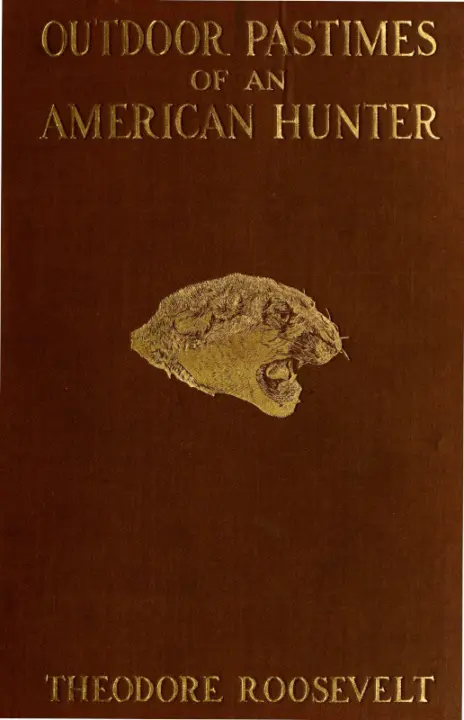
"Outdoor Pastimes of an American Hunter" by Theodore Roosevelt is a collection of personal accounts and observations regarding hunting and outdoor life written in the late 19th century. The book reflects Roosevelt's passion for nature and wildlife, showcasing his hunting experiences on various adventures, particularly focusing on cougars and other big game in the American wilderness. It serves as both a memoir and a commentary on the natural world, steeped in the author's vivid recollections and insights into the behavior of both the animals and the ecosystem. The opening of the book presents an engaging narrative of Roosevelt's winter cougar hunt in the harsh terrain of Northwest Colorado, accompanied by companions and expertly trained hounds. He recounts the challenges they faced from the cold weather and rugged environment while illustrating the unique bond between the hunters and their dogs, who play a vital role in the chase. Roosevelt takes the reader through the thrilling experiences of tracking and confronting cougars, weaving in descriptions of the majestic landscape and the importance of conservation for wildlife. This initial chapter sets the tone for the rest of the book, blending adventure with an appreciation for the wilderness.
Introduction adapted from the source catalogue; source summaries may be automatically generated.
Free to read · English · 122,861 words · No account needed
MAKE TIME FOR A GOOD BOOK
On by default. Untick to stop anonymous reading totals. Each page counts after 10 seconds in view. How this works.
Anonymous counting is on unless you have switched it off.
The cougar is a very singular beast, shy and elusive to an extraordinary degree, very cowardly and yet bloodthirsty and ferocious, varying wonderfully in size, and subject, like many other beasts, to queer freaks of character in occasional individuals. This fact of individual variation in size and temper is almost always ignored in treating of the animal; whereas it ought never to be left out of sight.
The average writer, and for the matter of that, the average hunter, where cougars are scarce, knows little or nothing of them, and in describing them merely draws upon the stock of well-worn myths which portray them as terrible foes of man, as dropping on their prey from trees where they have been lying in wait, etc., etc. Very occasionally there appears an absolutely trustworthy account like that by Dr. Hart Merriam in his “Adirondack Mammals.” But many otherwise excellent writers are wholly at sea in reference to the cougar. Thus one of the best books on hunting in the far West in the old days is by Colonel Dodge. Yet when Colonel Dodge came to describe the cougar he actually treated of it as two species, one of which, the mountain lion, he painted as a most ferocious and dangerous opponent of man; while the other, the panther, was described as an abject coward, which would not even in the last resort defend itself against man—the two of course being the same animal.
However, the wildest of all fables about the cougar has been reserved not for hunter or popular writer, but for a professed naturalist. In his charmingly written book, “The Naturalist in La Plata,” Mr. Hudson actually describes the cougar as being friendly to man, disinterestedly adverse to harming him, and at the same time an enemy of other large carnivores. Mr. Hudson bases his opinion chiefly upon the assertions of the Gauchos. The Gauchos, however, go one degree beyond Mr. Hudson, calling the puma the “friend of Christians”; whereas Mr. Hudson only ventures to attribute to the beast humanitarian, not theological, preferences. As a matter of fact, Mr. Hudson’s belief in the cougar’s peculiar friendship for man, and peculiar enmity to other large beasts of prey, has not one particle of foundation in fact as regards at any rate the North American form—and it is hardly to be supposed that the South American form would alone develop such extraordinary traits. For instance, Mr. Hudson says that the South American puma when hunted will attack the dogs in preference to the man. In North America he will fight the dog if the dog is nearest, and if the man comes to close quarters at the same time as the dog he will attack the man if anything more readily, evidently recognizing in him his chief opponent. He will often go up a tree for a single dog. On Mr. Hudson’s theory he must do this because of his altruistic feeling toward the dog. In fact, Mr. Hudson could make out a better case of philo-humanity for the North American wolf than for the North American cougar. Equally absurd is it to talk, as Mr. Hudson does, of the cougar as the especial enemy of other ferocious beasts. Mr. Hudson speaks of it as attacking and conquering the jaguar. Of this I know nothing, but such an extraordinary statement should be well fortified with proofs; and if true it must mean that the jaguar is an infinitely less formidable creature than it has been painted. In support of his position Mr. Hudson alludes to the stories about the cougar attacking the grizzly bear. Here I am on ground that I do know. It is true that an occasional old hunter asserts that the cougar does this, but the old hunter who makes such an assertion also invariably insists that the cougar is a ferocious and habitual man-killer, and the two statements rest upon equally slender foundations of fact. I have never yet heard of a single authentic instance of a cougar interfering with a full-grown big bear. It will kill bear cubs if it gets a chance; but then so will the fox and the fisher, not to speak of the wolf. In 1894, a cougar killed a colt on a brushy river bottom a dozen miles below my ranch on the Little Missouri. I went down to visit the carcass and found that it had been taken possession of by a large grizzly. Both I and the hunter who was with me were very much interested in what had occurred, and after a careful examination of the tracks we concluded that the bear had arrived on the second night after the kill. He had feasted heartily on the remains, while the cougar, whose tracks were evident here and there at a little distance from the carcass, had seemingly circled around it, and had certainly not interfered with the bear, or even ventured to approach him. Now, if a cougar would ever have meddled with a large bear it would surely have been on such an occasion as this. If very much pressed by hunger, a large cougar will, if it gets the chance, kill a wolf; but this is only when other game has failed, and under all ordinary circumstances neither meddles with the other. When I was down in Texas, hunting peccaries on the Nueces, I was in a country where both cougar and jaguar were to be found; but no hunter had ever heard of either molesting the other, though they were all of the opinion that when the two met the cougar gave the path to his spotted brother. Of course, it is never safe to dogmatize about the unknown in zoology, or to generalize on insufficient evidence; but as regards the North American cougar there is not a particle of truth of any kind, sort, or description in the statement that he is the enemy of the larger carnivores, or the friend of man; and if the South American cougar, which so strongly resembles its Northern brother in its other habits, has developed on these two points the extraordinary peculiarities of which Mr. Hudson speaks, full and adequate proof should be forthcoming; and this proof is now wholly wanting.
Your reading position is saved on this browser. Take it to another device with a library code. Reading pages adapt to text, rather than matching a printed edition.
Theodore Roosevelt
Theodore Roosevelt
Theodore Roosevelt

Theodore Roosevelt & Kermit Roosevelt
BEHIND THE BOOK
This eBook is for the use of anyone anywhere in the United States and most other parts of the world at no cost and with almost no restrictions whatsoever. You may copy it, give it away or re-use it under the terms of the Project Gutenberg License included with this eBook or online at www.gutenberg.org. If you are not located in the United States, you will have to check the laws of the country where you are located before using this eBook. Read the source licence.
The original source file, including credits and licence, is retained by this library. Request an original-format copy at no charge. Please include the book title and Project Gutenberg identifier #61935.
KEEP YOUR CURIOSITY GOING

Fanny Van de Grift Stevenson

Isabel Anderson
Charles King
Henry Vizetelly
Randall Parrish
James De Mille