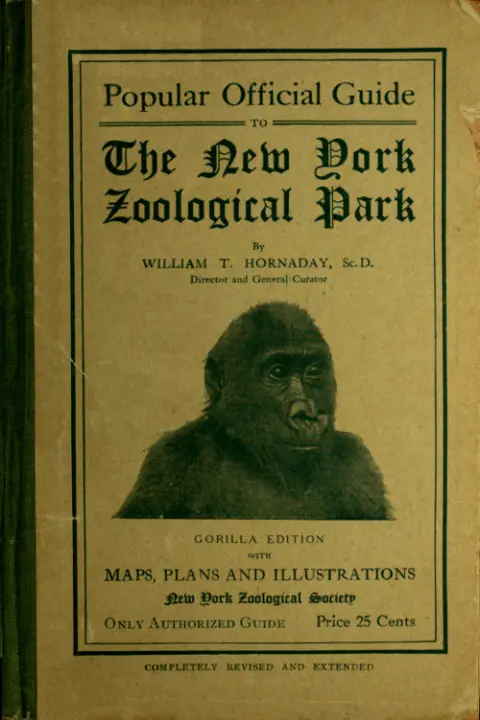
Popular Official Guide to the New York Zoological Park (September 1915) Thirteenth Edition
William T. (William Temple) Hornaday
THE CLASSIC COLLECTION · 1911
"Our Vanishing Wild Life: Its Extermination and Preservation" by William T. Hornaday is a scientific publication written in the early 20th century. The book focuses on the alarming decline of wildlife in North America, highlighting the species that have disappeared or are on the verge of extinction due to human activity. The author, a prominent conservationist and director of the New York Zoological Park, aims to raise awareness about the urgent need for wildlife protection and reform. The opening portion of the text sets a reflective tone as it emphasizes the historical abundance of wildlife now lost due to relentless hunting and habitat destruction. Hornaday discusses various species, using poignant examples such as the passenger pigeon, which once numbered in the millions yet became extinct through overhunting. He leverages historical anecdotes, legislative failures, and vivid imagery to illustrate the crisis facing wildlife. This introductory segment calls for immediate action from the public and lawmakers to protect the remaining wildlife, framing the preservation of nature as a moral obligation owed to future generations.
Introduction adapted from the source catalogue; source summaries may be automatically generated.
Free to read · English · 176,577 words · No account needed
MAKE TIME FOR A GOOD BOOK
On by default. Untick to stop anonymous reading totals. Each page counts after 10 seconds in view. How this works.
Anonymous counting is on unless you have switched it off.
Our wild birds are well protected, and there are none that are threatened with extinction. They are increasing.--(Fred. W. Chambers, State Game Warden, Salt Lake City.)
If all states afforded as good protection as does Vermont, none; but migrating birds like woodcock are now threatened.--(John W. Tilcomb, State Game Warden, Lyndonville.)
Pheasants (ruffed grouse), wild turkey and other game birds are nearly extinct. A few bears remain, and deer in small numbers in remote sections. In fact, all animals show great reduction in numbers, owing to cutting down forests, and constant gunning.--(L.T. Christian, Richmond.)
Wood-duck, wild turkey, northern raven, dickcissel.--(Rev. Earle A.
Brooks, Weston.)
Wild turkeys are very scarce, also ducks. Doves, once numerous, now almost nil. Eagles, except a few in remote fastnesses. Many native song-birds are retreating before the English sparrow.--(William Perry Brown, Glenville.)
Wood-duck and wild turkey.--(J.A. Viquesney, Belington.)
Double-crested cormorant, upland plover, white pelican, long-billed curlew, lesser snow goose, Hudsonian curlew, sandhill crane, golden plover, woodcock, dowitcher and long-billed duck; spruce grouse, knot, prairie sharp-tailed grouse, marbled godwit and bald eagle. All these, formerly abundant, must now be called rare in Wisconsin.--(Prof. George E. Wagner, Madison.)
Common tern, knot, American white pelican, Hudsonian godwit, trumpeter swan, long-billed curlew, snowy heron, Hudsonian curlew, American avocet, prairie sharp-tailed grouse, dowitcher, passenger pigeon. Long-billed dowitcher and northern hairy woodpecker.--(Henry L. Ward, Milwaukee Public Museum.)
Wood-duck, ruddy duck, black mallard, grebe or hell-diver, tern and woodcock.--(Fred. Gerhardt, Madison.)
Sage grouse and sharp-tailed grouse are becoming extinct, both in Wyoming and North Dakota. Sheridan and Johnson Counties (Wyoming) have sage grouse protected until 1915. The miners (mostly foreigners) are out after rabbits at all seasons. To them everything that flies, walks or swims, large enough to be seen, is a "rabbit." They are even worse than the average sheep-herder, as he will seldom kill a bird brooding her young, but to one of those men, a wren or creeper looks like a turkey. Antelope, mountain sheep and grizzly bears are going, fast! The moose season opens in 1915, for a 30 days open season, then close season until 1920.--(Howard Eaton, Wolf.)
Sage grouse, blue grouse, curlew, sandhill crane, porcupine practically extinct; wolverine and pine marten nearly all gone.--(S.N. Leek, Jackson's Hole.)
Swainson's buzzard and sandhill crane are now practically extinct. Elk and antelope will soon be as extinct as the buffalo.--(Arthur G. Wooley-Dod, Calgary.)
Your reading position is saved on this browser. Take it to another device with a library code. Reading pages adapt to text, rather than matching a printed edition.
William T. (William Temple) Hornaday
William T. (William Temple) Hornaday
William T. (William Temple) Hornaday & W. J. (William Jacob) Holland
William T. (William Temple) Hornaday
BEHIND THE BOOK
This eBook is for the use of anyone anywhere in the United States and most other parts of the world at no cost and with almost no restrictions whatsoever. You may copy it, give it away or re-use it under the terms of the Project Gutenberg License included with this eBook or online at www.gutenberg.org. If you are not located in the United States, you will have to check the laws of the country where you are located before using this eBook. Read the source licence.
The original source file, including credits and licence, is retained by this library. Request an original-format copy at no charge. Please include the book title and Project Gutenberg identifier #13249.
KEEP YOUR CURIOSITY GOING
Cécile Tormay

Moritz Busch
John L. Ransom
Frances Wright
Cécile Tormay

Mabel Potter Daggett