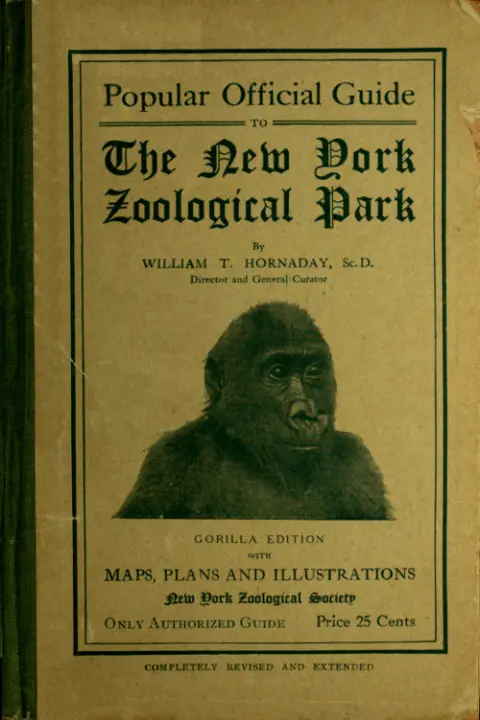
Popular Official Guide to the New York Zoological Park (September 1915) Thirteenth Edition
William T. (William Temple) Hornaday
THE CLASSIC COLLECTION · 1911
"Our Vanishing Wild Life: Its Extermination and Preservation" by William T. Hornaday is a scientific publication written in the early 20th century. The book focuses on the alarming decline of wildlife in North America, highlighting the species that have disappeared or are on the verge of extinction due to human activity. The author, a prominent conservationist and director of the New York Zoological Park, aims to raise awareness about the urgent need for wildlife protection and reform. The opening portion of the text sets a reflective tone as it emphasizes the historical abundance of wildlife now lost due to relentless hunting and habitat destruction. Hornaday discusses various species, using poignant examples such as the passenger pigeon, which once numbered in the millions yet became extinct through overhunting. He leverages historical anecdotes, legislative failures, and vivid imagery to illustrate the crisis facing wildlife. This introductory segment calls for immediate action from the public and lawmakers to protect the remaining wildlife, framing the preservation of nature as a moral obligation owed to future generations.
Introduction adapted from the source catalogue; source summaries may be automatically generated.
Free to read · English · 176,577 words · No account needed
MAKE TIME FOR A GOOD BOOK
On by default. Untick to stop anonymous reading totals. Each page counts after 10 seconds in view. How this works.
Anonymous counting is on unless you have switched it off.
Ruffed grouse, teal, canvasback, red-head duck, widgeon, and all species of shore birds, the most noticeable being black-bellied plover, dowitcher, golden plover, killdeer, sickle-bill curlew, upland plover and English snipe; also the mourning dove.--(James M. Stratton and Ernest Napier, Trenton.)
Upland plover, apparently killdeer, egret, wood-duck, woodcock, and probably others.--(B.S. Bowdish, Demarest.)
Forster's tern, oystercatcher, egret and snowy egret.--(T. Gilbert Pearson, Sec. Nat. Asso. Audubon Societies.)
Ruffed grouse rapidly disappearing; bobwhite becoming scarce.--(E.L.
Ewbank, Hendersonville.)
Perhaps American and snowy egret. If long-billed curlew is not extinct, it seems due to become so. No definite, reliable record of it later than 1885.--(H.H. Brimley, Raleigh.)
Wood-duck, prairie hen, upland plover, sharp-tailed grouse, canvas-back, pinnated and ruffed grouse, double-crested cormorant, blue heron, long-billed curlew, whooping crane and white pelican.--(W.B. Bell, Agricultural College.)
Upland plover, marbled godwit, Baird's sparrow, chestnut-collared longspur.--(Alfred Eastgate, Tolna.)
White heron, pileated woodpecker (if not already extinct). White heron reported a number of times last year; occurrences in Sandusky, Huron, Ashtabula and several other counties during 1911. These birds would doubtless rapidly recruit under a proper federal law.--(Paul North, Cleveland.)
Turtle dove, quail, red-bird, wren, hummingbird, wild canary [goldfinch] and blue bird.--(Walter C. Staley, Dayton.)
Pinnated grouse.--(J.C. Clark); otter, kit fox, black-footed
ferret.--(G.W. Stevens.)
American egret, snowy egret.--(W.L. Finley, Portland.)
Virginia partridge and woodcock.--(Arthur Chapman.)
Wood-duck, least bittern, phalarope, woodcock, duck hawk and barn swallow.--(Dr. Chas. B. Penrose.)
Wild turkey; also various transient and straggling water birds.--(Witmer
Stone.)
Wood-duck, knot, greater yellow-legs, upland plover, golden plover, piping plover, great horned owl.--(Harry S. Hathaway, South Auburn.)
Wood duck, abundant 6 years ago, now almost gone. Wild turkey (abundant up to 1898); woodcock, upland plover, Hudsonian curlew, Carolina rail, Virginia rail, clapper rail and coot. Black bear verging on extinction, opossum dwindling rapidly.--(James H. Rice Jr., Summerville.)
Prairie chicken and quail are most likely to become extinct in the near future.--(W.F. Bancroft, Watertown.)
Wild turkey and prairie chickens.--(J.D. Cox, Austin.)
Plover, all species; curlew, cardinal, road-runner, woodcock, wood-duck, canvas-back, cranes, all the herons; wild turkey; quail, all varieties; prairie chicken and Texas guan.--(Capt. M.B. Davis, Waco.)
Curlew, very rare; plover, very rare; antelope. (Answer applies to the Panhandle of Texas.--Chas. Goodnight.)
Everything [is threatened with extinction] save the dove, which is a migrating bird. Antelope nearly all gone.--(Col. O.C. Guessaz, San Antonio.)
Your reading position is saved on this browser. Take it to another device with a library code. Reading pages adapt to text, rather than matching a printed edition.
William T. (William Temple) Hornaday
William T. (William Temple) Hornaday
William T. (William Temple) Hornaday & W. J. (William Jacob) Holland
William T. (William Temple) Hornaday
BEHIND THE BOOK
This eBook is for the use of anyone anywhere in the United States and most other parts of the world at no cost and with almost no restrictions whatsoever. You may copy it, give it away or re-use it under the terms of the Project Gutenberg License included with this eBook or online at www.gutenberg.org. If you are not located in the United States, you will have to check the laws of the country where you are located before using this eBook. Read the source licence.
The original source file, including credits and licence, is retained by this library. Request an original-format copy at no charge. Please include the book title and Project Gutenberg identifier #13249.
KEEP YOUR CURIOSITY GOING
Cécile Tormay

Moritz Busch
John L. Ransom
Frances Wright
Cécile Tormay

Mabel Potter Daggett