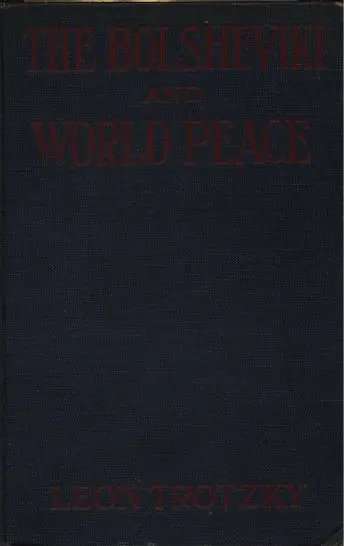
The Bolsheviki and World Peace
Leon Trotsky
THE CLASSIC COLLECTION · 1918
"Our Revolution: Essays on Working-Class and International Revolution, 1904-1917" by Leon Trotsky is a collection of political essays written in the early 20th century. The work explores the dynamics of the Russian Revolution and the role of the proletariat in achieving political and social change. It focuses on Trotsky's revolutionary theories, particularly his belief in the necessity of the working class as the driving force behind the revolution and the establishment of a socialist state. The opening of the book provides a preface written by Moissaye J. Olgin, who introduces Trotsky as a significant thinker and leader within the revolutionary movement, emphasizing the global importance of Russia's struggles. Olgin discusses the lack of understanding the world has had regarding Russian revolutionists and highlights the intense ideological development that has occurred among them over decades. Trotsky's essays aim to clarify these ideas and to mobilize the working class towards revolution, stressing the significance of active engagement and leadership in shaping the future of Russia and potentially, the world.
Introduction adapted from the source catalogue; source summaries may be automatically generated.
Free to read · English · 35,612 words · No account needed
MAKE TIME FOR A GOOD BOOK
On by default. Untick to stop anonymous reading totals. Each page counts after 10 seconds in view. How this works.
Anonymous counting is on unless you have switched it off.
Constituent Assembly, as a revolutionary slogan, 43-44.
Demonstrations, in the streets, 41-42;
to become of nation-wide magnitude, 57.
French Revolution, 73-77.
Gapon, 59, 62; 172-3.
Intelligentzia, 145.
January Ninth, 49; 59-60; 171-173.
June Third, 198.
Labor Dictatorship, 94-97;
crushing absolutism, abandoning its remnants, 103-104;
introducing class politics, 103;
introducing class struggle in the village, 104-105;
introducing Collectivism and Internationalism, 105;
abandoning distinction between minimum and maximum program, 106;
and eight hour workday, 106-108;
and unemployment, 108-9;
and agriculture, 109;
and Collectivism, 109-110;
and class consciousness, 124-128;
incompatible with economic slavery, 132;
and agrarian question, 132-136.
Liberalism, denying the existence of revolutionary masses, 52-53; defeated by events of January 9th, 54; trying to "tame" revolutionary people, 55; not reliable as partner in Revolution, 173-174; 176-7.
Manoeuvers, revolutionary, 29-30.
Masses, drawn into the Revolution, 37-39;
as a political reality, 51-52;
stirred by world-war, 183-4.
Middle-class (see Bourgeoisie), weakness of, in Russia, 71, 72.
Militia, 81-82.
"Osvoboshdenie," 52, 53, 62.
Peasantry, as of no significance in Revolution, 175-7.
Poland, as possible revolutionary link between Russia and Europe,
140-41.
Prerequisites to Socialism, in relation to each other, 113-117.
Proletariat, as a vanguard of the Revolution, 33-35;
role of, in events of January 9th, 56-57;
stronger than bourgeoisie in Russia, 72;
growing with capitalism, 84;
may sooner reach political supremacy in a backward country, 84-85;
87-91;
as liberator of peasants, 98-100;
as a class objectively opposed to capitalism, 119-124;
to revolutionize European proletariat, 142-4.
Revolution, in Europe, as aid to Socialism in Russia, 136-7; may be result of shattered European equilibrium, 141-42; as result of Russian Revolution, 142-4.
Revolution, in general, 83;
of bourgeois character, 92-93.
Revolution, of 1848, 77-80.
Revolution, of 1917, its causes, 181-5;
social forces in, 191-192;
to stir up revolution in Germany, 212.
Social-Democracy, foresaw revolution, 55-6;
natural leader of the Revolution, 60-61.
Soviet, distinguishing Russian Revolution from that of 1848, 80;
short history of, 145;
general survey of the role of, 151-4;
as class-organization, 154-156;
as organ of political authority, 158-9;
an imminent form of Russian Revolution, 160;
program of (outlined by Trotzky for the future), 160-1;
to fight against Provisional Government, 203.
"Spring," 24-25; 32; 54.
Strike, political, as beginning of Revolution, 35-36; 42, 43.
Struve, 62.
Technique, industrial, as prerequisite to Socialism, 113; 117-119.
"Underground," and the revolutionist, 165-8.
War, Russo-Japanese, 25;
of the world, as influencing masses, 183-4.
Witte, 62, 145.
Zemstvo, movement of, in 1904, 24-25; 33; 62.
Obvious typesetting errors have been corrected. Questionable or vintage spelling has been left as printed in the original publication. Variations in spelling have been left as printed, unless otherwise noted in the following.
Your reading position is saved on this browser. Take it to another device with a library code. Reading pages adapt to text, rather than matching a printed edition.
BEHIND THE BOOK
This eBook is for the use of anyone anywhere in the United States and most other parts of the world at no cost and with almost no restrictions whatsoever. You may copy it, give it away or re-use it under the terms of the Project Gutenberg License included with this eBook or online at www.gutenberg.org. If you are not located in the United States, you will have to check the laws of the country where you are located before using this eBook. Read the source licence.
The original source file, including credits and licence, is retained by this library. Request an original-format copy at no charge. Please include the book title and Project Gutenberg identifier #36303.
KEEP YOUR CURIOSITY GOING

David Patterson (Spirit) Hatch

David Patterson (Spirit) Hatch

David Patterson (Spirit) Hatch
Cécile Tormay

Moritz Busch
John L. Ransom