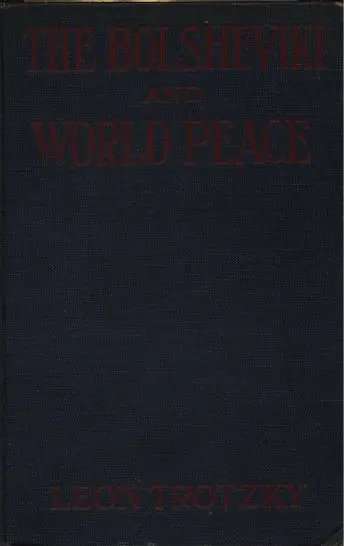
The Bolsheviki and World Peace
Leon Trotsky
THE CLASSIC COLLECTION · 1918
"Our Revolution: Essays on Working-Class and International Revolution, 1904-1917" by Leon Trotsky is a collection of political essays written in the early 20th century. The work explores the dynamics of the Russian Revolution and the role of the proletariat in achieving political and social change. It focuses on Trotsky's revolutionary theories, particularly his belief in the necessity of the working class as the driving force behind the revolution and the establishment of a socialist state. The opening of the book provides a preface written by Moissaye J. Olgin, who introduces Trotsky as a significant thinker and leader within the revolutionary movement, emphasizing the global importance of Russia's struggles. Olgin discusses the lack of understanding the world has had regarding Russian revolutionists and highlights the intense ideological development that has occurred among them over decades. Trotsky's essays aim to clarify these ideas and to mobilize the working class towards revolution, stressing the significance of active engagement and leadership in shaping the future of Russia and potentially, the world.
Introduction adapted from the source catalogue; source summaries may be automatically generated.
Free to read · English · 35,612 words · No account needed
MAKE TIME FOR A GOOD BOOK
On by default. Untick to stop anonymous reading totals. Each page counts after 10 seconds in view. How this works.
Anonymous counting is on unless you have switched it off.
It seems to me that Trotzky has become more nervous, more gloomy, and more restrained. Something like a freezing chill emanates from his deep and restless eyes; a cool, determined, ironical smile plays around his mobile Jewish lips, and there is a chill in his well-balanced, clear-cut words which he throws into his audience with a peculiar calmness.
He seems almost lonesome on the platform. Only a small group of followers applaud. The others protest against his words or cast angry, restless glances at him. He is in a hostile gathering. He is a stranger. Is he not also a stranger to those who applaud him and in whose name he speaks from this platform?
Calm and composed he looks at his adversaries, and you feel it is a peculiar joy for him to see the rage, the fear, the excitement his words provoke. He is a Mephisto who throws words like bombs to create a war of brothers at the bedside of their sick mother.
He knows in advance which words will have the greatest effect, which would provoke the most bitter resentment. And the more extreme, the more painful his words are, the firmer and stronger is his voice, the slower his speech, the more challenging his tone. He speaks a sentence, then he stops to wait till the storm is over, then he repeats his assertion, with sharper intonation and with more disdain in his tone. Only his eyes become more nervous, and a peculiar disquieting fire is blazing in them.
This time he does not speak; he reads a written declaration. He reads it with pauses, sometimes accentuating the words, sometimes passing over them quickly, but all the time he is aware of the effect and waits for a response.
His voice is the voice of a prophet, a preacher:
"Petrograd is in danger! The Revolution is in danger! The people are in
danger!" ...
He is a stranger on the platform, and yet--electric currents flow from him to his surroundings, creating sincere though primitive enthusiasm on one side, on the other anger and spite. He opens vast perspectives before the naive faithful masses:
"Long live an immediate, honest, democratic peace!"
"All power to the Workmen's Councils! All the land to the people!"
Absolutism, role of, in outgrowing economic basis, 69;
in promoting industry and science, 69, 70;
as an end in itself, 70-71.
Agrarian question, 132-136.
Armament for the Revolution, 57-58.
Army, 35, 36, 37.
Bourgeoisie, imperialistic plans of, 189-191;
afraid of peace, 194-5;
reactionary, 203-4;
responsible for the war, 209-211.
Capitalism, preparing its own collapse, 138-9;
and feudal reaction, 139-140.
Cities, as scene of revolutionary battles, 41;
social structure of, 71-72.
Class consciousness, of proletariat, as prerequisite to Socialism,
124-128.
Your reading position is saved on this browser. Take it to another device with a library code. Reading pages adapt to text, rather than matching a printed edition.
BEHIND THE BOOK
This eBook is for the use of anyone anywhere in the United States and most other parts of the world at no cost and with almost no restrictions whatsoever. You may copy it, give it away or re-use it under the terms of the Project Gutenberg License included with this eBook or online at www.gutenberg.org. If you are not located in the United States, you will have to check the laws of the country where you are located before using this eBook. Read the source licence.
The original source file, including credits and licence, is retained by this library. Request an original-format copy at no charge. Please include the book title and Project Gutenberg identifier #36303.
KEEP YOUR CURIOSITY GOING

David Patterson (Spirit) Hatch

David Patterson (Spirit) Hatch

David Patterson (Spirit) Hatch
Cécile Tormay

Moritz Busch
John L. Ransom