The Coming of the White Men: Stories of How Our Country Was Discovered
Mary Hazelton Blanchard Wade
THE CLASSIC COLLECTION · 1904
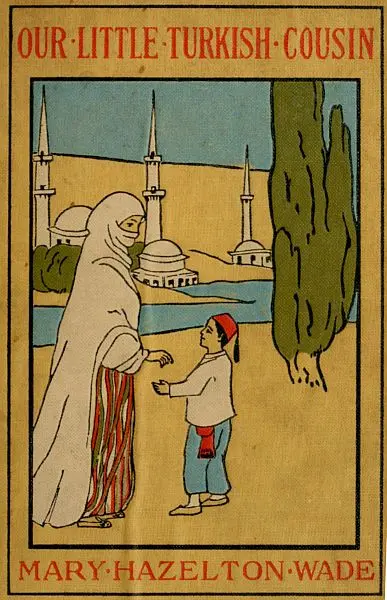
"Our Little Turkish Cousin" by Mary Hazelton Blanchard Wade is a children's fiction book written in the early 20th century. It is part of a series that introduces young readers to various cultures through the eyes of a child from those regions. The story centers on Osman, a young boy living in Constantinople, as he navigates his life within Turkey's unique social and cultural landscape. The opening of the book introduces Osman, who cannot remember his first birthday, but is now a big boy with a rich upbringing, surrounded by luxuries and customs that define his life. We see the traditional celebrations surrounding his birth, highlighting Turkish cultural practices concerning children and family. As Osman grows, he begins to experience school, friendships, and the daily life filled with distinct customs and festivities, all while remaining unaware of the societal disparities surrounding him. This introduction sets the stage for a narrative that promises to seamlessly blend education with endearing storytelling, focusing on young Osman’s adventures as he learns about his culture and grows up.
Introduction adapted from the source catalogue; source summaries may be automatically generated.
Free to read · English · 17,927 words · No account needed
MAKE TIME FOR A GOOD BOOK
On by default. Untick to stop anonymous reading totals. Each page counts after 10 seconds in view. How this works.
Anonymous counting is on unless you have switched it off.
"I WISH you had been with me this afternoon, Osman," said his father, as his little boy ran to meet him.
"What did you see, papa? Please tell me all about it."
"I went to walk with a friend. We wandered on and on until we came to a large field near the city walls. The field was alive with gipsies, who were having some sort of a holiday. They were dressed in their gayest colours and were having a dance."
"Outdoors in that field, papa?"
"Yes, Osman, and it was a very pretty sight. A number of the men were squatting on the ground in a circle. Those were the musicians. They played on different kinds of instruments. There were drums, flutes, and mandolins.
"The players banged away with no kind of time, but the gipsies seemed to enjoy it, notwithstanding."
"How did they dance, papa?"
"The men kept by themselves, each one moving separately. But the women danced together. They all beat time with their hands. At the same time they kept saying, 'Oh, Oh, Oh,' as they moved about.
"When the dance was ended, the gipsies went over to a corner of the field where a feast was being prepared. Great fires had been kindled. Huge kettles of rice were boiling there, and whole sheep were being roasted.
"Many of the young gipsies were handsome. Their eyes were dark and sparkling, and their teeth were of a pearly white. But the old women were wrinkled and ugly. Their long, thin fingers made me think of witches."
"The gipsies dress in the old style of our country, don't they, papa?"
"Yes, you always see them with large, baggy trousers, short jackets, and turbans wound around their heads. The men wear bright-coloured waistbands, stuck full of pistols and daggers."
"I feel scared, papa, only to hear you speak of such things."
"How foolish that is, Osman. The gipsies would do you no harm. They mind their own affairs pretty well. To be sure, we do not love these people, but there is nothing to fear from them.
"They have chosen to live among us, and, although they go away in large companies and travel all over Europe, they are sure to come back here."
"Where did they come from in the first place, papa?"
"A long time ago, I believe, they lived in the far East, or in Egypt. They speak a queer language, made up of Hindi and Greek, as well as Turkish words."
Just then, Osman's mother came into the room.
"Father has just been telling me about a feast held by the gipsies this
afternoon, mamma."
Your reading position is saved on this browser. Take it to another device with a library code. Reading pages adapt to text, rather than matching a printed edition.
Mary Hazelton Blanchard Wade
Mary Hazelton Blanchard Wade
Mary Hazelton Blanchard Wade
Mary Hazelton Blanchard Wade
BEHIND THE BOOK
This eBook is for the use of anyone anywhere in the United States and most other parts of the world at no cost and with almost no restrictions whatsoever. You may copy it, give it away or re-use it under the terms of the Project Gutenberg License included with this eBook or online at www.gutenberg.org. If you are not located in the United States, you will have to check the laws of the country where you are located before using this eBook. Read the source licence.
The original source file, including credits and licence, is retained by this library. Request an original-format copy at no charge. Please include the book title and Project Gutenberg identifier #42204.
KEEP YOUR CURIOSITY GOING
Coulson Kernahan

Maurice Baring
Frances Wright
Cécile Tormay

Frederic Jesup Stimson

W. H. P. (William Henry Pope) Jarvis