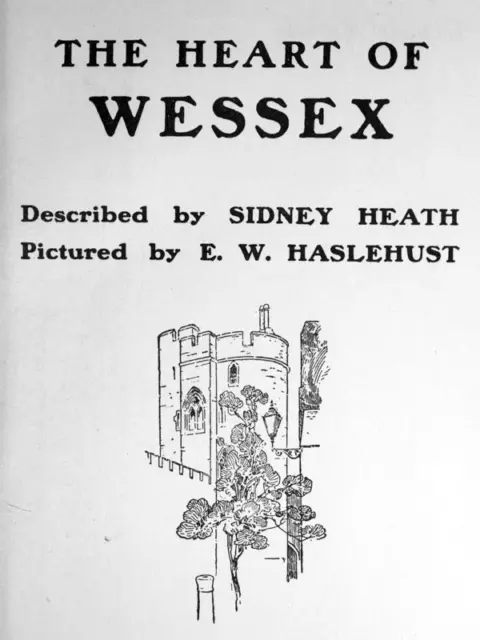
The Heart of Wessex
Sidney Heath
THE CLASSIC COLLECTION · 1907
"Our Homeland Churches and How to Study Them" by Sidney Heath is a historical account written in the early 20th century. This work explores the rich heritage of British ecclesiastical architecture, focusing on various styles and their symbolic meanings throughout history. The book aims to provide readers with insights into how to appreciate and understand the many details and features found in churches across England. The opening of the book sets the stage for a comprehensive exploration of church architecture by emphasizing the historical importance of these structures. Heath begins with a preface and dedication that reflect a deep respect for old buildings and the craftsmen who built them. He introduces the idea that churches are not merely architectural entities but are imbued with symbolism reflecting the beliefs and values of the eras in which they were constructed. The preface establishes the tone for the text, indicating that the author will guide readers through the significance of church design and ornamentation while uncovering the layers of historical context that inform the visitor's experience.
Introduction adapted from the source catalogue; source summaries may be automatically generated.
Free to read · English · 28,996 words · No account needed
MAKE TIME FOR A GOOD BOOK
On by default. Untick to stop anonymous reading totals. Each page counts after 10 seconds in view. How this works.
Anonymous counting is on unless you have switched it off.
MOULDING A term generally applied to the contours given to angle projections or hollows of arches, doors, windows, etc.
MULLION The dividing bars of stone or wood between the lights of windows, or the openings of screens.
MÜNSTER has now lost its simple application.
(MONASTERY)
NAVE From navis, a ship, the main body of a church west of the chancel.
NICHE An alcove or recess in a wall for holding a statue or
ornament.
OGEE A moulding or arch formed of a curve or curves somewhat like the letter S, the curve of contra-flexure, part being concave and part convex.
ORDERS In Gothic architecture, the receding mouldings of an
arch.
PARCLOSE The screen or railings protecting a monument or chantry.
PARVISE An open space or porch at the entrance to a church, and often wrongly applied to the room over a church porch.
PATEN The small plate or salver used to hold the Consecrated Bread in the celebration of the Eucharist.
PENDANT Ornaments which hang or depend from a ceiling or roof.
PENTHOUSE A covering projecting over a door, window, etc., as a protection from the weather.
PIER The masses or clusters of masonry between doors, windows, etc.; the supports from which arches spring.
PILLAR A term frequently confounded with column, but differing from it in not being subservient to the rules of classical architecture, and in not of necessity consisting of a single circular shaft.
PINNACLE A small turreted ornament tapering towards the top, and used as a termination to many parts of Gothic architecture.
PISCINA The stone basin or sink in the chancel used for cleansing the communion vessels.
PLINTH The lower division of the base of a column, pier or wall.
POPPY-HEAD An ornament boldly carved on the tops of bench ends, etc.
PRESBYTERY A term sometimes used to include the whole of the choir, but more often meant to refer to the eastern end of the choir from which it is generally raised by several steps.
QUARRIES or
QUARRELS The small diamond, square or other the shaped panes used
in plain glazing.
QUATREFOIL The shape resembling four leaves formed in tracery or panels by cusps.
QUOIN The external angle of a building, generally of ashlar.
REREDOS The wall or screen at the back of an altar, often enriched with carving, niches, statues, etc.
ROOD-BEAM or
ROOD-LOFT The loft or beam which, previous to the Reformation,
supported the Great Rood, or Crucifix.
ROSE WINDOW A term often used to denote a circular window of
several lights.
ROTUNDA A term used to describe a church or other building which is of circular formation both within and without.
Your reading position is saved on this browser. Take it to another device with a library code. Reading pages adapt to text, rather than matching a printed edition.
Sidney Heath
Sidney Heath
Sidney Heath
Sidney Heath
BEHIND THE BOOK
This eBook is for the use of anyone anywhere in the United States and most other parts of the world at no cost and with almost no restrictions whatsoever. You may copy it, give it away or re-use it under the terms of the Project Gutenberg License included with this eBook or online at www.gutenberg.org. If you are not located in the United States, you will have to check the laws of the country where you are located before using this eBook. Read the source licence.
The original source file, including credits and licence, is retained by this library. Request an original-format copy at no charge. Please include the book title and Project Gutenberg identifier #30290.
KEEP YOUR CURIOSITY GOING

David Patterson (Spirit) Hatch

David Patterson (Spirit) Hatch

David Patterson (Spirit) Hatch
Cécile Tormay

Moritz Busch
John L. Ransom